A guy crosses the road causing a passing car to brake hard. The driver jumps out and dashes towards the guy, who is now on the path. I can’t hear what they’re saying through the plate glass but the driver, who is wiry and jumpy, is clearly asking the guy if he wants some. The guy brandishes an opened bottle of beer, possibly a pale ale, held by the neck, at the driver. The driver puts both hands behind his back, as if going for a blade, and continues to enquire of the guy whether he would like to come and get some. At this cusp of ugliness, the guy backs off. The driver sneers and returns his to his car. As he opens the door, the other door, on the passenger side, bursts open. A stout blonde woman jumps out and dashes towards the retreating guy. She screams “You fucking bastard! Come here you fucking bastard! You fucking bastard! You fucking bastard!” She takes a step forward in order to to bend over in order to steady herself against the recoil from her shouting. She continues to scream “Come here you fucking bastard! You fucking bastard! You fucking bastard!” over and over and over. The guy is in retreat. The woman is beside herself. She seems utterly and dementedly and, I have to say, enviably, absorbed and has found an ideal posture, one which will probably allow her comfortably to void her rage without further physical adjustment. After a couple of dozen more screams she straightens up and returns to the car. Just before she gets there she waves to the driver of a car behind her, whose vehicle has been prevented from moving on. “Sorry!” she says politely (I can see her lips moving through the plate glass). I imagine the driver of this car thinking “I might just not say anything here. I might just not react. In any way.”
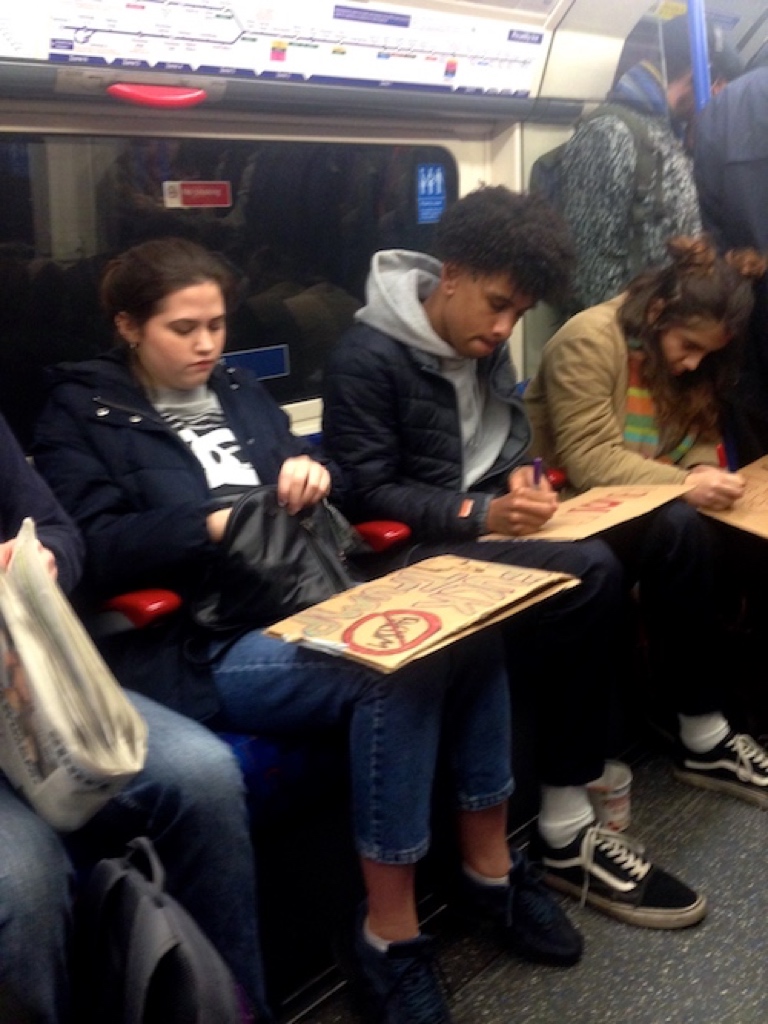
The first time I saw the black plastic lapel badges they had been pinned to two well groomed young men on the Tube. The men wore dark suits and had the pleasant, alienated directness so irresistibly simulated by Kyle MacLachlan as Agent Cooper in Twin Peaks. They were sitting either side of a student with a laptop yet did not appear to be accompanying him. As I idly watched they started chatting to their fellow passenger. They had good teeth and all of their conversation took the form of questions. They seemed very pleased to make his acquaintance and more or less took turns asking him pleasant things whilst smiling.
Because this was London and we don’t talk to strangers my interest was piqued. Where was all this going? At the next station the student got off. The badged Jimmy Stewarts from Mars continued to look quite pleased and I turned my attention to their badges. One bore, in incised white letters, the words ‘Elder John’ and the other was similar, with a name I couldn’t read. I felt I should know what this meant but I couldn’t place it.
On the train back from Dorset with my younger daughter and her friend we found ourselves sitting across the aisle from two American women in their early twenties with pleasant smiles and black badges pinned to their dresses. One was Sister Harriet and the other’s chest wasn’t in my line of sight. They smiled at me and my teenage companions. I donned my headphones and started reading my book. Some decades ago I would have allowed them to question me pleasantly in order to rebut them spiritedly but that was then and now I can’t be bothered. Reading is much more fun.
The teenagers plugged a headphone set into an iPod and took one earpiece each. They could pretend to be engrossed in Taylor Swift whilst actually listening to what was going down in stereo nearby. Unfortunately for the man sitting right behind me his son of perhaps five was sitting with him. The boy was saying things quite loudly. Sister Harriet and her sister Sister beamed at him and asked him questions. His responses were apparently delightful. The Sisters congratulated the father and began asking him questions. According to my daughter, who had been rolling her eyes and mouthing conspiratorially to me throughout this leg of the journey, they had secured the names of father and son, the occupation of father and wife, the town in which the family lived and, the cherry on the cake, a phone number. By the hesitant way in which the father gave the number to the Sisters, it was plain to my daughter that he was making it up.
The Sisters disembarked at somewhere or other, presumably to work the town, leaving the father to contemplate his good luck. Just before they left they asked him “Do you believe in the message that family is for ever?” The father mumbled his reluctant acquiescence. The Sisters said they looked forward to talking more on the phone. If it was a fake number then that shouldn’t be a problem – they could work whoever answered.
On the radio DJ Zane Lowe was talking about a song and he made some comment or other then said ‘No pun intended’. He didn’t want us to think that his sense of humour was so underdeveloped that it would lead him to stoop to the use of puns. Personally, I don’t mind them. You get good ones and you get bad ones. Certainly they have a strong association with the tastes of children and the insides of Christmas crackers, but in that context they are hardly worthy of more than a mild wince.
Children find the pun empowering, it demonstrates that they are getting on top of the language project to the point where they can enjoy its elasticity. They can deliberately misuse what they have learned and no one will think they are making a mistake. But the apologetic, muttered, adult utterance ‘No pun intended’ is delivered as if a breach of etiquette as applied, say, to table manners, had taken place. As if one had inadvertently expelled from one’s chewing mouth a small piece of food or hiccuped in mid sentence. There is clearly something disconcerting about the pun, especially when it arises artlessly, without intention, when apparently it has the potential to shame its originator. ‘Chance produces stupid puns’ (Emile Augier).
Alice, pressed by the March Hare to ‘Say what you mean’, asserted instead that ‘I mean what I say’ then added ‘…that’s the same thing, you know.’ To mean what you say is the easier part – it simply describes an attempt to get something across by closely and firmly aligning language with intention. Saying what you mean, on the other hand, can be dangerous if what you mean is at odds with what you are actually prepared to say. In such a situation, you run the risk of being understood. It might be preferable to insist that you mean what you are saying. The artless punster has no choice in the matter – language has caved in around him.
The pun, when credited with the autonomous capacity to intervene unbidden in speech, can be the very devil. It draws together two sets of meanings and, in the moment before it is laughed or shrugged off, introduces the threat of ambiguity hence the risk of being, in this case, misunderstood. It is the last ditch before the abyss of the Freudian slip wherein, and this is true, a vicar introducing 50s blonde bombshell film star Diana Dors, who was born Diana Fluck, to an audience at a fete held in her home town of Swindon, referred to her as Diana Clunt.
The punster – the purveyor of the lowest form of humour – is generally not considered to be clever but he or she who alliterates is seen as trying too hard to be clever. In an earlier Strength Weekly post I wrote about a tendency in the editing of live television to eliminate behaviour – such as reaching for a glass of water – that draws attention to the artificiality of the studio interview. She or he who alliterates – in a written medium – draws attention to language itself rather than to what the language is designed to convey thereby breaking the rule that language is an invisible conduit that reflects upon itself at its peril. It is as if the pun and certain other types of linguistic play have a capacity to induce autoimmune conditions in which language turns upon its generator and renders them pitiable. It’s not that the punster should apologise for the pedestrian quality of their humour, rather they have momentarily exposed the possibility that the elements of language might coalesce into unwieldy, unreliable, multiple merged masses by means of which nothing and everything, too little and too much, might be communicated.
Back in 2007, in the very first year of Strength Weekly (a digital display), I wrote here about neurotic vegetarianism and its spectral nemesis, the Meat Ray. In the course of a routine disparagement I mentioned a book my mother had bought in the USA in 1951: ‘Fun Fare – A Treasury of Reader’s Digest Wit & Humor’. In the collection, which I read avidly as a seven year old, was the following jewel-like item:
“The late Senator Charles B. Farwell claimed that this was the only perfect triple pun in the English language: A woman’s three sons went to Texas to raise beef cattle, sheep and hogs. Stumped for a good name for their ranch, they wrote home to mother for suggestions. NAME IT FOCUS, she telegraphed. Puzzled, they wired for an explanation. The reply came immediately: FOCUS – WHERE THE SUN’S RAYS MEET.”
There are so many reasons why I shouldn’t do this. Every time I think about it I think of fresh reasons. The fact that I’ve written about it before on Strength Weekly (a digital area), for example. The fact that everyone who has written about it says much the same things. They say, for example, many of them, that the whole thing is a pantomime. It’s an entertainment. We should not expect it to deliver substance or authenticity. It is, everyone agrees, not to be taken seriously. The people on it are clearly deranged but it wouldn’t work if they were not. And the people in charge are to a large extent only acting their sternness. They probably think that the other people on it are utterly ridiculous, as do we, but they appear to take them seriously and criticise them strongly in relation to criteria that people in their stern community take seriously.
It is as if the clowns, as one might regard the excitable entrants, would, if they responded constructively to the criticisms directed at them, be capable of improving their ways and become viable subjects of the ring master. As a hypothesis this only works if the clowns themselves are not pretending to be clowns. This need not be seen as an obstacle to their conversion, however. It can be argued that the clowns are, in fact, heralds of a new post-psychological personhood, sent among us to ease passage into new, simplified ways of being. In the new, or emerging, state of affairs, distinctions between pretending to be something and being something do not have the relevance that they are currently awarded.
But first the clowns must be sourced. The pre-project preparation could work two ways: in the hunt for a clutch or hilarity of suitable clowns the hunters will say things like “Even though you’re a team player under what circumstances would you throw fellow team members to the lions in order to advance your own cause? That is to say: can you reconcile your strong and, for some, unedifying, sense of entitlement with the requirement, felt by some at least, to be a social being?” Or, and this would be the other way, the hunters, having accumulated a collection or irritation of clowns in order to assess them would do this rather more straightforwardly by asking “Would you be prepared, for the purposes of the project, to pose as or enact the role of one who is so excavated by greed that he or she shows every sign of sociopathy even as the condition is understood in tabloid newspapers?” The latter enquiry immediately prompts the question of where the depravity – whether or not it is authentic – actually comes from. Upon what do the clowns, or wretches, as one might regard them, found their agitated displays?
Again, there may be two ways of coming at this. The wretches may simply take their cues from alpha wretches who, despite the veneers and polishes acquired in the field, have become masters of acquisition. This is certainly what the programme wishes to establish. It is more likely that if capitalism is what is left when more promising systems have been tried, then the non-psychology of the wretch is what is left when depth models of human potential have been systematically disparaged then abandoned. In the absence of psychology (not to mention socialisation) instinctual forms of expression may come to the fore.
Such is the greyness of the area pertaining to the distinguishing between modes of modern presentation that I find myself on the brink of suggesting that in the panicked, pantomimic and agonised exudations of the aspirants there is actually to be found an unproblematic authenticity. The sundering of psychology from behaviour is such that Behaviour 2.0, as it will come to be known, can only be authentic because it is derived from a radically de-complicated base, unlike the earlier ‘Dark Behaviour’ in which contradiction and ambiguity are present in an abundance that is acknowledged to be confusing. In those Dark times you had Elvis and you had Elvis impersonators.
A personality structure that is authentically degraded, through no fault of the owner, becomes the site of an array of urgent, unrooted compensatory behaviours. It is probable – as suggested above – that the wretches consider these behaviours to be credible imitations of those who are alphas in a slurry of omegas. It is just as likely that they simply perform them unreflectively because their sense of urgency is considerable and they must do whatever pops up. In both cases the unedifying behaviours are authentic. It is, after all, wretched to consent to enact wretchedness, to comply with the requirement to appear wretched. Those who comply will, by definition, already be authentic wretches. The hunters’ assessment, therefore, is not that hard. You just have to be sure that those who comply will do it well – you’re not trying to weed out malingerers. It’s not as if there’s a dearth of aspirants.
In the age of psychology, a phenomenon of the 20th Century, considerable attention was paid to matters of identity, which was viewed as a product of knowingly maintaining oneself in a framework over significant periods of time. With the passing of psychology, premised largely upon access to contents that were not necessarily evident, we see an emerging personality structure that is platformless – lacking a stable ground on which to perform. This unplanked condition is paradoxically fertile and subject to turbulence. Back in the day the hippy said “I am the wind that passes through me.” When he said it, however, it was understood to refer to the fact that he was so singularly lacking in block or barrier that nothing he experienced could be distorted by the taints of his ego. The 21st century winds are markedly more toxic and require a less wispy counter. What comes to pass, though, as those gusts howl through, makes the hippy look rather rugged. The 21st century wretch is instantly intoxicated and he stays that way. When he comes back to the house after a hard but successful day in front of the tribunal, his colleagues applaud him and he says, referring to his supporters, “From now on it’s dog eat dog.” He smiles. They smile too, congratulating him on his forthrightness in matters of cannibalism.
I was gratified by the volume of feedback received after the recent post titled ‘Plate‘. I had not realised that my account of the serendipitous purchase of a green towel in as-new condition would strike a chord with so many readers of ‘Strength Weekly’, an online entity. It is true that towels are comforting and also of great use. Were they sentient, they would know us intimately and be repositories of our secrets.
I was sitting in a café reading A Certain Tendency in Hollywood Cinema 1930-80 by Robert Ray and from time to time I would glance up to think. It was a sunny afternoon and the café was open to the street. Immediately in front of me sat two women and a little boy. The women were talking to the boy and he would say things to them. I realised after a while that the boy was deaf and that the women were mouthing their speech to him without speaking out loud. I continued reading.
When Ray said that most American films followed themes first established in westerns I looked up to think again. A man at a table next to the women and child had been greeted by another man. The man standing in the street talked animatedly to his seated friend. Despite being perhaps six feet away from them I realised I could not hear what they were saying. Clearly these two were also deaf. I wondered what it was about the café that attracted members of the deaf community.
Ray said that the classic objective of the western, and many western-like films, was to demonstrate how the individual could preserve his individualism at the same time as acting for the good of the community. But as I raised my head again I was seized by the irrational thought that I had myself become deaf and I swung my head round to scan the clientele inside the café. Their hubbub was exactly what would be expected moreover none of the patrons appeared to be deaf. I turned back to the deaf people ranged before me. Then I noticed a certain play of the light in the sky. It was an effect of the very clean plate glass window fitted between my table and the tables in the street. Very very clean.
I asked the waiter Who cleans your windows? They are exceptional. He said I don’t know – a guy comes once a week. I don’t know his name. We all like his work. We don’t do windows ourselves.
At the party later the hosts had a beautiful swimming pool in their garden. As it was a warm evening they had pulled open the big glass doors of the sitting room, effectively removing one wall of the space. One could walk across the flagstones onto the patio, which was similarly paved. Carrying a glass of prosecco, I made my way to the buffet laid out beside the pool. As I pressed past some of the guests I became aware that my right foot was wet. Within a moment my left foot was wet. Now things were happening at great speed, particularly within my nervous system. I was standing in the pool and there was not a moment to be lost. And then, on the tail of that moment, I found myself on dry land, still clutching my prosecco. My shoes and socks were soaked but the darkness only reached an inch up my trouser legs. I didn’t really mind. The warmth of my feet would dry everything out. My host asked if I was all right. I reassured him. I realised I had contacted my inner Christ. This, for an atheist fundamentalist such as myself, is no small beer. I had walked on water. My body, loath to become sodden, had, if only for a trice, overcome conventional physics. In my mind, hopefully not in a patronising way, I complimented my body.
A few minutes later, by which time the poolside had become crowded with guests loading plates, a woman in high heels, carrying a plate of various salads, cried out. She was sinking quite fast into the pool. Lacking, I supposed, my own fortunate if unlikely inner supernatural resources and not helped by her heels, she was already calf deep. A man leaned over and extended his arm. As she leaned over and extended her arm, they made contact, the effect of which was to tip the woman onto her side, after which she sank, if only momentarily, completely beneath the surface. The man at the poolside somehow had her salad but he also had her arm. My hostess took the woman, whose mood was gamely upbeat, upstairs where they discovered that they had sizes in common, including shoes, both pairs of which, the doused and the dry, it happily transpired, were in the style called nude. The woman towelled herself down and returned to the patio looking perfectly smart.
In a documentary film the other night about the war time codebreakers of Bletchley a woman takes a strip of paper and licks it in order to stick it in a logbook of some sort. I was surprised to note that I was shocked by this image.
In my time I have licked a quantity of envelopes, many stamps and, in the years before adhesive tape, length after length of brown gummed paper, known to we children of Austerity 1.0 as brown sticky paper. The white heat of subsequent adhesives technology has, of course, taken us all beyond the need to use our tongues to facilitate the adhesion of, say, paper and package. So common was such licking in my youth that I would often consider and sometimes practise the licking of unsuitable materials. I licked metals and woods, the latter sometimes still attached to trees or shrubbery. Often the tastes would make me smile in a way that was quite unconnected to pleasure, rather it was what my face muscles did in reaction to the chemical assault.
I had a cousin, cousin Gareth, from the Welsh side. He wasn’t actually my cousin but some relation or other. Gareth told me not to eat soap. He was staying with us for a day or two and came into the bathroom as I was conducting a curious experiment. This involved licking a bar of soap in order to see whether I could bear the taste, which I could not bear. I had been carrying out tests for a number of days: just one lick followed by noisy gagging. Gareth’s words were “David, you know you shouldn’t do that.” I can’t remember if I thought he thought I was mad. Is it possible for someone to be that imperturbable? Perhaps Gareth had licked soap in his youth and knew that it was just a phase.
At the time I couldn’t not lick the soap. I wanted to not lick it and I also wanted to not feel that I must lick it. If I didn’t know what licking it would be like – which is an unlikelihood – then after the first lick I very much knew.
But I went on licking. I think I may have been testing the limits of my manhood. This suggests that my idea of a man was one who can regularly survive the introduction to his body of vileness. Given the manhood models available even back then, my gagging was entirely inappropriate. Kirk Douglas, for example, would slide the bar into his mouth and routinely bite the end off. He would then munch the chunk and swallow the slippery surfactant without the trace of a grimace, let alone a convulsion. A few years later, Clint Eastwood would do much the same – Clint would not be copying Kirk, he would simply punish personal feeblenesses as they arose on the trail by passing his tongue across a red bar crudely hewn from a larger slab kept in a cool place in the shadows of the ranch house. So thorough was his application of the unbalm that weakness would flicker only briefly at the periphery of his consciousness before guttering then expiring.
But when the woman from Bletchley licked the paper strip I thought not of manhood but infection. And not even in a sensible way, where because you don’t know where it’s been the paper gives you germs. Everything gives you germs, of course, but they are usually harmless. I thought ‘She will give germs to the paper.’ This is clearly nuts. But I understand it. In my mind, for which I take only partial responsibility, we have all become infectious because we do not lick enough inappropriate surfaces. This starts to sound less nuts when one considers the importance of reinforcing the immune system – in our infancy, at least – by exposing ourselves – usually inadvertently – to a wide range of pathogens.
I must confess, however, that in a part of my mind that is, let’s face it, primitive, we have all become toxic. To a point where paper should give us a wide berth. It would be odd to suggest that we should get back to more catholic licking styles but it wouldn’t hurt, I think, if they showed, for example, more stamp licking on television. The under 20s would have to have the practice explained to them but it would serve to compensate for the only partially conscious realisation that in an unrelentingly consumerist society our mouths have become obsolete insofar as the goods now consume us. We should cultivate passivity in order that we do not contaminate those goods.
In another Oxfam I was poking about when it occurred to me that if I was ever to obtain a non-Swedish language edition of Stephen King’s ‘11.22.63’ (see ‘Plate‘) it would help to be confident of the category under which it might be shelved. My snobbisme told me that it wouldn’t be under ‘Fiction’ because that means Not Genre. (Many critics feel that Non-Genre Fiction cannot be held to be a genre. How could it be? they say.) As for Genre, it could not be Horror, the writer’s most widely employed category, nor was it Fantasy because that usually denotes a casual attitude to the laws of physics. As a time travel and alternative universe story it would count as Science Fiction, the only other genre category besides Thrillers to earn shelf space in this particular Oxfam. As I mused on these rather uninvigorating matters I spotted some fat books lying on their sides. ‘I wonder…” I wondered. Yes. There it was. These things only happen when you’re ready for them. Rubbish.
The jovial man with glasses who runs the till was pulling a big box on a trolley towards the back. I said ‘Nice box.’ He said ‘I bet you say that to everyone’. Yes, I know. But he did say it.
On a stool a woman gazed out of the window in the café further down the road. They had opened the window because it was warm. You could hear the traffic outside. She was just gazing and I was just looking.
She leaned forward and took the leaf of the pot plant between her finger and thumb and rubbed it. Then she grasped the stem and brusquely bent it towards her. When she released it it sprang away from her. It was too good to be true or not true enough to be any good. That this was clear to her was clear, even across a crowded room.
Next door was the shop which, it seems, will often be there and in it the box in which was the lovely blue towel that I seized and purchased. Now I had two, not including the ones I already had anyway, from other occasions.
I took it home and felt that I should raise it to my face in order to report on it for Strength Weekly, an enduring journal and platform. As if having washed I lifted it to my face and pressed it so that the light dimmed. In that darkness my eyes were closed anyway but did not, I suppose, have to be. I waited for sensations to do with the loop, softness and absorbency but instead there came pieces of thought and flashes of pictures, racing feelings as if glimpsed from a train window, voices some of which sounded like me others not