The Telltale Glass

In an earlier post about tennis on TV I wrote about how the sport, when televised live, is adulterated in order to shore up incomplete narratives. The adding of narrative filler is but one aspect of a pervasive mode of interference associated with the live editing of broadcast material. A subtler form of intervention, designed to diminish narratives that are complete but too revealing, is to be found in television programmes that feature presenter-led interviews. So modest are the adjustments wrought in this territory that, if noticed at all, they may be written off as insignificant. They are, however, aspects of a concealed system that, like the fantasticated Deep Web and its fearsome contents, is hard to uncover. This is not because the portal to the territory has been cunningly rendered invisible to search engines but because it is located beneath our noses.

The phenomenon that defines this shadowy realm can be called the Performance of Unperformance. In itself it is not a new phenomenon but one that has acquired a pervasive presence – a veritable Japanese Knotweed of deportment – its behaviours gradually overwhelming the flora of native conduct. It is readily researched and will be found thriving on a television near you.

Outside the realm of the actual actor employed in dramas there are individuals who come under daily scrutiny and of whom the highest standards of presentation are expected. The current affairs programme presenter must not only operate within conventional performance criteria but he or she must also regularly deal with interviewees from public life who may not be polished public speakers.


A similar protocol pertains when a studio visitor, having completed a response to a question, reaches for a glass of water. The vision mixers are invariably impressive – they rarely allow us to see such transgressions for more than a split second before cutting to another shot. A hand is extended, it moves towards a glass then pouf! It’s history. The mixer’s skill preserves the viewer from a sense that what is being viewed is in any way artificial. The viewer, it is assumed, will like to see people who can function without being compromised by nervousness. An inverted system of values is introduced in which to be seen reaching for a glass of water is not understandable but a sign of weakness. It is instructive to compare the team effort required to maintain these studio presentation values to the efforts of a football team, whose every mistake is fully visible and cannot be edited out.

The broadcast conventions generate images of individuals who appear to be at ease with performance conventions. They resemble, therefore, thoroughly confident and accomplished beings emptied of any compromising psychology that might have the unintended effect of suggesting that the studio situation is fundamentally untenable, by which I mean the notion that the mode in which they appear to function so well is absolutely not suitable for everyday life. Such beings are admired but there is a risk that they are seen as wholly spontaneous, that is, they do not think, they only utter. They have no interior, no mental process. Their powers of analysis and agility in argument are outwardly directed and focused but function without recourse to private knowledge.

Strictly speaking, it is possible for a presenter (but not an interviewee) to be wholly without knowledge if the director supplies them with a steady stream of information and instruction through a concealed earpiece. It is equally possible, of course, that the presenter is a well briefed professional but even if this is the case, the level of professionalism will be such that a drink of water or a quick scan of the notes can be pulled off while the camera is momentarily directed elsewhere.

Viewers know that people on television are performing but the polish that is consistently constructed around this mode of performance is seductive: it is easy to imagine that people on television are not performing because they perform nonperformance so well. The next logical step is to assume that this is how ordinary people who are not on television should also behave. It may even be assumed that most people do behave in this way and that oneself is the unfortunate exception.

If television viewers do not notice the sanitising activities of the vision mixer, they still, I am sure, experience them subliminally. The interventions fall beneath the threshold of conscious perception but their significance is noted. One effect of this will be to make physical indications of uneasiness seem shameful. While it may be considered simple common sense not to stutter or look panic stricken on live television, the editing out of reflexive behaviour – that which acknowledges the mechanics of the studio setup – is executed not by the presenter but by an invisible, unidentified agent whose activities may seem disapproving and punitive. This can be compared to a hypnotic injunction the content of which the subject internalises then experiences as their own view.

Such is the predatory nature of the point of view shot – it becomes our point of view rather than that of the interviewer, who functions as a (personable, quick thinking) prosthetic extension of our own position – that not only do we imaginatively appropriate the skills of the interviewer but we are also compelled to regard the interviewee as a potential repository of the tics and twitches that we, in our other imagined role as interviewee, must work to suppress.

The experience of watching interviewers and their subjects at work is not quite as exciting as this – the anxious and uncharitable thoughts are moved to the periphery of consciousness as they are when we watch a tightrope walker or lion tamer and ponder on the possibility of their falling off or being eaten alive.

The gaze of the television camera is carefully and skilfully constructed. The edits occur in real time before one’s eyes but they are largely imperceptible. The seamlessness is sufficient to persuade us that what we see is the product of our gaze. If this is the case then it is we, not the servants of the broadcaster, who are continuously modifying what is seen. It is we who are suppressing evidence of psychology and frailty.

Such a state of affairs will contribute to a rigid definition of what constitutes performance and to the elevation of the performer to the level of an opaque, human-like machine rather than a psychologised being. Performance itself comes to be seen as a purified, optimised behaviour that is implicitly disparaging of unpolished, unprepared and hesitant conduct. Performance actually acquires the status of the nonperformed while the latter loses all its connotations of authenticity and becomes the repository of shameful behaviours.

If we subscribe to this notion of widespread subliminal messaging we are within a hair’s breadth of the widely reported delusion of the paranoid schizophrenic that the television is sending him secret, personalised messages that are controlling his behaviour. In addition to the content delivered by the programme itself there is, in the view of the complainant,  an extra level of communication which is no less meaningful than the programme. The paranoid schizophrenic, in this model, is not only trying to impose some sense on an elusive internal phenomenon but is picking up on something going on in the real world that he also finds destabilising.

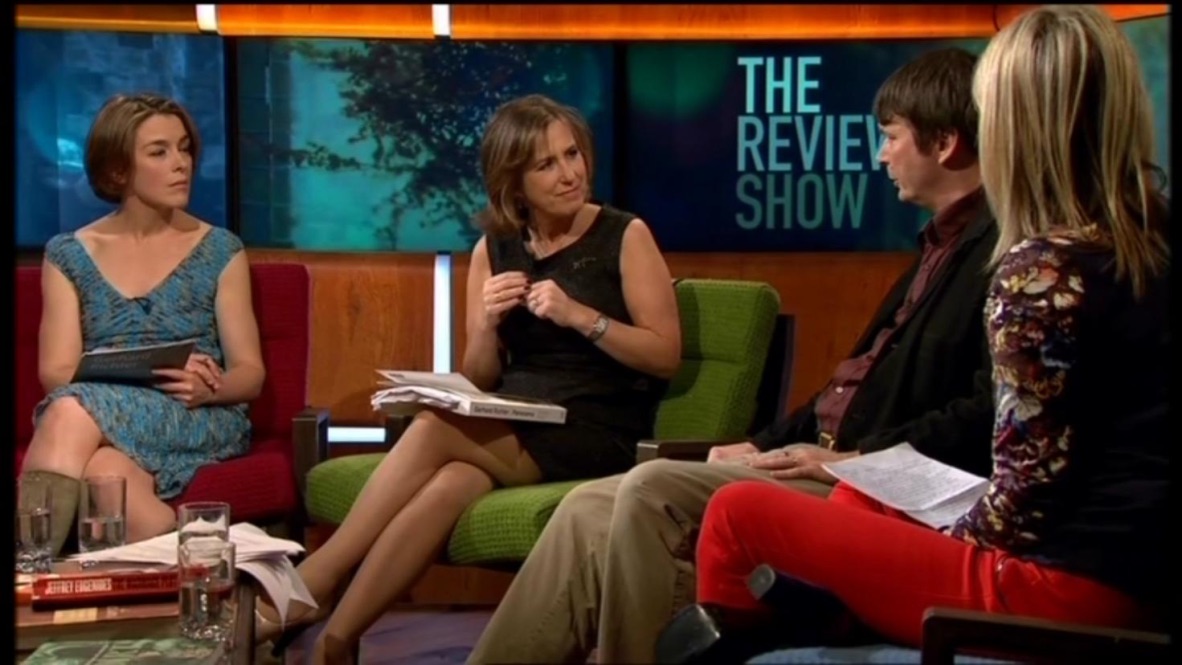
BBC2’s ‘Review Show’ is fertile ground for anxiety spotters because the guests are seated close to each other, often in a crescent, which makes it difficult for the director to isolate speakers without repeatedly going into a tight shot. The guests are not always aware that they are being included when attention appears to be focused on a speaker so they will often stray from the attentive ideal.  On this occasion everyone is performing their attention quite well:​

On this occasion the presenter, Kirsty Wark, seems less interested than she would wish to appear and has acquired a glazed expression. Her female guest, however, is being ideally attentive.

Attentiveness is obviously highly desirable. Here Kirsty – a highly experienced presenter –  has come up with an excellent version of attentiveness that could almost pass for the real thing. Possibly slightly too intense but pretty good.

The professional presenter, as distinct from the actor of dramas, must perform the unperformed with aplomb. The actor of dramas has, in some respects, an easier job because her objective is transformation – if she gets it wrong it will be seen as an insufficient conversion but if the presenter is seen to perform the unperformed then the shortcoming is a betrayal of the authenticity of the entire programme.

The unperformed of the presenter is not informal – we need it to be unwaveringly focused and efficient and we know that the autocue will often support this effect. Even so, the fantasy, I think, is that despite the fact that we know that it is the presenter’s experience plus the technical support of the team that gives him the requisite polish, we simultan­eously believe that he is a being of perfect confidence and self-belief.

We know it’s artificial but we want to see the subjects denying this, both in the name of professionalism – we appreciate a polished production –  and of self improvement, whereby we are able to study and learn from individuals who are being closely observed in real time as they make public presentations. In these studies we can distinguish between the consummate professional – Jeremy Paxman, say, and those interviewees who are not schooled in studio behaviour but are aware of the rules. This isn’t a purely voyeuristic exercise  –  the TV professionals are an educative presence – they not only teach us what’s going on in the world, if they happen to work in current affairs, but they also show us the minute details of artificial composure, the  moment by moment maintenance of a fluid, attentive, integrated surface. They demonstrate that you can go a long way with an edited, smoothed, heightened, repurposed version of what is normally regarded as your self.

03.07.2014

Murder in the Dark

When I was a film student in the mid 60s I read a translation of Antonin Artaud’s four page play ‘A Spurt of Blood’ (1925) and was gripped by the blunt but poetic directness of this remarkable work. Notwithstanding the author’s preoccupation with a punishing God and his fastidious unease with the sexual activity of women, the playlet is simultaneously pantomimic, florid, grotesque and grave.

The Wikipedia article on ‘A Spurt of Blood’ supplies a synopsis which supports the notion that the show could be a good night out, if a rather brief one. In my own production of the show (see below) we almost burned down the elaborately panelled ceiling of the Royal College’s Gulbenkian Hall when an ‘exploding star’ failed to fall from on high to the stage level. But that’s another story.

The extremity of the play also elicits a sort of delirious laughter in its audiences (as far as I know, Peter Brook (1964, Theatre of Cruelty season at Royal Court Theatre) and myself (1968, Royal College of Art) are the only directors to have mounted full-scale public performances of the work, which was not, it is thought, performed in Artaud’s lifetime), akin to the nervous delight aroused by some horror films – John Carpenter’s ‘The Thing’ (1982) is a fine example of this, as are, in what can only be called the Lynch genre, David Lynch’s ‘Blue Velvet’ (1986) and ‘Twin Peaks’ (1990-91), not to mention the rest of his work apart from the untypically charming ‘Straight Story’ (1999).

Peter Bradshaw, in a re-release preview for The Guardian captures the alarming humour of ‘Blue Velvet’ in a summary of the opening sequence that establishes the director’s mastery of deadpan excess – ‘(Jeffrey’s) capacity for obsessive rapture and scopophilia is unlocked by the bizarre discovery of a severed ear in some waste ground after walking home from the hospital where his dad is recovering from serious spinal injuries.’ The same species of horrified delight can be experienced most recently in the utter melancholic darkness of HBO’s ‘True Detective’ (2014, writer Nick Pizzollato, director Cary Fukunaga), which provokes dread-filled giggling in its rotating passages of philosophy, sociopathy and redneck homicidal occultism.

‘True Detective’ is not devoid of cliché insofar as the obligatory naked, tortured, tattooed, decorated and decaying female corpse is revealed within the first few minutes of Episode 1. Images of the extreme and homicidal abuse of women have become common in ‘dark’ film and TV dramas and have supplanted other lesser darknesses (drug retail and dependency, mainstream murder, police corruption etc) associated with the contemporary thriller genre. The ultimate plot driver now, it seems, is something so foul that it will appal and energise all who choose to endure it.

Certain crimes are deemed ‘unspeakable’ but they do, in fact, frequently prove to be describable both in words and images. Their unspeakableness is a function of the fact that they are, as far as the complainant is concerned, ‘undoable’ – one cannot imagine doing them oneself. (You can see the point of robbing a bank but do you really want to dismember women?) The crimes are not wholly unfamiliar, however. The horror that they provoke is partly comprised of uneasiness about the possibility that the darkness from which they arise is without boundaries. That is, it may reside in oneself, not just in psychopaths. It is possible, therefore, that one could imagine doing those sort of deeds oneself. But one would not do them. And one would not wish to test one’s imagination in order to see if they are imaginable. Because what if you started imagining then you liked what you saw? Unthinkable. But all sorts of cultural products will do it for you instead.

None of this is particularly contentious. Dark films and TV only thrive if they strike a chord, after all. And there’s no doubt that a violent, pervasive misogyny is on the rise. But why is it on the rise? Do we watch these dark programmes because we all somehow became psychos fairly recently? Or has the prevailing economic and political ideology reached the stage of development at which its hitherto obscured internal logic is steadily emerging and finding expression in extreme behaviours? If the latter is the case then the misogyny in dark films and TV is not only a psychiatric articulation but is a product of political formations that marginalise empathy and generate an extensive murderousness.

It can then be argued that the fashionable and apparently fascinating dismemberment of women is ‘successful’ in current fiction partly because it offers a coded indictment and partial analysis not of individual psychopaths but whole social systems. Such an analysis is hard to formulate, we see symptoms easily enough but causes are mysterious – we want to know whodunnit. But it seems to be transpersonal, taking place on a global scale. It would be objectionable to imply that widespread misogyny is no more than a symptom of a grander but less tangible scheme, but perhaps useful at least to make links between economic ideology, alpha masculinity and a hatred of women.

27.05.2015

Hey, Girlfriend!

In the cinema films are edited before they get to you. You can’t do anything about it. But what would you do anyway? Editing is a hard thing to criticise. It might be the least criticised aspect of a multi-disciplinary form in which casting, acting, dialogue, good bits, plots and stories, sets and setting, costumes and music tend to receive more attention than lighting, camera movement or sound design. Or hair.

Editing is among the least critiqued because it is premised upon being unobtrusive to the point of invisibility. Its unshowiness depends on seamlessness – transitions from shot to shot should not, on the whole, be readily describable as such. The seamlessness, in turn, encourages the view that the passing of time in a film resembles its passage in everyday reality.

This reality effect is based on a grammar that only exists within films. We know that films are put together in jumbled time – film crews shoot the end of the film on Monday because that’s the only day they can get those particular cars, horses, valleys or actors, then, for similar reasons, they shoot the beginning of the film on Tuesday. The actors quickly get used to this and develop appropriate but peculiar skills. The jumble produces a jumble of shots which, thanks to the grammar and, of course, the script, will be assembled into legible, coherent sequences.

With live television broadcasting, editing is carried out on the hoof. As you watch, sequences are being put together. You can, in this situation, mount small local complaints. You can say out loud “This Jubilee on the river thing, with lots of boats, singularly lacks good shots. These people should go to Film School, or at least watch more films.” Nobody cares that you said this but the point is made: a reality effect that is put together on the hoof will fracture from time to time.

This doesn’t mean that you suddenly see through the effect to a more definitive, hitherto concealed reality beneath. You will, more likely, gIimpse parts of an apparatus that usually serves to maintain the effect that an effect is not being maintained.

Editing is not only a matter of withholding ‘bad’ shots – often editors and directors conclude that something is missing and will have a range of strategies to compensate for this. Which is where tennis comes in.

Television coverage of championship tennis is, we can deduce from the way it is shot, basically flawed. The flaws stem from an impoverishment at the heart of the sport rather than a failure of imagination within the teams who produce the broadcast material. An abiding anxiety about the lack of anxiety evinced by the players is evident in the vocabulary of types of camera shot that typically constitute a sequence of play.

Despite the profusion, in our culture, of fictional narratives depicting struggles between men in which images of women may be absent for the entire duration of the artifact, and the innumerable broadcast instances of team sports coverage in which women are wholly absent for, say, both halves of those games thus structured or for, say, the duration of those comprising a number of successive innings, there is clearly a state of enduring crisis in the broadcasting of tennis that requires regular, radical intervention. The interventions, in the form of a species of camera shot, are radical not because they extend our understanding of the finer technical points of the sport but, instead, function as a narrative implant that, at first glance, has nothing to do with tennis.

In common with the broadcast presentation of most sports, the atmosphere and excitement attendant on tennis tournaments is enhanced by means of crowd shots and coach (or, in other sports, manager) shots, expert commentary and telling detail shots – the umpire conferring with a line judge, the relacing of shoes, the obsessive adjustment of racquet strings, for example. It is difficult, however, to think of a sport in which the girlfriend shot has acquired such importance.

The girlfriend shot caters to anxieties about the possibility that male tennis stars are not heterosexual, not properly socialised and not human. The shot also assuages the fear that tennis is obsolete insofar as all that can be achieved within its terms has been achieved. If the latter is the case then the peaked sport will tip over into a protracted but inevitable death characterised by decadent cultism of the body and baroque embellishment of the microkinesics of technique.

A handful of top tennis players can allay suspicions about their machinic qualities by being likeable in some way. This need not involve acknowledging their errors – displays of regret and irritation may fail to be ‘all too human’ and often suggest instead ‘coding malfunction’ and are therefore probably best suppressed. Likeability may consist in having a pleasant face, like Djokovic, or using a number of different facial expressions – all of which, needless to say, should be related to an event or a state of mind.

Having a girlfriend is tops, obviously. Having a highly focused mother will not appeal to everybody but an attractive girlfriend will solve a number of problems. It also introduces new levels of difficulty, however. While the presence of the girlfriend suggests not only that the millionaire player has a life, inhabits an emotional spectrum that includes the possibility of love and subscribes to the master template for all known relationships, namely heterosexuality, a certain amount of disowned anxiety is projected onto the female companion.

Her function is not merely to lay to rest uneasiness about the possible emotional vacuity of her partner but to fill in the expressive gaps in the partner’s repertoire. Where he does not, if he can help it, react to feelings of tension, trepidation, imminent loss, the vanquishing of a weakling etc, she will throw the emotional shapes on his behalf, thereby rendering legible the humanness of the struggle which otherwise might start to resemble computers playing chess together or an experiment in the command and control of humanoid drone vehicles.

The funny thing is that the girfriends almost invariably succumb to a sort of Stockholm syndrome wherein they appear to feel almost as constrained as their boyfriends. In what may be a bid for consistently ladylike behaviour, the girlfriends, isolated by the cameras every couple of minutes, suppress their faciality to within a few degrees of the range evinced by the partner they are gamely attempting to magnify to a human scale. The gravitational pull of gristly hypermanliness proves irresistible.

Posthumanists with an eye on sport would find the progression from blood to circuitry inevitable and predictable. Meanwhile tennis in its early phase of decay will, despite the assiduous application of the girlfriend shot, tend to the preconditions of mechanised warfare just as gamification – the applying of the principles of video gaming to non-gaming situations – facilitates the development of military drone guidance.

05.12.2013

Storm Thorgerson 1944 – 2013

Storm Thorgerson, whom I had known since my early teens, died three weeks ago after a long struggle with cancer. Storm was a legendary graphic designer specialising in album sleeves. He is responsible for the artwork on all the Pink Floyd albums and, with the Hipgnosis and StormStudios team, has produced memorable imagery for Led Zeppelin, Peter Gabriel, 10cc, Black Sabbath, Muse, Biffy Clyro and many other groups and artistes. I was asked by Storm’s wife Barbie to deliver a eulogy at the funeral. I have reproduced it below.

13.05.2013

The Inner Argosy

The man next to me has a pint glass of water, a biro and an Argos catalogue. He is bent over the catalogue circling pictures of watches. At first I assume he must be picking out a few examples in order to come back and compare them all later. But he leafs through the watches section and finds his way to gardening tools, where he circles forks and trowels. His concentration is considerable and from time to time he sips the water quickly without looking at the glass. I notice that the barman doesn’t seem too pleased with him. Probably because he’s not drinking a proper drink. The man finishes with trowels and moves on to the hi fi section, in which he proceeds to circle a number of compact stereo systems. He doesn’t study them for long, preferring to scan them then firmly mark them. Each time I look up from my book he has moved to a new section and continues to circle and to circle.

The man seems very methodical and efficient. Were he to select and purchase one item from each of the sections to which he had attended, his outlay would be considerable. The state of his clothes, however, does not suggest that he has access to significant outlay. His cuffs are frayed, his glasses are secured with tape, his shoes are laceless. But he has a project.

He has, perhaps, mastered the art of inner shopping, accessed the pleasures of virtual purchase. Perhaps he is able to imagine what it would be like to have things, to imagine this having in such detail that, with the end of reverie comes satiety: I dreamed of having it and I fantasised the pleasure pursuant on the getting and then I was over it. I say ‘I’ because I can do this. I can browse attractive items in magazines designed to make me yearn but the yearning does no more than smoulder, it remains platonic. I enjoy the attractive thing in my head. I have to say I think this is rather clever. Not to mention being possessed of a timely frugality.

The man in the pub probably has not had the opportunity to develop such a privileged enervation. It may be that he has not enjoyed the consumptive possibilities of the capitalist play area. He has not gone the whole way without protection. When I take my yearning for a walk I am fortunate to be able to recall the times when there actually was cake or stylish snowshoes and feed this into the chamber of vapours. However, my neighbour’s diligent circling does confirm the palliative aspect of consumption – in this case a modified shopping therapy with some of the satisfaction but no goods. The implanting of the yearning to yearn, however, can be counted as one of the success stories of consumerism.

If the circling project is there to take his mind off laceless life then the choice of shopping catalogues cannot be arbitrary. It’s not the need to draw circles that is compulsive – that could be satisfied by doodling. The need to corral images must be paramount. Once corraled they can be treated as objects of meditation. Consumerist spirituality, wherein essences are, by acts of worship and contemplation, transformed into materials, encourages an intense visualisation that may, at least in a magical world, cause images to take on extra dimensions and become pocketable.

The Tibetan Buddhist notion of the tulpa is a useful correlate: it is believed that an esoteric meditation technique may be employed gradually to transform a thought into an intense and detailed image and thence into a material object or being: the tulpa. If the tulpa is a being it is both sentient and autonomous. Once out of the bottle it must be treated with care lest it wreak havoc. Self help psychology also supports this notion: many an opulent charlatan, fattened by book sales and the lecture circuit, will assert that if you want something badly enough you will get it, such is the power of positive thinking.

It’s window shopping – for some the window will be opened on pay day, for others the window glazes the world. It’s enough to drive you mad.

29.03.2012

Down Roundabout Way: Part II

Poking around in my hard disk I came across an aborted piece on aborted pieces which reminded me that what goes around comes around. (Despite its aspiration to the crisp, Strength Weekly does not systematically eschew the homily.) In this case I was unsettled to find that something I wrote eleven years ago spells out a number of concerns that still concern me. Given that the piece is an account of the dangers inherent in setting unrealistic goals, I suppose the lesson to be learned is that if you don’t learn your lesson you will eventually find yourself writing a short introductory item like this.

The disinterred and unfinished account can be read here, in one of the archival wings of this digital estate.

01.02.2012