In Arms

When you have been breastfed by Brad Pitt you quickly come to realise that life will not be all hard or all soft. As in all things, a middle path. The third way, as it is had. Some say “Hey, that whole Brad Pitt thing – I was so surprised!’ Others, equally, go, “Surely, isn’t that fucked?” Well, perhaps there are stranger things. Who are we? Going with the soft: he is reassuring; you get some of his qualities; it’s an ice-breaker (later). The hard can be “I suppose you think you’re quite something well let me tell you mister I don’t care if Novak Djokovic makes your sandwiches to me you are a stain on some fabric.” You think of his eyes and hair, that rubbed off on you, how he was unwavering and unconditional and unjudgmental and uncomplaining and unperturbed and unpatronising and undemanding and unswerving

You Got This

A Preface to You Got This

The phrase ‘You Got This’ can be stressed in several ways, including ‘You Got This’ and ‘You Got This‘. In the first case it may be used when, as the meme-collecting website Saying Images enquires, ‘(have you) Got some friends going through a rough time or know people who need an extra push? Reminding them of how strong and capable they really are can help them get over their current situation.’


Often Ryan Gosling will say this to you while in his vest (or sleeveless undershirt).

The second inflection of the phrase, ‘You Got This‘, carries the suggestion that you should stop complaining because you got this and it’s all you’re going to get.

It’s the second meaning that is examined below. It may well be that the slogan on the girl’s T shirt in Holloway Road alludes to the first meaning. I can’t tell.

You Got This – Part I

A young girl walking along the Holloway Road with her mother is wearing a T shirt that carries the slogan ‘You Got This’. The slogan cancels all the other T shirts that bore a long-established complaint about the meanness of those who only handed over a lousy T shirt despite their return from an exotic location. If certain laws of physics and human biology were slightly modified then the manufacture of the ‘You Got This’ line would precipitate the instant discontinuance of all the T shirt lines that bore the initial complaint, in all its variations, globally. Although there is no suggestion in the slogan that You Getting This is in any way a satisfactory outcome for you, it does feel like the dialogue is over. You wanted something that you deserved? Now you’ve got it.

For a workaday encounter in the Holloway Road to effect such a comprehensive transformation, the fundaments of spacetime would have to be radically reconstituted, alongside a complementary remodelling of the human sensorium – a set of conditions in which it becomes possible for all the world’s phenomena to be experienced by everybody all of the time, in real time. In such conditions the open-ended complaint borne on the T shirts of hundreds of thousands of people would be resolved as soon as the first You Got This hit the street. In their multitudes wearers would turn to each other, not without a degree of weary resignation, and say ‘Right. We should move on now.’ Garment manufacturers would, of course, resist this shift but the Lousy T Shirt wearers would say to them ‘Hey! It’s over. We never got anything better than the lousy T shirt of yesteryear but we know, as you do, that a person in the world has received a riposte. One that is both credible and concrete. And this neutralises the whole scene.’ End of story.

You Got This – Part II

The whimsy apparent in Part I is all very well but it elides the cry for help that the original T shirt plaint articulates. The person who is, by implication, accused of failing to supply a pleasing gift or, at the very least, a T shirt that is not lousy, may be a parent, another family member, a spouse, a lover, a friend. These individuals, constituting the support team of the plaintiff and, by extension, representing, in this case, all human beings in the world, clearly, in the view of the plaintiff, do not love the latter enough. That this insufficiency could be assuaged by a more substantial gift or one that was not picked up at the airport does suggest that while the plaintiff seems to be generally relaxed about the translation from love to love token it may be the case that what they really want is the unalloyed love that everyone deserves. The T shirt is what they will settle for because you can’t always get what you want, especially if the want is profound, unwavering and painful to the point where it seems unreasonable, unwieldy, poignant, an ineffable yearning that may never go away until it is satisfied, which it never will be.

Shorts in June

There are many reasons why I like the very short stories of Lydia Davis. The most workaday reason is that it is possible to completely finish to finish completely as many as, say, six eight or ten in a journey. The kind of short journey about which I am thinking. On the bus, on the tube. I had found the very short stories of Diane Williams breathtaking and was on the lookout in that neck of the woods. Lydia Davis is far from the same (the tone overlaps now and then but there’s a world of difference) but I came across her shortly after and I knew an imminent reading pleasure when I saw one. The book that I came across looked very attractive. Although it was bright pink it was also very plain. The covers were matt, a bit like those sombre French paperback series. I’m looking at it now and it’s not so much pink as salmon. There is a problem, however, this book, the one I’m coming to, ‘The Collected Stories of Lydia Davis’, that I found in a charity shop, has over 700 pages. No way am I going to carry this around. But luckily yesterday I forgot to take with me my acceptably weighted copy of ‘Gun Machine’ by Warren Ellis when I went out and started to fret. I mean that as a result of the oversight, I started to fret. As soon as the bus stopped I walked 30 meters to the nearest charity shop to find another book that I could read in my café. Damn me. There, in attractive sky blue matt card covers was ‘Can’t and Won’t’ by Lydia Davis, at a mere 280 pages.

In a Perfect Bind

I was sitting down when I felt a curious sensation in my hands which reminded me of something I had had in my hands once but at first I wasn’t sure what it was then I realised it was a magazine. I have not held a magazine for several years if you discount the ones at the weekend in the papers.

My hands, however, remembered what magazines felt like. I wanted to hold one again. Particularly one with Perfect Binding. In the image above all the magazines have perfect binding apart from the fifth one down, which is saddle stitch.

The ones at the weekend are saddle stitch. I don’t dislike them at all. They can be good for content but the paper upon which they are printed has no sensuous appeal and there’s a dispiriting excess of articles on restaurants and holidays you can’t afford and people who have unique clothes. The magazines that my hands miss will also contain three or four long pieces of writing maybe and if there are three then you’ll buy it. They’ll still have far too much about things you can’t afford but no one is forcing you to read these dumb items. I’m not talking about perfectly bound magazines that specialise in golf or cars or male adventure or food. There’s a limit to how far binding can take you.

You may be thinking But what was in these magazines then, what were they about? Which is perfectly fair. The answer is: Oh, all manner of things.

I did have a huge collection of American underground newspapers, mind you. Village Voice, East Village Other, Avatar, Berkeley Barb, Los Angeles Free Press, Oracle, The Realist. Then I moved from one house to another. When I got to the new place, the papers had gone. I’ve never seen them since.

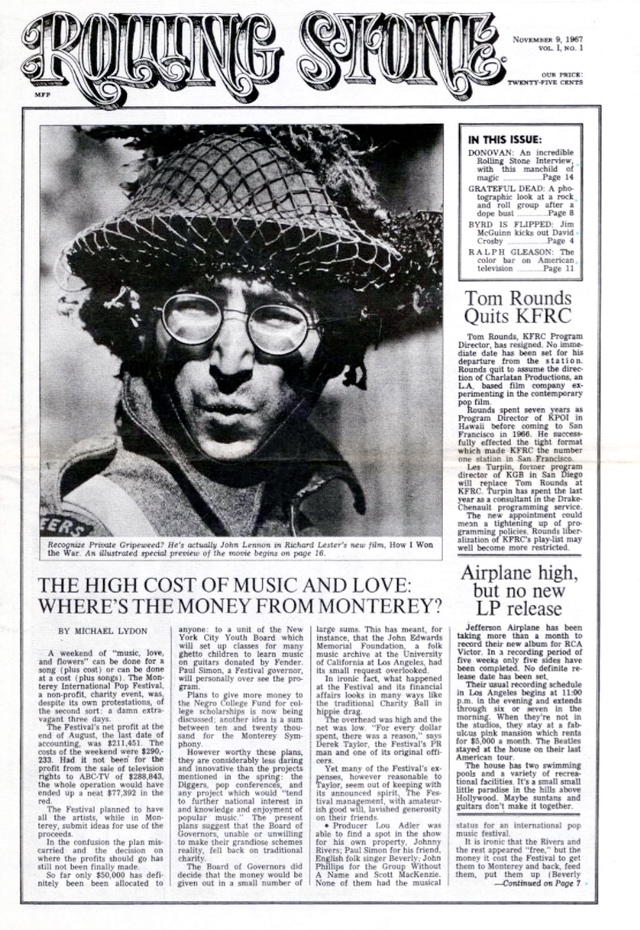
The thing about Rolling Stone (1967 and on) was they introduced longform New Journalism. Terrific, lively features on American politics, elections, riots, Hippies and Yippies and Panthers. Musicians and their appetites. Woodstock, Altamont. Hunter S Thompson, Tom Wolfe, Lester Bangs, Joe Eszterhas.

I don’t want to write about that. It was very exciting. But it’s been thoroughly well written about. I want to write about what my hands felt. Your hands can’t read, obviously, but for many years they complemented and facilitated a marvellous opening of the world.

Rolling Stone was a magazine in newspaper format but it stoked an appetite for a journalism that was closer to how you lived. It contained, of course, many slightly too fascinated articles about the lives of rich performers but it was critically acute and not really a music paper. I can’t remember if it was full-on saddle stitch i.e. with staples. Not in the early days, I think. It moved to saddle stitch at some point then, in 2008, to perfect bound.

The Face (1980-2004) had perfect binding. With layout, graphics and typography that introduced the first significant visual state change since art director Michael Rand’s groundbreaking work on the Sunday Times Magazine in 1962 – the first ‘colour supplement’. In terms of heft (perfect is usually introduced at around 90 pages) and gravitas (perfect benefits from its association with iconic mags like Vogue, Vanity Fair and National Geographic) The Face’s articulation of popular culture was subtly buttressed by its binding.

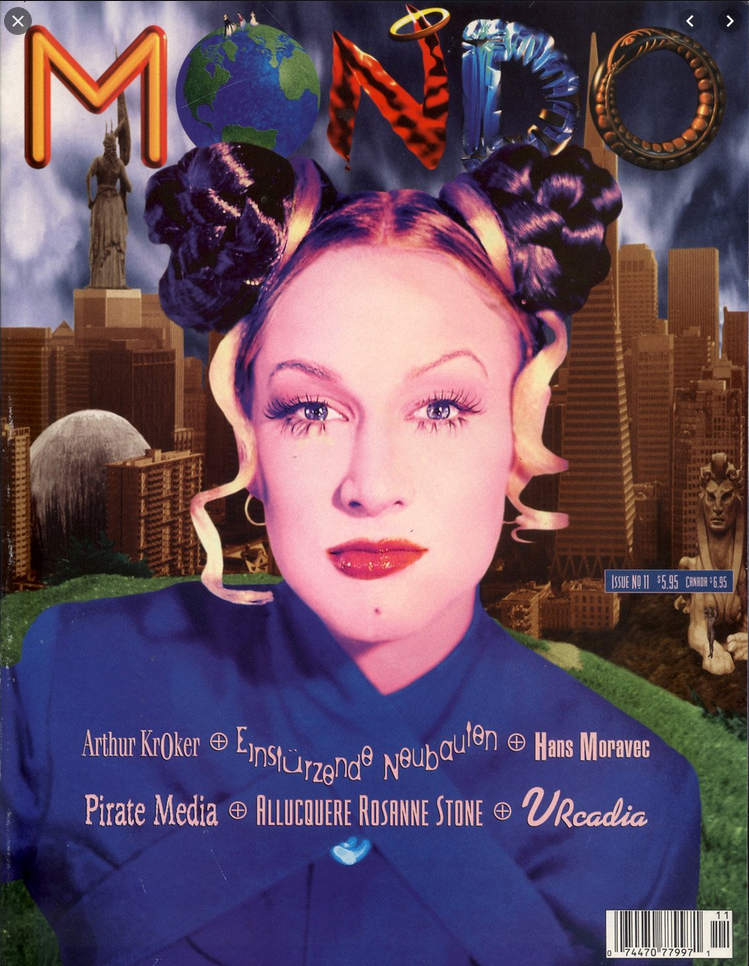
In the early 90s I was writing for GQ and had the pleasure of caressing a succession of issues in which my own longform features featured. I wrote a number of pieces about the rise of the internet and various emergent art-meets-technology developments. I went to Nevada to look into this UFO thing. When the unsoftly spoken, larger than life GQ Editor Michael VerMeulen died far too young in 1995, the glossiest perfect of them all, the cyberculture mag Mondo 2000, had been up and running for six years. Mondo, unlike GQ, had little time for food and cars and grooming. Its pages were heavy and coated and given its ardent advocacy of virtual reality, its gorgeousness could be mistaken for a key requisite of a pharaonic afterlife.

They felt nice, those Mondos. They smelt nice. Then they vanished, usurped by the new realities they had championed.

I love the internet but it plays havoc with your attentional skills, precisely at the point where you think you’ve acquired a serene 21st Century multitasking encyclopaedic fluidity.

[/et_pb_text]

I bought the first Rolling Stone in 1967, the Summer of Love, and then the rest. I kept them in bin liners in a cellar. I’d rather not say what happened to them. I did not sell them. They were not stolen. I did not lose them. I wish I still had them.

I did have a huge collection of American underground newspapers, mind you. Village Voice, East Village Other, Avatar, Berkeley Barb, Los Angeles Free Press, Oracle, The Realist. Then I moved from one house to another. When I got to the new place, the papers had gone. I’ve never seen them since.

The thing about Rolling Stone (1967 and on) was they introduced longform New Journalism. Terrific, lively features on American politics, elections, riots, Hippies and Yippies and Panthers. Musicians and their appetites. Woodstock, Altamont. Hunter S Thompson, Tom Wolfe, Lester Bangs, Joe Eszterhas.

I don’t want to write about that. It was very exciting. But it’s been thoroughly well written about. I want to write about what my hands felt. Your hands can’t read, obviously, but for many years they complemented and facilitated a marvellous opening of the world.

Rolling Stone was a magazine in newspaper format but it stoked an appetite for a journalism that was closer to how you lived. It contained, of course, many slightly too fascinated articles about the lives of rich performers but it was critically acute and not really a music paper. I can’t remember if it was full-on saddle stitch i.e. with staples. Not in the early days, I think. It moved to saddle stitch at some point then, in 2008, to perfect bound.

The Face (1980-2004) had perfect binding. With layout, graphics and typography that introduced the first significant visual state change since art director Michael Rand’s groundbreaking work on the Sunday Times Magazine in 1962 – the first ‘colour supplement’. In terms of heft (perfect is usually introduced at around 90 pages) and gravitas (perfect benefits from its association with iconic mags like Vogue, Vanity Fair and National Geographic) The Face’s articulation of popular culture was subtly buttressed by its binding.

In the early 90s I was writing for GQ and had the pleasure of caressing a succession of issues in which my own longform features featured. I wrote a number of pieces about the rise of the internet and various emergent art-meets-technology developments. I went to Nevada to look into this UFO thing. When the unsoftly spoken, larger than life GQ Editor Michael VerMeulen died far too young in 1995, the glossiest perfect of them all, the cyberculture mag Mondo 2000, had been up and running for six years. Mondo, unlike GQ, had little time for food and cars and grooming. Its pages were heavy and coated and given its ardent advocacy of virtual reality, its gorgeousness could be mistaken for a key requisite of a pharaonic afterlife.

They felt nice, those Mondos. They smelt nice. Then they vanished, usurped by the new realities they had championed.

I love the internet but it plays havoc with your attentional skills, precisely at the point where you think you’ve acquired a serene 21st Century multitasking encyclopaedic fluidity.

[/et_pb_column][/et_pb_row][/et_pb_section]

Fare

I went to this hippy fair in my home town not too far from here the other day. I had been there before a couple of times and had quite enjoyed it: my daughters liked very much the food and the jewellery from tents and stalls; I liked drinking cool ales on grass; there was a stall selling random artefacts from beyond Europe – I bought an old Indian framed colour print of Krishna up a tree having purloined the clothing of the naked gopi girls as they bathed; I liked the local bands – some of them, anyway.

Among the roaming youth, the dreadlocked white boys and the beaded and hennaed full-skirted women of many ages, I noted that there were groups of older men and women perhaps in their forties, some with greying hair, who stood chatting here and there and looked not like hippies not like the Peace Convoy of yesteryear but certainly road hardened yet easeful as well some with sports coats and some with jodhpurs not posh not horsey, certainly of no fixed abode, the bearing of long established circus family maybe but also quite regal. The men with bands of cloth at the neck, tied round and round with a knot, the women not always full-skirted but a few tattooes and riding boots. These clothes were not costumes, they looked like their wearers’ daywear of choice and the wearers looked as though the outdoors was comfortably their indoors. This place, I thought, was salubrious for them. I think they had vehicles to live in at the end of the day but I couldn’t say for sure.

You should not on the whole try to repeat things. It was a very hot day the other day and on the way through my home town to the common by the river there were great streams of people heading in, from every street converging. It wasn’t that the average age had dropped a few years to the mid teens, or that the beer wasn’t up to snuff – I had a hazy and rewarding pale ale, the current supplanter of the darker beers – but a kind of traipsey feel had taken hold. There were stalls with beads and rings and flowing tie-dye garments and a great many of these; there were stalls with food and many many of these; the bands were shy boys and girls whose systems had little sound. It seemed that within these categories there was little variety and among these islets of equivalence one could only make undistracted passage because not one had a distinct allure that would make marks or leave traces. I know I’m hardly the target patron here but fairs are supposed to be sites of adventure and excess not just traipse’n’trinket opportunities.

The fair as stockade is a welcome notion though, and as they pile into the fenced-off common the thousands of cheerful young attendees seem likely to find the makings of a Saturday asylum. It struck me, however, that the homogenising of the High Street had got there before them, flooding the field with a wealth of barely distinguishable choices. As safe place or benign enclosure it was continuous with the city around it insofar as both offer an overabundance of goods but actually generate a non-celebratory agitation. You can get lots of stuff but it’s not what you came for. Maybe you didn’t know what you came for but although the idea of the fair is deeply embedded its spirit here is elusive, submerged in a torpor of busyness and business.

I looked for the serene older travellers but they weren’t to be seen. My sighting of them a few years ago had prompted romantic daydreams of an offgrid life but now they had moved on. I wonder where they went and what they do there.

§§§§§

It Has Always Been There

In a bed at night in a Paris hotel a few decades ago I could hear a couple of men talking in the corridor. I thought they were speaking English but I realised it was another language, one that did not even resemble English. I was hearing clear snatches of English though, and I continued to hear them until I fell asleep.

Shortly after this I realised that all languages were English, it was just a matter of how you listened, where you put the gaps between the words. A bit later I realised that all languages were your own language – this would apply to Estonians, Arabs, Vietnamese etc. Speakers of these languages listening to speakers of other languages could hear their own language providing they listened in the right way and were prepared to put the gaps in at the same speed as the speakers were forming sentences.

This went some way to explaining how it was possible, before everything had been explored, to travel to remote places and to find tribal groups, hitherto completely cut off from ‘civilisation’, who spoke English as if they were English. The members of these groups did not, of course, regard themselves as English because none of them had been born in England. Nevertheless, when they spoke, and when their visitors listened carefully, strings of English words in sentences could be heard and understood.

Sometimes it is possible to get a false positive. I was on a train near Cardiff late in the 20th Century, idly overhearing two women talking in Welsh. At a certain point I clearly and unmistakeably heard the phrase ‘washing machine’. A couple of minutes later I heard ‘Hoover’. I was on the verge of berating myself for not being able to follow the speakers more closely when I saw the mistake I had made: it appears to be the case that Welsh speakers may use English terms when they refer to things that have emerged since the settling of the Welsh language. This is not because there is no term in Welsh for ‘washing machine’ (peiriant golchi), it is, rather, a pidgin formation, perhaps a matter of convenience. I had rather complacently assumed, after ‘washing machine’, that I had put the gaps in the right places and enabled myself to understand the English that lay beneath the Welsh. My mother was Welsh and spoke the language and I think this may, in some obscure way, have limited my capacity to find the submerged English within the conversation on the train. It may be that when the overheard language, in this example Welsh, is salted with straightforwardly pronounced words from first-level English that the brain, otherwise linguistically elastic, cannot process two conflicting sets of gap-insertion conventions, one based on effortless acceptance, the other on the real-time re-gapping of the so-called ‘foreign’ language.

I have discussed my findings with linguists and they have suggested that I may have been unconsciously clustering groups of speech sounds in order to make words that I wish to hear. I understand the psychological principles that are being proposed but am inclined to believe that if this is the case then it is not my wishes that I am detecting but those of others – the participants in the many exchanges that I am able to understand.

I would add in my defence that this psychological hypothesis fails completely to explain the fact that it is not intermittent clusters of English words that I hear but entire conversations consisting of protracted, properly grammatical exchanges.

I am not translating. All languages lie beneath other languages. They are distinguished by differentials in stress and phonetic clusters. There are no words that are not composed in this way and consequently no words that cannot be understood, providing that the listener is able to relinquish conventional modularisations.

§§§§§