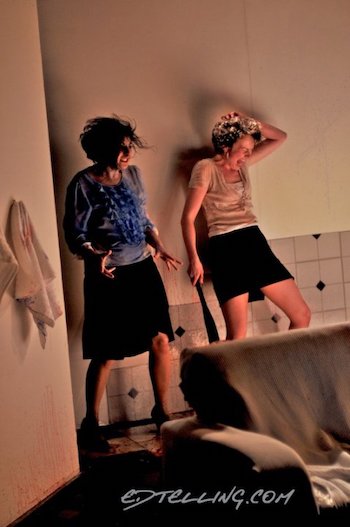
Alice in Progress

The website (from 2011) mentioned below is extinct but some of its contents will be found in ensuing Strength Weekly Posts.

I’m working on a large-scale outdoor show called ‘Dining with Alice’, which opens at the Norfolk & Norwich Festival in May. The show places its patrons in a country house garden where they eat a meal whilst encountering characters from Alice in Wonderland. It was first presented at the Salisbury Festival in 1999 and is being extensively refurbished for its imminent Spring revival. Directed by Hilary Westlake, with text by Strength Weekly’s CEO, writer David Gale, music by Frank Millward and produced by Artichoke (the company that brought ‘The Sultan’s Elephant’ to London), it can be examined here. On the dedicated ‘Dining with Alice’ website I’m writing a regular blog called ‘Ruminations’ and a column called ‘Aliciana’ which collects quotes from hither and thither that illustrate some of the debates around the Carroll/Dodgson/Alice nexus.


18.03.2011

The Show Must Go On

In the course of the curtain call for ‘A Dog’s Heart’ – Simon McBurney’s sellout ENO opera based on a Bulgakov novel – the chorus performers take their massed bow first, followed by more prominent performers and so on. One of these latter, who has a small part as a stout well-to-do lady, crosses the stage in her character walk then, pausing to take the bow, hitches up her skirt hem a few inches and drops it, as if coquettishly but wishfully advertising her sexagenarian sexiness. A panto moment. But this is the curtain call. The show is actually over.

A few performers later, the soprano playing the maid Zina prefaces her bow with a couple of wacky calisthenic moves that have earlier served to signal her character’s ditziness. Finally, the star of the show, the tenor Peter Hoare, having played Sharikov the dog-man, scampers on and pretends to lunge doggily at the performer next to him in the lineup.

Why is the show still going on? The idea is that when you reach the last page of the script or, in this case, the score, you stop. There is a lighting change which facilitates a clear view of the performers’ faces and bodies, which have been divested of all the qualities of their fictional roles. If we are pleased we clap and, by so doing, please the performers. Then people leave the theatre.

It’s even worse at ‘Billy Elliot’. At the end the lights change, the cast takes its bows but then the entire troupe suddenly becomes inexplicably loveable, regardless of their erstwhile showtime qualities. This is not, however, an opportunity to glimpse their unadorned workaday charm. They have assumed new characters! Who proceed to deliver a right old knees-up replete with teeth, smiles and the obligatory ‘nimble turn’ executed by the oldest member of the cast!

Let it go, why don’t you? The curtain call has an important ritual function. It reseals the envelope between a fictional world and the everyday, thereby contributing to the reinforcement of the psychological skill known as ‘reality testing’. We must assume, given the leakages I have described, that the premium placed on such skills has been significantly reduced. We may now feel safer in imagining that Zina the Maid is downing a glass of vodka in The Salisbury in St Martins Lane, just up from the Coliseum, before returning to her flat in either Maida Vale or below stairs in her employer’s house in Moscow, depending on the levels of hybridity in which we choose to immerse these homunculi who hail simultaneously from fiction, our imaginations and the lives of everyday theatre folk.

It’s a harsh thing, the end of a show. As post-carnival suicide figures in Brazil attest, life can suddenly seem even drabber when the house lights come up. The possibility of magically maintaining a fiction in the eye of the hurricane of the everyday is detectable in fairy-tales wherein the woodcutter who helped out a disadvantaged goblin will be given three wishes, only to squander them on a succession of slapup feeds. As Jack Zipes has pointed out, the benighted mortals of the forest do not wish for social change that might alleviate their feudal misery because they cannot conceive of such a scenario, even in their most magical dreams. When a show with its heart in a progressive place, such as ‘Billy Elliot’, is hijacked by the sentimentality of West End actors who refuse to go home then not only is everyday life betrayed but it is as if the political aspirations embedded in the work are actuated and thereby instantly depotentiated. The distance between fiction and reality is collapsed thereby neutralising any leverage inhering in the fiction.

Chastising the actors for their indulgence is beside the point. It may be that they sense that their refusal of ritual will be warmly received in a climate in which the only defence against a predatory reality lies in chronic, concerted fabulation.

03.12.2010

My Sweet Lord

Having muted the television in order to avoid contracting depression from a very popular programme, I couldn’t help noticing, as I peeked over the rim of the newspaper, that there was something compellingly awful about the clutch of young suits and suitinas either sitting at tables or running about. There is always something awful in programmes about success, and the quality of the awfulness never varies, so I should have known better. The table episodes in ‘The Apprentice’, as everyone who owns a television knows, feature Sugar and two lieutenants on one side and, on the other side, suits who have abandoned all distinctiveness in the name of being similar to their peers, only more so.

It occurred to me that when I was a schoolboy, back in a time when most schoolkids wore uniforms, my friends and I experienced a strong need to distinguish ourselves from the pack. Undeterred by the fact that other pack members were also thus motivated, the members of my group applied themselves to tweaking the uniforms that made them appear uniform.

Ties were knotted inventively and the knots positioned in unusual relationships to the top button of the white shirt. Caps were subjected to distress in ways that costume assistants in movies would respect. Trousers were purchased (by your mother) with less than 16 inch bottoms (your mother was told the limit was 14). Shoes had to Italianise to a point. The look was scruffy with patches of style. Models for the look were Teddy Boys, Tony Curtis, Rockers, Elvis, the hairstyles of Hollywood Romans, Mods, Beats and Artists. Middle class boys, such as myself, were drawn to certain elements of working class grooming, such as hair cream, but found our mothers intransigent in their resistance to the pompadour.

We were, of course, cleaving to convention but our conventions were oppositional. Sugar’s suits, on the other hand, are intent on practising a mode of reverse evolution so radical that one wonders if sheer intention could actually effect parthenogenetic regressive restructuring at a molecular level. A key strategy on display appears to be based on the principle that if a rival makes an effective or ineffective move of some sort – it doesn’t matter which – then his associates will exert a form of homeostatic adjustment designed to return the system to a state of equilbrium. Instances of dissident idiosyncrasy that might be viewed as potentially and constructively state-changing are efficiently suffocated in this scheme. The errant suit is not ejected, he is simply divested of his difference. This is not competition.

What’s odd here is that all the participants and ourselves have come to believe that the spectacle is, in fact, based on principles of competition and is therefore exciting. In practice, however, the emanations of the patriarchy are so overwhelming that the suits have prioritised becoming like each other as a means of achieving what is deeply craved: becoming like Lord Sugar. Lord Sugar will note their capacity to be like each other and will understand that, with a modicum of realignment, they can become like him. They will, of course, having achieved this condition, be obedient. The least competitive will be the most powerful if he can suffocate competition in the name of the persistence of the patriarch. This makes for better television than watching silly competitions, even if the event is blazoned as contest essentialised.

It will be argued that I am failing to notice that every single programme features barely concealed ambition, anger and terror in addition to blatant and incontinent self-promotion. My point is that the vocabulary of the combat is exceptionally small and decreases steadily as its founding ideology becomes increasingly pervasive. Although behaviours may seem florid – the attempts to suppress strong unteamly emotion at a facial level are certainly compelling – they are drawn from such an impoverished stock that their degree of difference, even when counterpointed, is minimal. Border skirmishes are the order of the day, fully mobilised wars are relegated to video games.

The watery-eyed, puff-cheeked, sidelong-glancing novices are actually much more accomplished team-members than they privately would wish to concede. They share a passionate allegiance to the process of abjection by self-promotion. The latter comprises an incantatory series of profoundly abasing assertions of their value in the baldest terms. This is the equivalent of writing your own references. Once the principle of self-commendation is accepted, difference is made obsolete and collapses. This style of self-abasement is clearly intoxicating insofar as the practitioners are able to overlook its resemblance to the canine practice of offering the arse up for sniffing.

31.10. 2010

Dash: Gore

A post about ‘Dash Dash Dash’, a series of shows I wrote and directed in 2010

Further to the material on the releasing of liquids in the previous post I am appending here a short technical monograph.

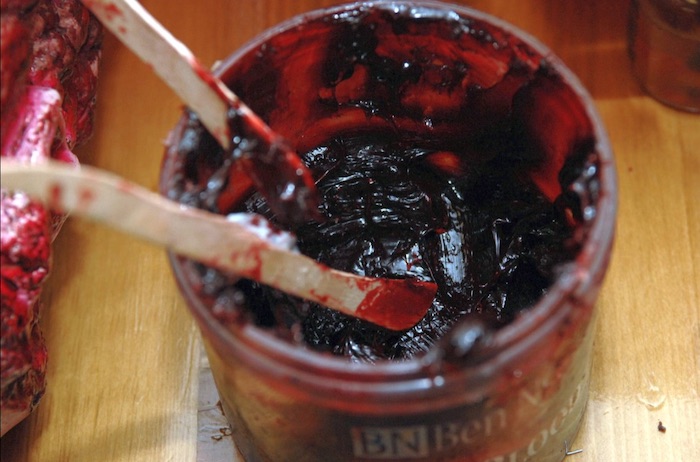
Blood in the performing arts is always the wrong colour. It’s never dark enough. The benchmark for film blood used to be a concoction known as Kensington Gore. (This is a pun: Kensington Gore is the name of a number of connected streets that run around the Royal Albert Hall in Kensington, adjacent to Hyde Park on its south side.)

I am indebted to tvtropes and Everything2 for posting an original recipe:
“… this is a name for fake blood, especially the sticky, edible sort in old British horror films. Everything2 gives the recipe as:
• 2 cups of corn syrup (for viscosity and color)
• 1 cup of water (for balancing viscosity)
• 10 table spoons of corn (maize) flour (for making the blood less translucent)
• 10 tea spoons red food coloring (for color)
• 10 drops blue food coloring (for color)
• A few drops concentrated mint (for taste – optional)
The blood is sticky, thick and bright red (crimson in fact). The original Kensington Gore was a specific brand of proprietary stage blood manufactured by retired pharmacist John Tynegate in the ’60s and ’70s. It can be seen in a lot of old horror films, especially the Hammer Horror series.”
While the ingredients above are fairly standard, it’s all in the mix. The old school Gore had a letter box hue that was far too bright and light. The recipe does stress viscosity, however – a crucial but entirely controllable consideration. This is where the corn syrup (treacle is easier to get in the UK) comes in. The value of corn flour is debatable – it can make the mix irreversibly lumpy. Translucency can be countered with careful and cautious administration of food colouring. In film, it should be noted, the blood can be refreshed between takes. In live performance one is looking for an effect that does not dissipate as time passes.

In the Dash Dash Dash array five out of the six shows featured gratuitous bloodshed:
• In the Bosom of Roy: when Angela spits it, possibly consumptively, in Alex’s face, twice.
• The Flutters: when Grace returns from murdering the man who had been cutting to Roy in his place of work it emerges that she has shagged the culprit and then cut his cock off. She carries the detached penis in a neat, penis-sized package and her chest is smeared with blood.
• The Fastness: Dan has returned, thanks to breakthroughs in time travel technology, from Golgotha, where he was able to film the crucifixion of Jesus Christ, in colour, using a small camera concealed in his chest cavity. His companions, Ann, Tod and Pat, wearing appropriate surgical scrubs, cut into his upper body to retrieve the device, in the course of which Dan inadvertently emits plumes of blood from, we imagine, severed arteries and other vascular components. His resourceful team members are drenched.
• Gulch: Betty, Hector, Frank and Trudy leave the house and return several times, as if there were assignments that had to be completed. With the exception of Hector, all are bloodstained on their return. When Betty re-enters, her face and arms glisten with dark gore. The high window, its sills snowed up, silently seeps blood that drips to the table below, bathing the pearl-handled pistols.
• Sleet: no blood is shed in Sleet.
• Gush: Roy, beneath a bucket of blood, is dowsed. Gina, searching for biscuits, is copiously blued. Dean, wishing to make cupcakes, is enfloured (not a liquid but producing a pleasing halo effect when backlit). Roy, beaten with sticks, stamped upon and having his testicles bitten off, is yellowed from above. Nina, seeking to restrain the reddened, maddened and yellowed Roy, is, while grappling with him, blackened, also from above.

We have, therefore, five sets of requirements:
• the blood that is spat must be non-toxic and thinnish but not too thin or else, on the face, it goes pink and translucent within a matter of seconds.
• the blood that adheres to the skin must not run from its original site of placement. If it runs it will mottle. It must be particularly sticky and is daubed rather than wiped on.
• the blood that spurts from the body must be thicker than that which is spat but not so thick that it blocks the washing-up liquid bottles from which it is squirted or so thin that it soaks within seconds into the fabric of the scrub leaving a stain that is pale and half-hearted.
• the blood that bleeds from the window passes through pipes then soaks into salt. It needs to be thick but must not clog.
• the blood that drops from the sky, as with the red and the yellow and the black, must, as it falls, form cords in the air, hitting the deck with a splat and splashing the walls as it utterly masks the features of those underneath.

All these bloods can be made on a table with buckets and bowls, stirrers and spoons.

While the ingredients above are fairly standard, it’s all in the mix. The old school Gore had a letter box hue that was far too bright and light. The recipe does stress viscosity, however – a crucial but entirely controllable consideration. This is where the corn syrup (treacle is easier to get in the UK) comes in. The value of corn flour is debatable – it can make the mix irreversibly lumpy. Translucency can be countered with careful and cautious administration of food colouring. In film, it should be noted, the blood can be refreshed between takes. In live performance one is looking for an effect that does not dissipate as time passes.

In the Dash Dash Dash array five out of the six shows featured gratuitous bloodshed:
• In the Bosom of Roy: when Angela spits it, possibly consumptively, in Alex’s face, twice.
• The Flutters: when Grace returns from murdering the man who had been cutting to Roy in his place of work it emerges that she has shagged the culprit and then cut his cock off. She carries the detached penis in a neat, penis-sized package and her chest is smeared with blood.
• The Fastness: Dan has returned, thanks to breakthroughs in time travel technology, from Golgotha, where he was able to film the crucifixion of Jesus Christ, in colour, using a small camera concealed in his chest cavity. His companions, Ann, Tod and Pat, wearing appropriate surgical scrubs, cut into his upper body to retrieve the device, in the course of which Dan inadvertently emits plumes of blood from, we imagine, severed arteries and other vascular components. His resourceful team members are drenched.
• Gulch: Betty, Hector, Frank and Trudy leave the house and return several times, as if there were assignments that had to be completed. With the exception of Hector, all are bloodstained on their return. When Betty re-enters, her face and arms glisten with dark gore. The high window, its sills snowed up, silently seeps blood that drips to the table below, bathing the pearl-handled pistols.
• Sleet: no blood is shed in Sleet.
• Gush: Roy, beneath a bucket of blood, is dowsed. Gina, searching for biscuits, is copiously blued. Dean, wishing to make cupcakes, is enfloured (not a liquid but producing a pleasing halo effect when backlit). Roy, beaten with sticks, stamped upon and having his testicles bitten off, is yellowed from above. Nina, seeking to restrain the reddened, maddened and yellowed Roy, is, while grappling with him, blackened, also from above.

We have, therefore, five sets of requirements:
• the blood that is spat must be non-toxic and thinnish but not too thin or else, on the face, it goes pink and translucent within a matter of seconds.
• the blood that adheres to the skin must not run from its original site of placement. If it runs it will mottle. It must be particularly sticky and is daubed rather than wiped on.
• the blood that spurts from the body must be thicker than that which is spat but not so thick that it blocks the washing-up liquid bottles from which it is squirted or so thin that it soaks within seconds into the fabric of the scrub leaving a stain that is pale and half-hearted.
• the blood that bleeds from the window passes through pipes then soaks into salt. It needs to be thick but must not clog.
• the blood that drops from the sky, as with the red and the yellow and the black, must, as it falls, form cords in the air, hitting the deck with a splat and splashing the walls as it utterly masks the features of those underneath.

All these bloods can be made on a table with buckets and bowls, stirrers and spoons.

16.06.2010

Dash: Babble

A post about ‘Dash Dash Dash’, a series of shows I wrote and directed in 2010

The eight month Dash Dash Dash project is largely over. I say ‘largely’ in order to acknowledge the distressing impact of a theft which led to the abrupt cancellation of our final show. On the night of Saturday 15th May, one hour before we were to open the third night of The Omnibus (six short shows smoothed into one long one) to a full house at Battersea Arts Centre, the laptop containing our 60 cue soundtrack was stolen from the control booth of the theatre. Other than humming the various pieces of music at appropriate points there was no way we could proceed. I won’t dwell on it, it’s too depressing. We hope to regroup and re-present later in the year. (This did not happen. Ed. (2019))

There is, however, much to be pleased with. The project was premised on my writing and directing a 25 minute show once a month for six months. The shows had no narrative connection to each other but a number of shared themes bound them into an inter-related collection. I was not producing episodes in a serial but elements that, when combined, would display unobtrusive affinities and be more than the sum of their parts.

I was also keen to avoid story-telling and the presentation of fictional characters. Certainly the figures who ended up on stage were different from each other but not by dint of personality traits that would invariably be reflected in their speech and behaviour. They were physically reliable insofar as they didn’t change shape in the course of a scene (something they might have achieved in an animated film) but other than that their periods of consistency were shortlived, like particles forming then disappearing in a cloud chamber. They were not, however, vehicles for random utterance. That’s too easy.

While there are plenty of diagnostic justifications available for formless babbling – madness, brain damage, attention deficit hyperactivity disorder, post traumatic stress disorder, too much crystal meth and so forth – the use of such speech in performance has a very short shelf-life and tests its audience unnecessarily. The Surrealists, for example, tired quite quickly of the pure products of automatic writing and sought ways to tweak the recipe in order to generate a higher strike rate, while those writers taken with the cutup technique (Tzara in the 1920s, Gysin then Burroughs in the late 50s and early 60s) were in the habit, from the start, of winnowing out the nonpoetic dross from the serendipitous gemlines in simple recognition of an inevitable mathematical deadness that would otherwise reliably extinguish the spirit of the whole experiment.

Nevertheless, in one of the short shows (Show 3: ‘The Fastness’), I wanted a scene in which the figures on stage would be seized with a babbling mania of an intensity that defied all logic and continuity.

DAN Hello everybody I’ve succeeded in painting the town red in a very direct and lively manner.
ANN I disagree. It is time for unrelenting and pitiless war.
TOD Who’d like a delicious cuppa? I would. Thank you.
PAT This afternoon I’m going to strip the 444 down and see if we can’t get it to run about a bit.
DAN You could take it down the town. Which is so colourful.
ANN Yes. I’ve got people coming in from all over roundabout these parts in effect.
TOD Which is a monster plus. By Jiminy.
PAT By crikey.
ANN By fuck.
DAN Hoorah to all that.
PAT Right then! Let’s!

I wrote about 40 lines in this manner. While there is certainly a baton being passed at times, for much of the episode the lights are just popping on and off all over the neighbourhood. In order to make the scene work at all the actors had to invest it with enormous and cartoonish manic energy, simply to elevate the material from a condition of disposable random to one in which it could be said that the figures are, at least, sharing a disconcerting and uncontrollable impulsion. On a number of occasions I considered cutting the scene altogether but my gifted and indefatigable actors proved able to pull it out of the bag on a nightly basis.

Pure random utterance has no spirit. On the other hand, the delicacies of the well-written and psychologically substantial character did not interest me. Inconsistent character had to be deployed in such a way that it would act as evidence of a socially pervasive inner disconnection.

DEAN Nina is an interior decorator.
ROY How’s it going?
NINA It’s tremendous.
ROY It must be very satisfying to have an interior.
NINA Are you not of fixed abode, Roy?
ROY I find them labour intensive.
(Show 6: ‘Gush’)

What I hoped to produce, across the whole of Dash Dash Dash, was the speech of figures whose insides had melted. This would not be evidence of the personal psychiatric condition of unfortunate individuals so much as a concentration of responses to an extreme and widely distributed social fragmentation.

09.06.2010


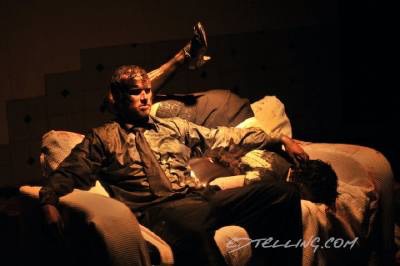
photos from ‘Gush’ by Ed Telling
to be continued…