The cafe, situated on a main road, gets its fair share of passing citizens not currently carrying coin. The manager generally shoos them back onto the street but sometimes gives tea and a sandwich to one or two of them, even allowing them to wheel their battered and heavily laden trolleys in and set them beside their table. A young guy, pale and sullen, wanders in and starts moving from one table to the next, aggressively demanding of each patron that they give him a cigarette. He is ignored or politely rebuffed. The manager hasn’t noticed anything. Everybody at the tables is now watching with interest if they have been approached, with mild trepidation if their turn is to come. The guy approaches a man sitting on his own, reading the paper. This man tells the guy to go away. The guy brings his fists up threateningly. The man stands up and, in a pleasant almost friendly way, says “Come on then” and assumes a boxer’s stance. He’s a big man but he’s parodying the fighter pose by giving it an upright, Victorian quality. The cigaretteless guy is transformed. He backs off rapidly and start flailing his arms like a five year old in the playground trying to rain blows on a classmate. The big man playfully lurches forward, the manager moves in, the trembling youth is shown to the door. The big man smiles untriumphantly.
For the recent ‘Dining with Alice’ project I was asked by the director, who loves riddles, puzzles and jigsaws, to compose some riddles, in the Alician manner, for placing on the dining tables in order to divert the diners. I said I could do it if I didn’t have to come up with the answers. Deal.
Here they are, in the order in which they were written: And is there pie in these tall halls? If the raven is ravenous what of the otter? Whither the philanthrope? Of what packed lunch is this lost carton? What, in the name of crikey? Will Jack see Jill across the crowded platform? Does the clock still tick its deathless tock? What did the dodo? What has Peter got, three arms and fits in a paper bag? I have a full stop. What am I? What is this tall? My first is insane, my second incense. Am I? Is this the way to treat the Home Counties? Which well known ballroom begins with a polka? My first is incredible, my second in Cardiff. Is it? If the party of the first part parts, is the second party depressing? A man takes three years to paint a room. What kind of man is this? A girl and a boy climb a tree. Whom shall we inform? Is the wombat the female of bat or is this a rumour? Why does the pony trek? I am my brother and my sister. How is this possible? When is a jar not a jar? How many light bulbs does it take to change society? Is this the way to carry on? What is black and white and a camel? Why did the man eat regularly? Why did the condiment? Is an artist palatable? What is the difference between a concept and a catacomb? Why is the dog only visible from a considerable distance? Shall we take the air? Three men step into the road. Will they get there? I am surrounded by trees. Who am I? Is this strictly true or merely strict? Explain. When will whatever will be be? I have two arms, a personality, and some pets. What more could I want? The rich man has it in spades. The gardener shelters in the hut. What? If this is an answer then what is the question? A dog licks a man’s elbow. Here, boy? My car is in second and I am in pieces. What is it? Look! There! On the horizon! Is it a bird? Here today, gone fishing. Is that all there is? What is between a difference and the same again? When are the rough ready? What is the difference between a rope, a string, a cord, a fibre, a thread, a hawser, and a cabinet? What is the difference between a cord and a card? What is the difference between a kid and a cod? What paper is it that is widely discussed but never eaten? What is this that I am holding? Where is the station? A man sees a dagger before him. What day is it? What is the difference between Swedish and this? A three year old digs a hole. Under what circumstances is this permissible? What is that lives in a burrow, drives a car and eats blancmange?
The Alice of Lewis Carroll’s books would not be good company. She is pedantic, humourless, irritable and finds fools where others would find engaging eccentricity. It’s odd, then, that she is seen as an emblem of the liberated imagination as well as one who is endowed with fluent social skills. In the Sixties she should have been seen as ‘uptight’, yet was credited by Jefferson Airplane, in their stirring 1966 acid anthem ‘White Rabbit’, with being an intrepid psychonaut leading the children of emergent consumerism out of their conformist slumber:
And if you go chasing rabbits And you know you’re going to fall Tell them a hookah smoking caterpillar has given you the call Call Alice When she was just small
Carroll’s heroine is being confused with the spirit of the book in which she serves as an unenthusiastic navigator. While Alice certainly embodies Carroll’s antipathy to the stuffy formality of Victorian life, she lacks the playfulness and abandon with which she is commonly credited. The paradox that prompts this upbeat misreading may reside in the fact that the logic of many of the Wonderland characters is not actually nonsensical but excessively logical, to an absurd degree. This is not the same as their being wild, wacky or anarchic but seems to have been taken as evidence of such a condition.
The purportedly trippiest, most psychedelic encounter in ‘Alice in Wonderland’ is between Alice and the Caterpillar. The latter smokes a hookah pipe and is seated on a mushroom – that’s got to be trippy, right? Probably wrong. The Caterpillar asks plodding questions and says nothing that is at all wise or excitingly unwise. The only direct advice he gives is ‘Keep your temper’, hardly a siren call from the healing maelstrom that is imagined to lie beyond sense.
Alice is constantly shifted across the line so that she becomes an eager participant rather than a small and conventional girl who falls down a hole by accident and at best puts up with the mayhem she encounters down under. Somehow her characteristic consternation and vexation have been systematically overlooked, perhaps because readers take up the invitation to identify with her but do not share her antipathy to inflexible logic, which is seen as pleasing nonsense. Her own misgivings are ignored as the reader simply invents a surrogate who is more tolerant and adventurous.
Tenniel has much to answer for here, of course. He supplies Alice with expressions that could be said, at a pinch, to service his employer’s need for a sensible, level-headed girl yet simultaneously equips her with a range of highly ambiguous looks that may be read as debauched abstraction, cool and sophisticated disdain or ravenous impatience – all of which are qualities of the pleasure seeker rather than the bluestocking.
It is the artists who eroticise Alice, if only mildly, who make her an active participant rather than a spectator. This tendency is to be found in the images of another distinguished Alice illustrator, Mervyn Peake (published in 1946).
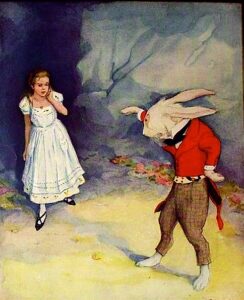
Rene Cloke, on the other hand, is unambiguously illustrating for children and presents images (published in 1944) of a passive child subjected to a mad situation in a way that emphasises her unworldliness and vulnerability rather than her appetite for immersion.
Perhaps those illustrators who saw the books as charming fantasies gravitated towards depicting the child as captured by the events around her while those who sensed a darker psychology beneath the fantastical surface would produce an Alice who was the generator of her own dreams, one who would embrace rather than resist her imaginings. It could be argued, however, that if we have dreams because we do not wish to know about our darker selves then Carroll was merely being psychologically realistic when he made Alice so tentative and sceptical.
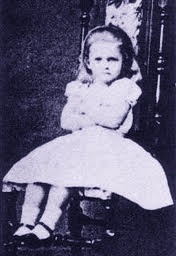
The main problem with Alice is the darkness. It’s not as if this were a recently concocted and Freudianised 20th century difficulty. A key contemporary of Carroll unhesitatingly treated his ‘Wonderland’ text as if it were a tissue of whimsy concealing a substantial and threatening shadowland. Less than two years after Carroll’s ‘golden afternoon’ spent in a boat with Alice Liddell and her sisters, on the 4th of July 1862, the writer was extending the text transcribed from the original storytelling as part of its preparation for publication. He had supplied a number of his own illustrations but was advised to seek a professional draughtsman. The Punch cartoonist and caricaturist John Tenniel was approached to illustrate the work, which was executed in 1865. Carroll sent the illustrator a photograph not of Alice Liddell but another child, Mary Hilton Badcock. Tenniel refused to work with any model however, and, in Carroll’s words, ‘drew several pictures of “Alice” entirely out of proportion – head decidedly too large and feet decidedly too small.’
Tenniel’s distinctive sense of proportion was not confined to his renderings of the dreamchild. The cartoonist stripped the language of dream of its sunshine and imposed the shifty, shifting, scratchy and shadowy crosshatch that would unsettle nursery-dwellers for the next century and a half. Sloughs of febrile gloom and maniacal despond provide the dark ground upon which Carroll’s’s lighter fancy comes to rest, profiting greatly from the interplay with its shadow, so insistently conjured by the illustrator.
But is the darkness actually there? Without Tenniel would the tales not be delightful blossoms of absurdity no more taxing than the drift of a rowing boat along the upper reaches of the Thames? The short answer is that the tales are bristling with invitations to explore the abyssal depths but these latter are consistently overlooked in favour of jolliness. Tenniel reversed this trend, reacting as though a surface sweetness was to be expected then brusquely swept aside.
Notwithstanding the purportedly ‘factual’ yet debatable view that Carroll’s preoccupation with pre-pubescent girls constituted a perversion, this possibility was not the one so firmly taken up by Tenniel. It is more likely that the illustrator recognised, in the subterranean location and disjointed narratives of Wonderland, a territory that was not just quaintly engaging but psychologically rich and therefore deserving of the imagery of nightdream rather than daydream. Some decades later the Surrealists would come to a similar conclusion.
The invitation to the land of light, child-pleasing enchantment has been declined on a small number of occasions in the course of the history of the adaptation and illustration of ‘Alice’. In 1985 Gavin Millar directed ‘Dreamchild’, a film about Alice Liddell’s relationship with Carroll/Dodgson. The screenplay, by Dennis Potter, focused on the reminiscences and insights of 80 year old Alice Hargreaves, née Liddell, as she travelled to New York in 1932 to attend Carroll’s centenary celebrations. The film moves between Alice’s American experiences of being a celebrity, her recollections of her intense friendship with the author of the Alice books and hallucinated encounters with the creatures from the stories. The latter are fine examples of cable-control puppeteering, a pre-animatronic technology, constructed by Jim Henson’s Creature Shop and featuring the Gryphon, the Mock Turtle, the Mad Hatter, the Dormouse, the Caterpillar, and the March Hare. The creatures are crabby, shrill and unkempt. Those with teeth have yellowed fangs and those with skin have livid, blotchy skin.
The lack of whimsy in the film is, more importantly, not restricted to those denizens of Wonderland who are ordinarily portrayed as wacky and cuddlesome. As Alice finds her long forgotten or suppressed memories of Carroll returning, the film dares to raise, quite tastefully, the possibility that Carroll was passionately in love with Alice Liddell. Ian Holm’s portrayal of Dodgson/Carroll elicits our sympathy with the author and helps us to be reassured that his inclinations were in some sense ‘innocent’ and never actually enacted. The film moves beyond this widely held view, however, when it examines the impact on young Alice, as recalled by the octogenarian Mrs Hargreaves, who is seen to be haunted if not permanently marked by the experience of her girlhood exposure to the pressure of an adult’s amorous attentions.
The marquees have been taken down and the grass can get its breath back after a month’s coverage. The trestle tables for communal meals at Production Village have been folded up. The trucks are hauling the generators out of the grounds. The contractors are craning the pontoon units out of the lake. The plug has been pulled on the mobile walk-in fridge. The bridge over the ditch has been removed. Over 140 cast and crew have gone home. The girls who played the five Alices are already back at school. The show retreats to boxes and hangers and shelves but we have some very good reviews to boast about, particularly here, here and here.
Also some handsome photos here. (You can find the site but the snaps have vanished. (Ed.)
In the course of extending the script of ‘Dining with Alice’ I was also entrusted with maintaining a blog called ‘Ruminations’ on Artichoke’s dedicated but now extinct Alice site. Now that the show is over, some of the less production-specific posts from that site have been imported to this one.

 The cafe, situated on a main road, gets its fair share of passing citizens not currently carrying coin. The manager generally shoos them back onto the street but sometimes gives tea and a sandwich to one or two of them, even allowing them to wheel their battered and heavily laden trolleys in and set them beside their table. A young guy, pale and sullen, wanders in and starts moving from one table to the next, aggressively demanding of each patron that they give him a cigarette. He is ignored or politely rebuffed. The manager hasn’t noticed anything. Everybody at the tables is now watching with interest if they have been approached, with mild trepidation if their turn is to come. The guy approaches a man sitting on his own, reading the paper. This man tells the guy to go away. The guy brings his fists up threateningly. The man stands up and, in a pleasant almost friendly way, says “Come on then” and assumes a boxer’s stance. He’s a big man but he’s parodying the fighter pose by giving it an upright, Victorian quality. The cigaretteless guy is transformed. He backs off rapidly and start flailing his arms like a five year old in the playground trying to rain blows on a classmate. The big man playfully lurches forward, the manager moves in, the trembling youth is shown to the door. The big man smiles untriumphantly.