Yearning At Both Ends

dunkirk.jpg

The over-rated ‘Atonement’ features a cumbersome episode on the beaches of Dunkirk. Had the episode been excised before shooting then the movie would immediately have become a low-budget costumer. As it was, a large proportion of the inhabitants of Redcar got to stand on the beach dressed as Tommies waiting for boats and Joe Wright, the director, was able to stage a complicated exercise in logistics that probably qualifies him and Seamus McGarvey, the Director of Photography, as safe pairs of Hollywood hands.

Directing a war scene is possibly as demanding as directing a battle but the hotels are better. On the basis of a long, ambitious, logistically challenging scene that makes its point in two minutes, Wright’s hotels can only get more splendid.

There’s much to be said about ‘Atonement’ – the woodenness of Knightley, the cleanliness of the costumes, the televisualness of the non-battle scenes – that I don’t want to get into. The battle scene, though, put me in mind of a very different film: ‘Le Grand Meaulnes’ (‘The Wanderer’, also ‘The Lost Domain’) made in 1967 by Jean-Gabriel Albicocco. Based on the eponymous Alain-Fournier novel (1913), it

follows the book’s account of 17 year old Augustin Meaulnes, a newcomer to a village school in the Sologne district in the Loire Valley. Big Meaulnes, much admired by his younger school fellows, goes missing for three nights. When he returns, he tells an extraordinary story.

Meaulnes had got lost in the countryside and wandered into the grounds of a mysterious country house where a grand and magical engagement party was being prepared. Passing himself off as a guest he met Yvonne de Galais, the sister of Frantz, for whom the party was being held. Meaulnes was transfixed by Yvonne’s beauty and when he returned home, vowed to see her again. Despite searching obsessively he was never able to find the house – the lost domain – and spent much of the rest of his life pining for the woman he had only met for a few minutes.

Albicocco’s cinematic rendition of the country house fete is extraordinary. Shot through heavily vaselined lenses, Meaulnes is seen weaving from one dreamlike setting to another, encountering rooms hung with lanterns and swathes of brocaded cloth, through which a gambolling Pierrot leads crowds of revellers in fancy dress. Compared to the drab flatlands in which Meaulnes lives, the place is almost unbearably exotic and comes to represent all that is unrecoverable about experience. The novel and the movie both set benchmarks for the melancholic, elegiac celebration of nostalgia and lost youth.

alain-fournier.jpg
Alain-Fournier 1888-1914

‘Le Grand Meaulnes’ counterpoints an expressionistic – albeit dated (a little vaseline goes quite a long way) – film style with the restrained, naturalistic palette used for the scenes of school life, searching and yearning. The film is, in fact, a masterpiece of yearning and manages to give this doomed and solitary practice a good name. The most talked about episode in ‘Atonement’, however – the epic Dunkirk beach scene – is, in addition to being almost superfluous to the film’s concerns, a covert vehicle for a far less attractive yearning.

The Dunkirk section is shot through with so much carnivalesque romance that it made me want to dash to the seaside in an itchy outfit and die among the ferris wheels, grand abandoned hotels, beached boats and battered bandstands. I would ride on the back of a long tracking shot through the superb carnage, dying frequently, waking up time and time again with my tragic Tommy muckers, hoisting foaming, pillaged tankards with blind and half-blind ordinary heroes, shooting stallions regretfully, howling, weeping and laughing at the sheer heck of it all and adjusting my scarf. Tapped on the shoulder by a curious passerby I would declare “Yes, this is what I have yearned for and only now have I found it!”
“And what’s that, dear?”
“What men want, old lady! A ferris wheel turning as my dreams of democracy collapse only to be revived by community singing! The nobility of having one leg! The admirable servility of the Cockney soldier towards his betters reduced only slightly yet quite understandably in times of extreme privation! In fact, yes – the closeness of men, the openness of wounds, the fun of hell, the hell of heck, the death of death, the picturesque, the picturesque!”

I’m sorry. I became over-excited.

13.09.2007

Behind the Pav

Newsnight: the closing credits: Pavarotti sings from ‘Tosca’ as images unfold of British soldiers in Iraq. Suddenly all is beautiful. Bare-chested, muscular, tattooed young soldiers against sand. Grunts dash thru storm of sand. Tanks bang in plumes of sand. How blind we were! All that was needed was the voice of the late Pav and lo – the poetry of war is suddenly apparent! War: where higher feelings go to hear music.

07.09.2007

Tip Top Condition

In late 1973 Hilary Westlake and I were commissioned to supply in-foyer diversions for a Henry Cow concert at London’s Rainbow Theatre, then a major rock venue. A few days later we used elements from the foyer in a show called ‘Tip Top Condition’ – Lumiere & Son’s first theatrical production – at the Rotterdam Science Fiction Festival in ’74. I wrote about its genesis in our Tenth Anniversary brochure, produced in 1983:
“The directors were excited by the success of their first project (the Rainbow event) and decided to seek funds to pay the wages of a small company of actors. A luminary of the rock and roll world who had schooled with David Gale was approached (actually, he went to a nearby school – Ed.), and after a frank and uncomplicated discussion £1,500 was generously donated to the cause of experimental theatre with no strings attached. We also applied to the Arts Council Drama Panel and were surprised to be promptly awarded £750 (in those days you could take a woman out for a fine dinner, hail a cab to the railway station and weigh yourselves and still have change from a pound – Ed.)

Whilst discussing the implications of our good fortune a few days later, we received a phone call from Rotterdam. The director of the De Lantaren Theatre was organising a Science Fiction Festival and had heard about our barely formed theatre company from a Time Out theatre writer (John Ashford CBE, now Director of The Place Theatre – Ed.) Were we doing anything concerned with Science Fiction or Space at the moment? Within seconds an important lie was told and a verbal contract for a week’s work in eight days time had been agreed. The directors now had the rest of the afternoon to cast actors for Lumiere & Son’s first European tour. By supper time the best of the actors from the Rainbow had been persuaded to sell their services for £15 a week gross. (see ‘fine dinner’ reference above – Ed.)

After supper the directors found stark terror to be a most effective lubricant of the imagination and devised a quantity of exercises for a workshop to be held the next day in the lounge of David Gale’s house. Over the next three days Hilary Westlake encouraged the group to evolve a selection of stylised body movements based on the deliberate exaggeration of the members’ own most visible mannerisms. Our intention was to present ourselves as a group of aliens who were anxious to pass themselves off as Earth-people by imitating Earthly behaviour. The audience would perceive that the aliens were getting their imitations badly wrong, which would provoke mirth within a Science Fiction context.”

Disingenuous as it may seem publicly to profess an interest in one’s own artistic development, I have to interrupt this 24 year old account of a 34 year old show in order to note the writer’s (my) enduring preoccupation with social transactions as performance rather than unprepared reciprocation. Not a novel stance, to be sure, but one that kicked off in the 70s as an expression of personal experience and has gradually, it seems to me, come to serve as an analysis applicable to a broad section of contemporary social life. The steady osmosis of theatrical values into that life has absorbed me greatly. The comic impersonations of ‘TipTop Condition’, in that respect, are not so very far from the complications of identity evident in my last show, ‘Vanity Play’ (2007).

But that’s enough about me – let’s see what you think of this extract from my show business memoir…

“Our Dutch host had asked us to perform vignette-like events in various corners of his theatre buidling, so we prepared a vocabulary of activities from which we would select items appropriate to each futuristic cranny. During rehearsal a number of decisions were made on costume. We wished to avoid what we felt were the banalities of fictional space-wear, and therefore designed costumes based on found and altered second-hand clothing that was clearly contemporary yet had an eccentric and awkward quality that did not stray into the dubious area of the ‘wacky’.”

The ‘look’ of early Lumiere & Son shows was strongly influenced by the presence among its actors of a recent graduate from Leeds Art College called Rose English. Rose was six feet tall and had a highly distinctive dress sense supported by her regular and forensic inspections of jumble sales and junk shops. Her personal style was reflected in the drawings, designs, found objects and garments she produced for the company and for the first few years our costumes, props and programmes all bore her elegant and thoroughly idiosyncratic mark. Our interest in a ‘contemporary timeless’ visual quality was not merely complemented but considerably extended by Rose’s unique take on performance. In later years Rose English, of course, went on (and continues) to produce a remarkable succession of increasingly large scale works, some of which featured horses, dogs and children.

“We were surprised on arriving in the foyer of De Lantaren to see Lumiere & Son billed to perform their play at 8.30pm the following evening. We had no play in our possession at that time, and a ripple of panic lightly disguised as weak giggling ran through the band of international travellers grouped around the notice board. After supper Hilary took all the separate components of our ‘event’ and joined them together into a ‘play’. The next morning this play was rehearsed for a few hours and was found to be 40 minutes long. Surely this was unpardonably short? Our Dutch host passed through the auditorium, nodding approvingly at our dedication and apologised for failing to mention earlier that our show could not be longer than 40 minutes. We thanked him and said this was perfectly in order.

That evening the play ‘Tip Top Condition’ opened to the space connoissuers of Rotterdam and was warmly received. Our host was delighted because we were one of the few groups whose work had a genuine Sci Fi theme – it seemed that a number of less scrupulous organisations had merely brought along their current show and recostumed it in silver lurex tights!” (What do you have to say about that, Natural Theatre of Bath? –Ed.)

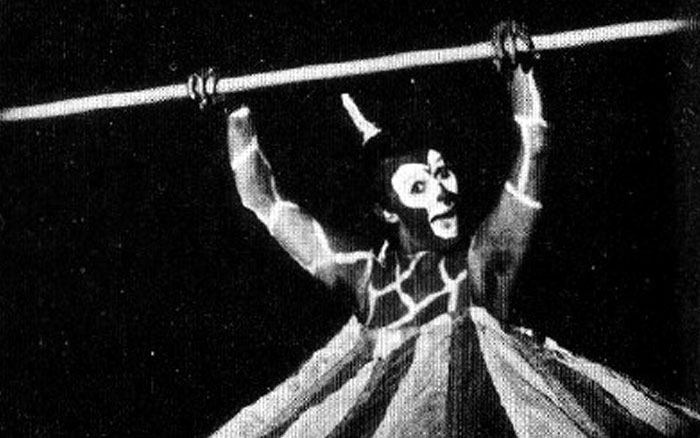
A major physical element of the hastily composed show was a large white and orange silk parachute, equipped with shoulder straps and worn as a long, billowing dress by Hilary. When the hem of the parachute was grasped around its perimeter by the cast of six we discovered that it could be raised above our heads and brought firmly down to the floor as we ducked under. The silk would fill with air, creating a giant striped hemisphere beneath which we placed lights that made the costume glow, revealing our own shadows beneath it. Hilary’s hair was bound around a foot-long stick to make a vertical tuft, her face was whitened and her arms were decorated with giraffe markings, a make-up technique patented within the company and featuring the application of Sellotape in five sided shapes to the bare skin of the performer.

It took about twenty minutes to giraffe the naked body of an alien visitor: after the tape had been applied, dark brown make-up was sponged on. When it had dried, the tape was peeled off, to the accompaniment of shouting. The performers then donned their costumes over their new mottling and, when on stage, sweated profusely in an intensely physical show. Somehow the make-up stayed intact. The climax of the performance found the aliens creeping out from beneath the mother chute, having cast off their earthling outifts, their giraffing apparent to all.

“‘Tip Top Condition’ further consolidated areas of style and content that we felt were central to an emerging notion of what ‘our theatre’ was about. The use of disciplined exaggeration, the development of a ‘Lumiere & Son look’, and an atmospheric use of lighting were further additions to a repertoire of devices which we were becoming confident of using well.

Back in London we savoured our continental success and resolved to make further offers to our actors in order that we might start putting together our first full-length play. The verbal content of ‘Tip Top’ had totalled some eight lines and the directors felt that the next production should expand in the writing department and also involve a fuller use of set and properties than our hand-luggage oriented sci-fi entertainment.”

‘Tip Top Condition’ was one of the few shows that Lumiere & Son kept in repertoire. Its structure was modular: the aliens demonstrate their grasp of greeting, eating, washing, sex, fighting and other basics, interspersed with long periods of ‘line work’ in which they rock to and fro and from side to side in line abreast unison, impelled by piercing shrieks and cries from the parachuted giantess. It was possible to train up new performers in a day and have them out front shortly thereafter. I loved performing in the show – its prerequisites of a maniacal fixed grin, much hair cream and eruptive clowning more or less reflected the palette of my own ‘acting’ skills and kept me extremely fit. Modesty does not quite prevent me from disclosing that I believe I was the first in the cast to perfect the ‘accidentally placing the shoed foot in the plastic bowl of soapy water then affecting to fall over backwards thereby propelling the water into the front rows of the audience’ gag.

04.09.2007

Back to Work

I asked an osteopath friend what had been the most significant developments in his 25 year career as a respected practitioner and teacher. His reply was immediate and emphatic. He said that it is now widely accepted that 60-70% of all muscular and skeletal pain in the back and neck is psychological in origin. He said that in surveys, researchers had approached asymptomatic people – those not presenting symptoms of pain. Scans of the back and neck revealed that while a quarter demonstrated disc damage, they were not experiencing difficulty or discomfort. Conversely, patients presenting with back or neck symptoms can often show no spinal damage. It was suggested that psychological and psychosocial factors play an important role in the level of pain that individuals experience. These factors seem to be even more important than mechanical factors. Psychological wellbeing can enable individuals to function more comfortably.

My friend said that dramatic bone-cracking, while sometimes satisfying to the patient, was no longer considered useful. He said that he now saw patients once or twice only rather than setting up a protracted programme of visits. He said that people who exercise regularly feel less pain, period. As for the type of exercise, extensive surveys had not established the superiority of any type of exercise – the best exercise is the type that the patient likes doing best. It could be tennis, it could be swimming, it could be walking, it could be yoga.

He said that surveys had not established any connection between the increase in symptoms of lower back pain and sedentary occupations. Office workers, for example, do not experience more back pain than more active workers. It has been found that the most significant cause of back pain in office workers is insufficient social and psychological support in the office.

02.09.2007

Matt & Tom

Watching the largely entertaining “The Bourne Ultimatum”, in which Matt Damon starts running over the credits and continues to do so for 111 minutes, it struck me that, despite what we are being told about a supersurveillant society and the patriotism of the rogue but wronged agent pursued by a corrupt national agency, the movie’s most relevant message is expressed in its unremitting pace. We are presented with a surface that is ultimately more eloquent and important than its own embedded, anxious examination of allegiance. It’s a polished visual poem foregrounding an efficient thriller narrative as a means of delivering a manically edited and sound-scored piece of impressionism concerned with the quality of everyday life in a society defined, engulfed and oppressed by speed. Within the terms of the movie, speed is what you need to evade the zero-reaction time surveillance prosthetics that can be effortlessly turned against you. Outside the cinema it’s the speed at which choices and options are unceasingly renewed within the consumerdome, outstripping comprehension and inducing existential panic and breathlessness.

Thinking of Matt made me think of Tom, insofar as an aspect of his current work offers another sort of arresting surface phenomenon, this time at odds with its pretensions to substance.

There’s a scene in Tom Stoppard’s most recent play “Rock’n’Roll” (2006) which, in its untypical ingenuousness, undermines the notion of the orderly ‘play of ideas’ that the playwright’s work is held to exemplify. Set in the Cambridge garden of the Marxist philosopher Max Morrow, the scene features the busy preparation, dishing out and consumption of an al fresco lunch. Several characters are on stage and a lot of the bustling ‘business’ consists of the naturalistic enactment of ordinary tasks such as laying the table, passing plates from one guest to another and so forth. Dialogue between the characters is maintained throughout.

Despite the ongoing development and refining of ‘ideas’ implicit in the interplay of various ideologically differentiated figures, the scene’s most powerful effect, for this viewer, was its depiction, at the level of image, pace and tone rather than verbal content and plot, of middle class manners. If the scene had been an episode in a contemporary visual theatre production it is possible that the dialogue would have been cut completely, given the eloquence of the movement and setting. If cutting the dialogue seems drastic then it could have been replaced with ‘meaningless chatter’ in order to reduce its obtrusiveness. Had these modifications been applied, however, a set of meanings parodying the play’s own artistry would have emerged.

It is not the case that the play can be described as a multi-layered unity whose physical, imagistic and designed aspects support and complement, as a matter of course, the character relationships and their articulation of political and historical positions. While Stoppard is obviously concerned to comment upon the academic middle class milieu in which the Marxist professor moves, this is not a particularly trenchant operation. The bourgeoisification is not condemned so much as wryly noted. It is incidental to the play’s central arguments. As a result, the surface of the play, in parts, is out of control. Either the playwright or the director, or both, have taken their eye off the ball.

The meanings which the scene conveys are inadvertently made. The overriding effect is one of demonstration rather than explication. The latter function is relatively sophisticated, the former quite primitive. The scene is being performed to an audience that is either familiar with the chatty al fresco luncheon or aspires to its production. It would be at its most eloquent when received by those whose sense of middle class entitlement is tenuous. It provides reassurance much in the same way that a parade of soldiers or circus folk or lifeboatmen demonstrates the style and comportment and therefore the basic nature of these groups. In a parade notions like ‘basic nature’ are unproblematic. Parades are extremely formalised and have the power of rituals rather than stories. They do not present subtleties so much as components of a kit.

The meal scene in “Rock’n’Roll” presents a kit of middle class components. These are arranged in such a way that their primitiveness is obscured with the conventional theatrical artistry of narrative, character, the unfolding of themes and so forth. The main function of the scene is, however, to demonstrate and to celebrate, in a congratulatory manner, what it is to be middle class. This is not subtle but it is profound, like the May Day ‘Obby ‘Oss celebrations in Padstow or the annual Bacup Coconut Dance. In the midst of an earnest theatrical examination of the contradictions of communism the trappings abruptly fall away and the value of the weekly, monthly or whatever custom known as Going to the West End becomes apparent, revivifying and consolidating the community and offering handy hints on style, tone and tempo to the uncertain. It’s not just “This is how you pass a plate” it’s “When you pass a plate this is the level of entitlement, attentiveness, poise, personation, sociability, worldliness and muscle tone that is appropriate.” You need decent actors to do such a demo properly but you don’t really need a sophisticated story or psychologically complex characters – anything that obscures the ritual aspect will suffice.

If “Rock’n’Roll” discreetly presents the theatregoing classes with an Owner’s Manual while distracting them with ‘ideas’, “The Bourne Ultimatum” is less unwitting and hands the viewer a surface that abstracts plot concerns while making them more timely.

28/08/2007