The Next Big Thing

The animation in Pixar’s ‘Wall-E’ is exceptional. The detail is more, rather than less, than the eye can absorb and the rendering of distressed, battered and grubby surfaces parallels the scuffed production design that distinguished the ‘Alien’ movies when they first came out. The film’s director, Andrew Stanton, has said “Life is nothing but imperfection and the computer likes perfection, so we spent probably 90% of our time putting in all of the imperfections, whether it’s in the design of something or just the unconscious stuff. How the camera lens works in [a real] housing is never perfect, and we tried to put those imperfections [into the virtual camera] so that everything looks like you’re in familiar [live-action] territory.”


Disney used to do detail, albeit not particularly grubbily. (He wasn’t averse to dust, though – see cottage-cleaning scenes in ‘Snow White and the Seven Dwarfs’ (1937). Dirt is probably okay if its removal can be ideologised.)

By the ’50s shadow detail and foreground texturing was on the wane – ‘Cinderella’ (1950) is going the way of the greetings card and bland, athleticised Aryanisation is taking over the depiction of faces and bodies.

After a partial return to form with ‘Peter Pan’ (1953), it was downhill to ‘Lady and the Tramp’ (1955) and subsequent decades of giftwrap art.

In 1991 Disney did a three picture deal with Pixar, the first fruit of which was the three-dimensionalised and instantly successful ‘Toy Story’ (1995). Although the business relationships between the companies have changed over the years (a good outline of that here) Pixar’s CGI has returned Disney to its role as administrator of the portal to the corporate virtual.

It seems extraordinary, in retrospect, that Disney missed the boat back in the ’50s. While virtual reality technologies were not even a twinkle in Ivan Sutherland‘s eye at this time, the projects of engulfment and immersion of the clientele by means of screen-based enchantment were not exactly a footnote on Walt’s agenda. It must have been abundantly clear that deeper immersion was the ticket to ride but what we got was depth collapse.

The prospect of exerting social control by dissemination of the imagery of bodies defined by competitive sports seems to have been more attractive to the corporation. The equation, within the cartoon product, of the fairytale prince with the high school footballer and the princess with the tireless laundress of his nobly soiled garments produced not only a generic facial rendition but set standards for reduced affect in acting that are still being honed today.

American Stranger, in the post ‘Rational Actors’, fingers George Lucas’ ‘The Phantom Menace’ as a prime example of the new botox-face-and-monotone-delivery school of synthespianism and contends that it can be seen in more and more movies. He observes that it’s not the actors themselves who are responsible for this absenteeism:
‘I challenge anyone to hold its performances up to those of the critically acclaimed The Dark Knight, and, excluding Heath Ledger for the moment, say what the difference is. There’s the same vacuity, the same open invitation to allegory. One has to assume they’re told to act this way, since both films are full of actors with proven talent. All that’s purchased are their names and faces (I wonder if that’s in the contract). They inhabit their parts with all the smoothness of an automaton, a styleless mode of performance apparently designed for easy exchange with animated versions, comic book images, videogame avatars, concepts.’
Pixar itself has no truck with this kind of eviscerated acting in its use of character voicing, and many animations, particularly short kids’ cartoons, tend to the hypermanic in the vocal department. If, however, one posits post-Golden Age Disney animations as a precursor to the current out to lunch acting style identified by American Stranger, then one can go on to observe that the vocalising in these films has, obviously, arisen as a response to a graphic genericising of the male and female figures that populate the work. Current zombie acting may mark a return from the manic avidities fuelled by headlong consumption (as seen, for example, in foam-flecked Jack Nicholson acting styles) to a need for a style that is not, say, coolly and cruelly connoisseurial in the James Bond manner but more suited to withstanding an overwhelming battering. If acting styles are taken as a form of recommendation, what are the extreme circumstances on the horizon that might be most effectively countered with stupor and dissociation?

27.08.2008


In the Bosom of Roy

Prior to writing the script hereunder, performed at Wimbledon College of Art in January 2008, I ventilated here my thoughts on Theatre at the End of the World and here an account of aspects of the preparation of the piece. Clearly the world had not ended subsequent to the publication of the earlier post. More recently I wrote an introduction to the play here.

(a Note (2019): If pressed I would concede that the text hereunder, in which I strove to defeat story-telling at every turn, is hard to follow at times. A pre-occupation with identical twins, played either by the same actor or by two actors who do not remotely resemble each other, has resulted in this postdramatic vehicle intermittently sailing quite close to the coast of opacity.

Completists may wish to be advised that this is the first version of ‘In the  Bosom of Roy’. It was, as usual, written in three days for a subsequent two day rehearsal and a single in-house performance in the Theatre at the Wimbledon College of Arts. (2024)

Scene 1
THE SET HAS SIX DOORS MOUNTED IN A WIDE BOX SET. THE BACK WALL HAS FOUR DOORS IN A ROW WHILE AT EITHER END, AT RIGHT ANGLES TO THE BACK WALL, MOUNTED IN THE SIDE WALL, IS ANOTHER DOOR. BETWEEN THE DOORS ARE WALL PANELS. THE DOWNSTAGE SPACE IN FRONT OF THE BACK WALL IS SHALLOW – A FAIRLY NARROW CORRIDOR RUNS BETWEEN THE FRONT ROW OF THE AUDIENCE AND THE SET.
Music: Couperin: Le Charme

ROGER AND BETTY ENTER
ROGER Betty, would you get me some bread?
BETTY Of course I will. Are you hungry?
BETTY EXITS
ROGER What?
BRIEF PAUSE
ENTER WENDY WITH SOME BREAD
WENDY Here we are.
SHE HANDS ROGER THE BREAD
ROGER Thanks, Betty.
WENDY So, wow!
ROGER What have I been up to?
WENDY And me!
ROGER EXITS
MUSIC ENDS

Music: O.S.I.R.I.S. – Oneness with the Universe @ 3mins 30secs
THE FIRST 30 SECONDS OF THE TRACK (HEAVY POUNDING TRANCE) IS PLAYED THEN ABRUPTLY CUT.
AS THE MUSIC PLAYS WENDY DANCES TO IT AND STOPS WHEN IT STOPS.
ENTER BETTY.
THE FIRST 30 SECONDS OF THE TRACK IS PLAYED AGAIN THEN ABRUPTLY CUT.
AS THE MUSIC PLAYS BETTY DANCES TO IT AND STOPS WHEN IT STOPS.
ENTER ROGER.
THE FIRST 30 SECONDS OF THE TRACK IS PLAYED THEN ABRUPTLY CUT.
AS THE MUSIC PLAYS ROGER DANCES TO IT AND STOPS WHEN IT STOPS.
THE CAST EXITS.

Scene 3
THROUGHOUT THE ENSUING DIALOGUE SEQUENCE MUSIC IS PLAYED.
Music: Corelli: Concerto da Chiesa No 8 in G minor
THE VOLUME OF THE MUSIC IS SUCH THAT THE DIALOGUE CANNOT BE HEARD.
ROGER AND WENDY ENTER.
A MOMENT LATER BETTY ENTERS.
WENDY SCREAMS IN DELIGHT AND HUGS BETTY. IT IS AS IF BETTY IS RETURNING AFTER A LONG TIME AWAY. ROGER TOO IS DELIGHTED AND HUGS BETTY. THEY EACH TAKE ONE OF BETTY’S HANDS AND EXCITEDLY WALK UP AND DOWN WITH HER.
THEY TALK (INAUDIBLY) NINETEEN TO THE DOZEN.
THEY ARE VITAL AND ENCHANTING. THEY TOUCH EACH OTHER AFFECTIONATELY FROM TIME TO TIME.
THIS IS WHAT THEY ARE SAYING:
BETTY Now it’s all behind me! The places!
WENDY We thought…
ROGER The good things first!
BETTY The hill villages, the plage, the general feeling of groups of people very much in love struggling through on board ship.
WENDY We thought…
BETTY What did you think, darling?
ROGER I think we thought you’d…gone.
WENDY CHOKES BACK A TEAR.
BETTY Oh, Wendy!
WENDY Now we can really start.
ROGER Now that everything is over.
WENDY Tell us about the islands.
BETTY Some days soot and mud. Other days flowers.
ROGER Did it drive you mad?
BETTY I liked the variety. The problem was being followed all the time. Or feeling that.
WENDY Were you? Followed?
BETTY (LAUGHING GRIMLY) You’d see the boats out there. The people were hard to make out. Sometimes one of them would be washed ashore though. Then you’d see them. Bloated. Grinning through dead lips. Their spines torn out.
ROGER But you got away. You made it all the way back to Combray.
THE MUSIC STOPS ABRUPTLY.
BETTY I’d love a sweet biscuit now.
BETTY AND WENDY EXIT.

Scene 4
ROGER WALKS TO THE NOISY BOX (A LARGE, HOLLOW METAL STRUCTURE) AND LIES ON IT FACE DOWN. HE STARTS TO TREMBLE ALL OVER. HIS FEET KICK AT THE SURFACE OF THE BOX AND HIS ARMS JERK OUT FROM HIS SIDES. HE GETS OFF THE BOX.
ENTER WENDY.
SHE WALKS TO THE NOISY BOX AND LIES ON IT ON HER BACK. SHE STARTS TO TREMBLE AND UNDULATE, KICKING THE SURFACE OF THE BOX WITH HER HEELS. SHE GETS OFF THE BOX.
ENTER BETTY.
SHE MOUNTS THE NOISY BOX, LIES ON HER BACK AND HAS A GRAND MAL SEIZURE.

Scene 5
THIS SCENE IS REPEATED SEVERAL TIMES. ON EACH OCCASION IT TAKES PLACE IN ROGER’S OFFICE. HOWEVER, THE SET IS BUILT TO ACCOMMODATE 4 IDENTICAL OFFICES, ARRANGED SIDE BY SIDE, EACH WITH ITS OWN DOOR. THE SCENE WILL TAKE PLACE IN A DIFFERENT OFFICE EACH TIME IT IS REPEATED. WHEN AN OFFICE IS BEING USED, ITS DOOR IS LEFT OPEN SO THAT THE AUDIENCE CAN SEE ROGER AND ANGELA WITHIN. THE INTENTION IS TO SUGGEST THAT EACH OFFICE IS LOCATED IN A WORLD PARALLEL TO THE OTHERS.
ROGER IS AT HIS DESK AT MI5, WHERE SPYING IS DONE. SEATED BEFORE HIM IS BETTY.
ROGER We’re getting news of certain effects, Betty. It’s hard to know what sort of a box to put them in. Guinness thinks it’s a social sort of thing, sort of social breakdown. Stella tends to some kind of fracture in the fabric of reality. Whatever the bloody hell that means.
BETTY Reality is a language, Roger.
ROGER Really? I wish I bloody spoke it, then.
BETTY I’ve always considered you fluent.
ROGER How are the headaches?
BETTY Do you want to play doctors, Roger?
ROGER No, Wendy. I wanted to talk about your sister.
BETTY Wendy.
ROGER Yes.
BETTY I’m told we’re very alike.
ROGER I wouldn’t know. What interests me is that you’re physically identical. I’m going to need you to persuade her to work with us.
BETTY Shall I get her in?
ROGER If you would.
BETTY EXITS.
BETTY COMES RIGHT BACK IN AGAIN, THROUGH ANOTHER DOOR.
ROGER Wendy! How are you?
BETTY Very well, Roger. Nice place.
ROGER Keeps the rain off.
Music: O.S.I.R.I.S. – Oneness with the Universe @ 1min 37 secs. (THE CHILL PASSAGE)
WENDY ENTERS.
ROGER AND BETTY ENTER AND WATCH WENDY WITH INTEREST AS SHE DANCES TO THE CHILL PASSAGE AND ON INTO THE POUNDING @ 2min 11 secs UNTIL THE BREAK @ 2 mins 52 secs WHEN THE MUSIC IS ABRUPTLY CUT.
ROGER AND BETTY EXIT.

Scene 6
WENDY My brief was to go upriver, to the islands. I would be disguised as Betty and I would attempt to seduce Roger’s brother Roy, who had gone rogue. Apparently his penchant for sexual intercourse had led him into practices that verged almost on amateur surgery. Not unreasonably the islanders wanted something done. Roy, however, was a fractured, complex character with an intermittent grasp of reality. Roger, with whom I had briefly had intercourse some years ago, thought that Roy, who had been enamoured of my twin sister Betty more recently, could be made vulnerable were I to appear to hold out to him the possibility of getting his leg over. Unlike Betty, I have martial arts and, given the physical resemblance that some find uncanny, although it is, let’s be frank, only the standard monozygotic anomaly, could look after myself if Roy, once drawn, started to ‘have a laugh’, as he chillingly puts it.

Scene 7
IN THIS SCENE WE HEAR THE DIALOGUE THAT WAS RENDERED INAUDIBLE IN Scene 3.
BETTY ENTERS FAR STAGE LEFT.
ROGER AND WENDY ENTER FAR STAGE RIGHT.
WENDY SCREAMS IN DELIGHT AND HUGS BETTY. IT IS AS IF BETTY IS RETURNING AFTER A LONG TIME AWAY. ROGER TOO IS DELIGHTED AND HUGS BETTY. THEY EACH TAKE ONE OF BETTY’S HANDS AND EXCITEDLY WALK UP AND DOWN WITH HER.
THEY TALK NINETEEN TO THE DOZEN.
THEY ARE VITAL AND ENCHANTING. THEY TOUCH EACH OTHER AFFECTIONATELY FROM TIME TO TIME.
BETTY Now it’s all behind me! The places!
WENDY We thought…
ROGER The good things first!
BETTY The hill villages, the plage, the general feeling of groups of people very much in love struggling through on board ship.
WENDY We thought…
BETTY What did you think, darling?
ROGER I think we thought you’d gone…
WENDY CHOKES BACK A TEAR.
BETTY Oh, Wendy!
WENDY Now we can really start.
ROGER Now that everything is over.
WENDY Tell us about the islands.
BETTY Some days soot and mud. Other days flowers.
ROGER Did it drive you mad?
BETTY I liked the variety. The problem was being followed all the time. Or feeling that.
WENDY Were you? Followed?
BETTY (LAUGHING) You’d see the boats out there. The people were hard to make out. Sometimes one of them would be washed ashore though. Then you’d see them. Bloated. Grinning through dead lips. Their spines torn out.
ROGER But you got away. You made it all the way back to Combray.
BETTY I’d love a sweet biscuit now.
THE CAST EXITS.

Scene 8
Music: Roy Orbison: A Love So Beautiful.
UNTIL FURTHER NOTICE IN THE SCRIPT, A SHORT LOOP TAKEN FROM THE FIRST FEW SECONDS OF THE TRACK – THE ‘DRONING DRUM BEAT’ PART – WILL BE PLAYED ACROSS THE WHOLE OF THE FOLLOWING SCENE BUT NOT OVER LOUDLY.
THE SET, WITH ITS SEVERAL DOORS, IS NOW USED INTENSIVELY.

(Note: A farce is a comedy written for the stage or film which aims to entertain the audience by means of unlikely, extravagant and improbable situations, disguise and mistaken identity, verbal humour of varying degrees of sophistication, which may include sexual innuendo and word play, and a fast-paced plot whose speed usually increases, culminating in an ending which often involves an elaborate chase scene. Farce is also characterized by physical humour, the use of deliberate absurdity or nonsense, and broadly stylized performances.

As opposed to romantic comedies, farces usually do not utilise a traditional plot involving frustrated young lovers who eventually surmount all obstacles. Rather, they frequently focus on a transgression or on a character’s urge to hide something from the other characters, and the unforeseen chain reaction that results. In staged farce there is usually only one setting throughout the play, often one with numerous doors, such as a drawing room, hotel or hospital room or an office.)

THE ENSUING STAGE DIRECTIONS DESCRIBE A SERIES OF ACTIONS BUT DO NOT SPECIFY THE LOCATION OF THE ACTIONS – IN PARTICULAR THE DOORS THAT WILL BE USED FOR ENTRANCES AND EXITS. SUCH PARTICULARS WILL BE DETERMINED IN REHEARSAL.
CERTAIN PRINCIPLES OF IDENTITY WILL PERTAIN:
1. ROGER AND ROY ARE FREQUENTLY MISTAKEN FOR EACH OTHER.
2. BETTY AND WENDY ARE FREQUENTLY MISTAKEN FOR EACH OTHER.
IT MAY BE THAT ROGER AND ROY ARE DIFFERENTIATED IN SOME MODEST WAY, SUCH AS BY THE USE OF A HAT. IT MAY ALSO BE, HOWEVER, THAT THIS LEAVENS THE CONFUSION OF THE AUDIENCE TO A DEGREE THAT IS NOT CONDUCIVE TO CONSTRUCTIVE PERPLEXITY.

ENTER ROGER
ROGER Where is Roy?
ENTER WENDY
WENDY (SEEING ROGER) Roy!
ROGER (SEEING WENDY) Betty!
WENDY I still bathe in the milk of your admiration.
ROGER Where is Wendy?
ROGER EXITS
ENTER BETTY
BETTY Sis!
WENDY Don’t let Roy see you!
A KNOCK AT A DOOR
WENDY EXITS
ENTER ROGER
ROGER Wendy!
BETTY We had intercourse, Roger.
ROGER Good. Please be careful of Roy.
BETTY Has he gone ‘upriver’?
ROGER Considerably.
BETTY EXITS
ROGER So much horror.
BETTY ENTERS
ROGER Betty!
BETTY SCREAMS
ROGER AND BETTY EXIT, BY DIFFERENT DOORS
ENTER WENDY
WENDY Roy? Roy? It’s Betty!
ENTER BETTY
BETTY (SEEING WENDY) Wendy!
WENDY Let me handle this, Betty!
BETTY I’m afraid I shall mistake Roy for Roger and go all the way with him!
WENDY Betty! Rise above it ! Try to keep your pants on for once!
BETTY I melt even when I say his name!
WENDY Go! I am Betty now!
EXIT BETTY
ENTER ROGER
ROGER Wendy!
WENDY I am Betty!
ROGER God! it’s impossible to tell!
WENDY There are discernible differences of temperament.
ROGER I really love you then. The way a smile plays ironically yet vulnerably around your lips is very Betty.
WENDY That’s right.
ROGER And your sister – is she well?
A LOUD BANGING ON A DOOR
WENDY It’s Roy!
ROGER I’ll talk to him.
ROGER EXITS
ENTER BETTY
BETTY Wend!
WENDY Sis!
BETTY I’ve just been with Roger!
WENDY WHAT!? But…
BETTY He was so direct!
WENDY Are you sure? I mean, how did you know?
BETTY Well, the things you told me after you had had intercourse with him.
WENDY That was years ago!
BETTY Well, you can’t teach an old dog!
WENDY Bet, but what if…
BETTY Roy…?
WENDY Then..?
BETTY He squeezed my cheek.
WENDY In a nice way?
BETTY How do you tell?
A DOOR BURSTS OPEN REVEALING ROGER, HIS TROUSERS ROUND HIS ANKLES.

BETTY Roy!
WENDY Your belt!
ROGER We can’t be judged. It’s judgement that destroys us. I’ve seen so much, Betty.
BETTY &
WENDY (TOGETHER) Wendy.
ROGER I’ve seen men, moral men, men with great purity, full of love, men with families. Walking across towns, along the high streets, past the shops with their insulting wares, striding to the gates of the town, more men joining them, some of them shaved, some with the growth of days, some with full, flowing beards.
WENDY It’s you, Roy.
BETTY We need new standards of beauty, Roy. Let us stand under different flags.
ROGER When you speak it’s as if I had glimpsed the shadow world. Just beyond my reach but full of all the choices we could have made, all the people we could have been.
BETTY They are streaming through now, Roy. They see Illyria.
ROGER What’s that?
BETTY What you will, Roy.
WENDY Betty?
BETTY I’ve been there. Upriver. I stepped through. It was like a slash in the silk. As I pushed through it brushed against my cheek. You were there, Wendy. I thought you were me. But then I saw me.
ROGER There were two?
BETTY Three. I was there too, don’t forget.
WENDY Pull up your trousers, Roy.
ROGER PULLS UP HIS TROUSERS
BETTY In Illyria, Roy, is the man who didn’t pull up his trousers.
WENDY In Illyria are the sisters of all our thoughts.
BETTY Roger would love this.
ROGER But I am Roger.
BETTY &
WENDY (TOGETHER) What!?
ROGER My brother and I share ideals of purity, certainly, but where he is rogue I am of the people.
BETTY &
WENDY (TOGETHER, AGHAST) Roy!
THEY ALL DASH OUT.
AN EVEN LOUDER BANGING ON SEVERAL DOORS.
THE Music TRACK NOW STOPS LOOPING AND MOVES INTO THE REST OF THE ROY ORBISON SONG (c 3 mins 20 secs REMAINING).
AN EPISODE OF WORDLESS FARCE ENSUES (TO BE DETERMINED IN REHEARSAL): THE CHARACTERS HURTLE THROUGH DOORS, PAUSE TO POSE THEN HURTLE OUT. THEY ARE ALWAYS ENTERING A SPACE IN WHICH THEY ARE EXPOSED AND COMPROMISED. THEIR CLOTHING, AFTER THE MANNER OF 20thC BRITISH FARCE, WILL, WITH EACH SUCCESSIVE ENTRANCE, BE REDUCED. THE GENTLEMAN WILL LOSE HIS TIE, JACKET, SHIRT AND TROUSERS UNTIL HE IS CLAD ONLY IN HIS UNDERPANTS AND SHOES. THE LADIES WILL LOSE THEIR BLOUSES, DRESSES, SKIRTS AND SLIPS UNTIL THEY ARE CLAD ONLY IN BRAS, PANTS, SUSPENDERS AND STOCKINGS AND HEELS. ALL THIS WILL BE A SOURCE OF SHOCK AND EMBARRASSMENT TO THEM. SCREAMS WILL REGULARLY REND THE AIR. REACTIONS GENERALLY WILL BE TYPICAL OF THE ‘CARRY ON MISSIS’ SCHOOL OF ACTING.

THE EPISODE BUILDS UNTIL THE PANTED AND PANTING ROY FINDS HIMSELF ALONE ON STAGE. HE RUNS IN AND OUT OF THE DOORS DESPERATELY THEN FORLORNLY, FINALLY EMERGING WITH HIS CLOTHES CLASPED TO HIS GROIN AS HE WALKS THE WIDTH OF THE STAGE AND EXITS. THE MUSIC STOPS.

Scene 9
BACK AT MI5.
IN THIS SCENE ROGER’S OFFICE DOOR IS CLOSED. THE AUDIENCE CANNOT, THEREFORE, SEE THE CHARACTERS. THE VOICES OF THE LATTER, HOWEVER, CAN BE HEARD FROM BACKSTAGE.
WENDY How did Roy go?
ROGER He was noisy. Kicked a lot.
BETTY And Illyria?
ROGER Closed it down. And not without a struggle, I might add.
WENDY What did it entail?
ROGER It was a question of directness. Not deciding to do something without actually doing it, thereby avoiding the creation of a universe in which that thought – the one you didn’t act on – was acted on.
BETTY Please don’t, Roger. I find it all faintly psychotic.
WENDY Betty – what if..?
BETTY Roger! Your brother wanted to kill you, didn’t he?
ROGER I’m afraid he did.
WENDY He wanted a world in which you had never existed!
THE WOMEN LOOK AT EACH OTHER IN HORROR AS IT SLOWLY DAWNS ON THEM THAT THEY ARE IN ROY’S WORLD NOW. THEY SCREAM.
BETTY & WENDY Roy!
IN A FRANKLY REMARKABLE PIECE OF STAGE SPECIAL EFFECTS THE TWO WOMEN BURST EXPLOSIVELY RIGHT THROUGH THE PANEL WALLS OF THE SET, FROM BACKSTAGE TO DOWNSTAGE.
AS SOON AS THEIR FEET TOUCH THE GROUND, Music CRASHES IN: Beds Are Burning – Novaspace (from 50″) (SAMPLE LYRICS: How can we dance when our earth is turning? / How do we sleep when our beds are burning? ) (HEFTY POUNDING WITH A DASH OF BARN DANCE). MOMENTS LATER ROY BLASTS THROUGH THE CENTRE PANEL OF THE SET, LANDING BETWEEN BETTY AND WENDY, WHO ARE ALREADY DANCING, WITH GLASSY SMILES.
ROY QUICKLY REALISES THAT HE HAS LANDED IN A DANCE NUMBER AND STARTS TO EXECUTE THE QUITE DEMANDING ‘DICK VAN DYKE COCKNEY CAPER’ MOVES.
THIS ALL FADES, IN EVERY WAY.
End


David Gale
Archway/Avignon/Bute 2007

Leaving It All Behind

The text below is extracted from a stab I made at an autobiography. The writing of this page-turner initially went well, right up to the point where I realised that merely describing the many fascinating things that had happened to one was not quite the same as producing a structured work that had a point and was going somewhere. I retired the project until I felt I could return to the partial draft with a more insistent shaping impulse.

The excerpt hereunder follows some material on my youthful visits to my father’s laboratory, where I was allowed to play with very sensitive scales that could weigh thousandths of a gram. My father was enchanted by the microscopic – he worked on antibiotics for much of his career – and my own daydreaming was sometimes taken up with fantasising about just how light something would be before it became unweighable and undetectable. When I got to my teens, entered the 60s and encountered the sudden onslaught of ‘spiritual ideas’ that characterised the period, I found that my thoughts about atoms, weights, traces and vapours fitted, perhaps eccentrically, into the whirl of ideas about spirit, essences, auras and rays. I also found amusement in imagining detection technologies that would operate at a miscroscopic level and tie atoms to their owners.

This piece isn’t strictly about rays but it does deal with traces that are so slight that they verge on the immateriality of rays.

26.08.2008

When I was 18 and taking for granted the eccentric wisdoms I had distilled from my early encounters with science, my Uncle Geraint, from the Welsh side, an affable slacker and Bohemian, told me something that acted as a counterpoint to my preoccupation with weights, measures and contamination. He told me – it being the sixties by then – that the Buddha leaves no traces. I knew what he meant, or I thought I did. He meant that persons of a particular spiritual weight made no waves. That such a person did not invest his presence in one, he wished to make no impression, consequently, when the guy is gone, it’s like ‘Who?’

In 1963, after they had hoisted the mail bags, the Great Train Robbers repaired to Leatherslade Farm until the heat died down. The cops found the farm, but not until the robbers had fled. The robbers left their fingerprints behind, however, and eventually these would tie many of them to the crime. As soon as I read about the fingerprints I started ruminating and have been doing so ever since.

You see, if I had been chief robber Bruce Reynolds I would, first of all, have lined my fellow robbers up in the barn and delivered a lecture on the perils of the trace. I would have instructed them to exercise a degree of care unprecedented in their criminal lives. Men, I would have announced, let me not even bother my fucking head with comments on fingerprints. Any of you leaves his dab (I revert here to the argot of the 1950s British black and white caper) is frankly a cunt. What we need to get fucking straight is the rest of it: the body as snail, the body that leaves its mark, even when you’ve washed the fucker. A constant hail of dermal flakes, sometimes seen against the sun then mistaken for dancing motes that give substance to a pleasing aura-like effect. Sodden with telltale DNA [anachronistically I fold contemporary forensics into the scene here, much as I do in my private ruminations], they combine with the soft downpour of desiccated sebum routinely dislodged by the most straightforward movements of the most meticulously medicated head of groomed and glossy hair. You walk across the room, Ronnie, you’re an absolute shower! (While alerting Biggs to the whirling fallout of his own biodust I simultaneously evoke Terry-Thomas in the Boulting Brothers’ ‘Private’s Progress’ and ‘I’m Alright Jack’.) You are sitting, Buster, on a tractor, studying the horizon for telltale signs and smoking a Woodbine. Bits of your lip and spit are on the fucking end you prat! Next you bite a pippin to freshen your mouth well bugger me your teeth have carved out their negatives in the flesh of the core you toerag! These can be remodelled in plaster of paris you daft slag!

I continue to adduce examples that frankly astonish and unsettle the robbers. Satisfied that they are now both contrite and all ears I instruct them to wear silk or surgical gloves (whichever is the more practical) at all times, together with fitted plastic shower-hat-like caps and overshoes with elasticated anklets. If they wish to stretch their arms, ruffle their hair, change their clothes, expectorate or clean out their noses they must do so at night, in a field, downwind of the farmhouse so that their flakes don’t simply blow straight back in again.

What I do not tell them is that thirty years later, in the involuted scheme of my imagining, they’re bang to rights just by the act of passage. Thermal signatures, penetrative scans, digital noses – this stuff tracks so tight it has to get a smart-talking lawyer to reduce a charge of buggery to one of following too close.

Men, I could have said, frankly none of this obsessive shit is worth worrying about. There’s nothing you can do about it. We are all trash trailers. Start littering now.

The Buddha proposition left its grease on me. My uncle made his proclamation ten years after I had first pondered exudates but it served to bring symmetry to one of my abiding occultisms. Buddha’s example neatly capped my thoughts about leakage and enabled me to formulate a modest logical chain:
We all leave skidmarks. So you can’t get away with anything because you’ll always be traced. Furthermore, nobody likes a skidmark, that’s why they leave them behind. So your traces are tell-tale, they’re the worst thing about you. But if you are cool, you don’t leave skidmarks. And people can’t get you. And they like you.

But Buddha, and I’m guessing here, didn’t care if people liked him. On the other hand, with due respect where respect is due, we have to say that nobody likes a person who leaves no marks – what’s to like? Do you say “What a great guy – so very little there”? Of course not. So you do need to leave something, but something not too greasy.

We can see Buddha in a garden or something:

People – Hey, Gautama, how are you?
Buddha – It’s of no consequence.
People – But, you know, are you well?
Buddha – I don’t see it like that.
People – Oh.
Buddha – I must go.
Buddha goes.
People – Fascinating man.
Other People – He doesn’t care, does he?
People – I’m sorry?

William Burroughs wrote about this in ‘Naked Lunch’. Instead of Buddha it was junkies. Junkies, Bill said, could sit all day in a cafe, dunking pound cake (I never knew what pound cake was) and you would not see them. They repelled attention. When they left you would not notice they had gone. It could be inferred therefrom that young people wishing to savour Buddha consciousness might try heroin. As far as one can tell the reduction of affect can be relied upon and the concomitant ecstatic disconnection is guaranteed.

I found a book in a charity shop called ‘Invisibility – Mastering the Art of Vanishing’ by Steve Richards. Steve goes on about the Rosicrucians and the Qabalah and Madame Blavatsky and so forth. Basically what you do is conjure the cloud. It is summoned from the invisible and it obscures the vision of others. In some circles it is identified with ectoplasm and may be exuded by those who are ready, willing and able. The book is not entirely ponderous – Steve relates a story of Bulwer Lytton, whose Rosicrucian novel ‘Zanoni’ is apparently Harry Potter for the mature credulous. Convinced that he had mastered invisibility, Lord Lytton strode through a gathering of guests in his dressing-gown then returned later, splendidly attired, greeting his visitors as if for the first time. It was observed in the course of the test run that Lytton was observed.

I was pleased to come upon the book because it fitted neatly into the research I was doing for my novel. In this neglected work, Jack, a wide boy, discovers that he is able to rob houses by cultivating drastically reduced affect. So unremarkable does he make himself that he can saunter through his victim’s lounge while his victim is present and wholly conscious. Jack was inspired to this audacity by the spectacle of a homeless person pissing in the High Street while others studiously ignored him.

Elsewhere in my novel I described an apparatus that would unerringly find things. All you had to do was tune it to your requirement. Its prime application was in the locating of flesh, whose molecular templates were lodged within the device and served a calibrating function. Once the thing was activated it would sweep moors and beep when buried bodies were underfoot. The days of tracelessness were over, I think I wanted to say.

I wanted the best of both worlds, of course. To dwell in the invisible yet be admired for my prominence. I had no wish to disappear like the benighted creatures in Christopher Priest’s novel ‘The Glamour’, who spent their nights living wretchedly in the bedding sections of department stores, uncouth and unseen, their self esteem so thoroughly extinguished that they could hold the attention of no-one.

Tip Top Condition

In late 1973 Hilary Westlake and I were commissioned to supply in-foyer diversions for a Henry Cow concert at London’s Rainbow Theatre, then a major rock venue. A few days later we used elements from the foyer in a show called ‘Tip Top Condition’ – Lumiere & Son’s first theatrical production – at the Rotterdam Science Fiction Festival in ’74. I wrote about its genesis in our Tenth Anniversary brochure, produced in 1983:
“The directors were excited by the success of their first project (the Rainbow event) and decided to seek funds to pay the wages of a small company of actors. A luminary of the rock and roll world who had schooled with David Gale was approached (actually, he went to a nearby school – Ed.), and after a frank and uncomplicated discussion £1,500 was generously donated to the cause of experimental theatre with no strings attached. We also applied to the Arts Council Drama Panel and were surprised to be promptly awarded £750 (in those days you could take a woman out for a fine dinner, hail a cab to the railway station and weigh yourselves and still have change from a pound – Ed.)

Whilst discussing the implications of our good fortune a few days later, we received a phone call from Rotterdam. The director of De Lantaren Theatre was organising a Science Fiction Festival and had heard about our barely formed theatre company from a Time Out theatre writer (John Ashford CBE, later to be Director of The Place Theatre 1986-2009 – Ed.) Were we doing anything concerned with Science Fiction or Space at the moment? Within seconds an important lie was told and a verbal contract for a week’s work in eight days time had been agreed. The directors now had the rest of the afternoon to cast actors for Lumiere & Son’s first European tour. By supper time the best of the actors from the Rainbow had been persuaded to sell their services for £15 a week gross. (see ‘fine dinner’ reference above – Ed.)

After supper the directors found stark terror to be a most effective lubricant of the imagination and devised a quantity of exercises for a workshop to be held the next day in the lounge of David Gale’s house. Over the next three days Hilary Westlake encouraged the group to evolve a selection of stylised body movements based on the deliberate exaggeration of the members’ own most visible mannerisms. Our intention was to present ourselves as a group of aliens who were anxious to pass themselves off as Earth-people by imitating Earthly behaviour. The audience would perceive that the aliens were getting their imitations badly wrong, which would provoke mirth within a Science Fiction context.”

Disingenuous as it may seem publicly to profess an interest in one’s own artistic development, I have to interrupt this 24 year old account of a 34 year old show (at the time of revising this page (2019) the account is now 36 years old and the show itself is 45 years old – Ed.) in order to note the writer’s (my) enduring preoccupation with social transactions as performance rather than unprepared reciprocation. Not a novel stance, to be sure, but one that kicked off in the 70s as an expression of personal experience and has gradually, it seems to me, come to serve as an analysis applicable to a broad section of contemporary social life. The steady osmosis of theatrical values into that life has absorbed me greatly. The comic impersonations of ‘TipTop Condition’, in that respect, are not so very far from the complications of identity evident in my show, ‘Vanity Play’ (2007).

But that’s enough about me – let’s see what you think of my show business memoir…

“Our Dutch host had asked us to perform vignette-like events in various corners of his theatre building, so we prepared a vocabulary of activities from which we would select items appropriate to each futuristic cranny. During rehearsal a number of decisions were made on costume. We wished to avoid what we felt were the banalities of fictional space-wear, and therefore designed costumes based on found and altered second-hand clothing that was clearly contemporary yet had an eccentric and awkward quality that did not stray into the dubious area of the ‘wacky’.”

The ‘look’ of early Lumiere & Son shows was strongly influenced by the presence among its actors of a recent graduate from Leeds Art College called Rose English. Rose was six feet tall and had a highly distinctive dress sense supported by her regular and forensic inspections of jumble sales and junk shops (or ‘charity shops’ as they are now known). Her personal style was reflected in the drawings, designs, found objects and garments she produced for the company and for the first few years our costumes, props and programmes all bore her elegant and thoroughly idiosyncratic mark. Our interest in a ‘contemporary timeless’ visual quality was not merely complemented but considerably extended by Rose’s unique take on performance. In later years Rose English, of course, went on (and continues) to produce a remarkable succession of increasingly large scale works, some of which featured horses, dogs and children.

“We were surprised on arriving in the foyer of De Lantaren to see Lumiere & Son billed to perform their play at 8.30pm the following evening. We had no play in our possession at that time, and a ripple of panic lightly disguised as weak giggling ran through the band of international travellers grouped around the notice board. After supper Hilary took all the separate components of our ‘event’ and joined them together into a ‘play’. The next morning this play was rehearsed for a few hours and was found to be 40 minutes long. Surely this was unpardonably short? Our Dutch host passed through the auditorium, nodding approvingly at our dedication and apologised for failing to mention earlier that our show could not be longer than 40 minutes. We thanked him and said this was perfectly in order.

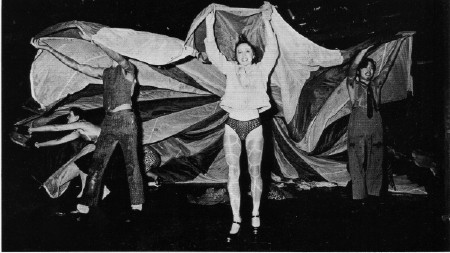
That evening the play ‘Tip Top Condition’ opened to the space connoisseurs of Rotterdam and was warmly received. Our host was delighted because we were one of the few groups whose work had a genuine Sci Fi theme – it seemed that a number of less scrupulous organisations had merely brought along their current show and recostumed it in silver lurex tights!” (You know who you are, Natural Theatre of Bath – Ed.) A major physical element of the hastily composed show was a large white and orange silk parachute, equipped with shoulder straps and worn as a long, billowing dress by Hilary.

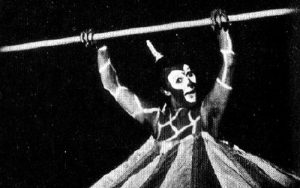
When the hem of the parachute was grasped around its perimeter by the cast of six we discovered that it could be raised above our heads and brought firmly down to the floor as we ducked under. The silk would fill with air, creating a giant striped hemisphere beneath which we placed lights that made the costume glow, revealing our own shadows beneath it. Hilary’s hair was bound around a foot-long stick to make a vertical tuft, her face was whitened and her arms were decorated with giraffe markings, a make-up technique patented within the company and featuring the application of Sellotape in five sided shapes to the bare skin of the performer

It took about twenty minutes to giraffe the naked body of an alien visitor: after the tape had been applied, dark brown make-up was sponged on. When it had dried, the tape was peeled off, to the accompaniment of shouting. The performers then donned their costumes over their new mottling and, when on stage, sweated profusely in an intensely physical show. Somehow the make-up stayed intact. The climax of the performance found the aliens creeping out from beneath the mother chute, having cast off their earthling outifts, their giraffing apparent to all.

‘Tip Top Condition’ further consolidated areas of style and content that we felt were central to an emerging notion of what ‘our theatre’ was about. The use of disciplined exaggeration, the development of a ‘Lumiere & Son look’, and an atmospheric use of lighting were further additions to a repertoire of devices which we were becoming confident of using well.

Back in London we savoured our continental success and resolved to make further offers to our actors in order that we might start putting together our first full-length play. The verbal content of ‘Tip Top’ had totalled some eight lines and the directors felt that the next production should expand in the writing department and also involve a fuller use of set and properties than our hand-luggage oriented sci-fi entertainment.”

‘Tip Top Condition’ was one of the few shows that Lumiere & Son kept in repertoire. Its structure was modular: the aliens demonstrate their grasp of greeting, eating, washing, sex, fighting and other basics, interspersed with long periods of ‘line work’ in which they rock to and fro and from side to side in line abreast unison, impelled by piercing shrieks and cries from the parachuted giantess. It was possible to train up new performers in a day and have them out front shortly thereafter. I loved performing in the show – its prerequisites of a maniacal fixed grin, much hair cream and eruptive clowning more or less reflected the palette of my own ‘acting’ skills and kept me extremely fit. Modesty does not quite prevent me from disclosing that I believe I was the first in the cast to perfect the ‘accidentally placing the shoed foot in the plastic bowl of soapy water then affecting to fall over backwards thereby propelling the water into the front rows of the audience’ gag.

Excerpted from a 1983 L&S brochure, first blogged 2007, updated 2019

Popeye

This playlet is an adaptation of certain aspects of King Lear, written in 2003 for theatre design students at Wimbledon College of Art.

(It was the first time  I had ‘adapted’ a Shakespeare text for WCA)

(see introduction to this script here and here)

Some of the characters have been renamed. Delia is Cordelia, one of Lear’s daughters. Lear’s other daughters, Regan and Goneril, are not renamed. Kenny is the Earl of Kent, Lear’s friend. Bodmin is the Duke of Cornwall, Regan’s cold-blooded husband. Eddy is Edmund, the illegitimate son of the Earl of Gloucester.

The scenes are separated with an excerpt (at 3:27 – 3:53) from  ‘Elastica Presents Maximizing the Audience / with Jesus Elices’ (Gatecrasher Digital Meltdown CD02 Track 08) played at full volume. The track can be heard here:
https://www.youtube.com/watch?v=tg0ENWagdU0


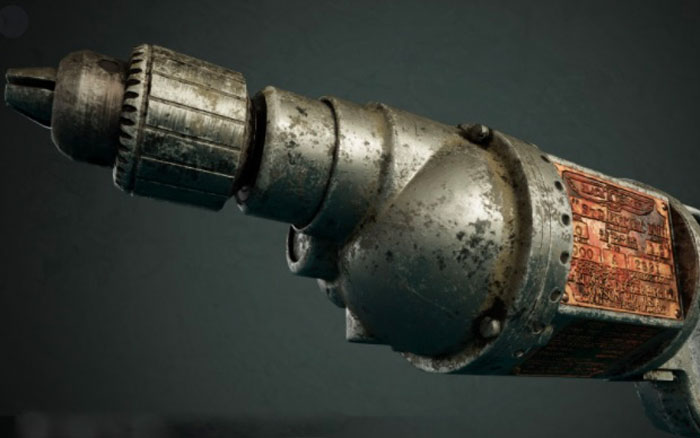
Properties required: 1 Power Drill (cordless), 1 white cord for binding hands, 2 wine glasses containing cranberry juice or similar, 1 pair of sunglasses (male).

Music 1
GLOUCESTER The old guy hasn’t got a clue. Stumbling about all night, shocking weather, no coat on. And those girls, they’re just, what can you say, I mean, they’re animals. They’re only going to kill him, aren’t they? So I took him, well I got Kenny to, down to Dover. We’ve got some Frogs there that are well handy, they’re looking after that Delia and they’re getting mobbed up. He’ll be all right with them. I just need to watch my own back.

Music 2
REGAN We’ll do him.
GONERIL We’ll drill him.
REGAN We won’t kill him
GONERIL No. Drilling without filling. Bare nerves. Very nervy.
REGAN He’s a scamp.
GONERIL He’s a tyke.
REGAN We’ll give him another mouth.
GONERIL He can eat twice as fast.
REGAN We’ll get Eddy on it.
GONERIL Eddy! Get on it!
EDMUND What do I do?
GONERIL Popeye.
EDMUND Where is he?
REGAN This is it.
EDMUND I’ll find him.
REGAN You will.
GONERIL Very much so.

Music 3
EDMUND Popeye. I got him.
REGAN You did.
GONERIL (TO GLOUCESTER) What a scamp you are.
REGAN We’re going to drill you.
GONERIL Give you another mouth.
REGAN You can play the bugle and eat spaghetti at the same time.
GONERIL That’s handy.
GLOUCESTER You’re being silly.
EDMUND Be polite.
GLOUCESTER What’s the excitement? We’re round mine.
REGAN Make him shut up, Eddy.
EDMUND His hands are tied.
HE BINDS GLOUCESTER
This is so you don’t hurt yourself.
GONERIL A lot of people put their hands in the way.
REGAN Holes in the hands. You don’t want that.
EDMUND Do you want that?
GLOUCESTER We’re round mine. You’re out of order.
REGAN You sent Grandad off with the Frogs.
GLOUCESTER He’s at the seaside. Fresh air.
REGAN The seaside? You were told, you were told…
EDMUND Why the seaside, Popeye? Tell me that.
GLOUCESTER He’s a poor old boy. Losing it fast. He’d been up all night. No mac. No brolly. Shocking weather. I took pity. More than you would.
GONERIL Shut it, Popeye.
GLOUCESTER Don’t call me that.
GONERIL We’re taking you to the dentist.
REGAN The Beast of Bodmin. My old man.
EDMUND No need to open wide. No need to open. We’ll make our own way in.

Music 4
GLOUCESTER’S CHEEK IS DRILLED. SCREAMING

Music 5
REGAN Your own Dad, Eddy.
EDMUND Went wrong though, didn’t it?
GONERIL How’s that?
EDMUND Bodmin. Got a puncture.
REGAN So I’m avaliable.
EDMUND Not sad then?
REGAN Not that sad.
GONERIL You’re the Duke of Earl, Eddy.
EDMUND Earl of Duke, if you don’t mind.
REGAN Anyway, when you’re passing, Eddy…
GONERIL Drop in.

Music 6
GLOUCESTER You don’t look to anyone. You don’t ask for anything. If a kid sees a pigeon, he stamps on it. What do you expect? He stamps on it. What do you want? It’s a bit of fun.

Music 7
GONERIL Eddy – go back to Bodmin. Help him get mobbed up. As for me, my old man, the Albanian as I call him, he’s gone Nancy. He’ll be getting hot flushes next. Still, he won’t be around for ever, will he? Give us a kiss before you go.
SHE KISSES EDMUND
That’s just a sample.
EDMUND I’ll be off then.
GONERIL I expect you will.
EXIT EDMUND
Hard all over. I like that. Why did I marry a poof?

Music 8
REGAN Now I’m really avaliable. Bodmin took a single. Lovely man but, you know, are you gonna live in the past? Now Eddy – he’s something else. The eye language, I have to say, has been exceptional. My sister, a slag basically, seems to think, and this is getting on my wick, that she’s right in there. Not for long.

Music 9
EDMUND The Albanian, as I call him, is such a div. Can’t keep his eye on the ball.
REGAN My sister married a sissy. But you quite fancy her, don’t you, Eddy?
EDMUND Only in a nice way.
REGAN You haven’t been in there then?
EDMUND Don’t be silly!
REGAN I’m sure you’ve dipped your stick, Ed.
EDMUND What you talking about?
REGAN That would really irritate me, Eddy. I could see myself getting upset.
EDMUND Well I haven’t. Bloody hell.
REGAN Keep it in your pants.
EDMUND Bloody hell.
EXIT REGAN
EDMUND I have to say: you’re all right here, my son. Spoilt for choice, frankly. They’re gagging for it. Mind you, if I was to go with Mrs Bodmin that’d really piss her sister off. But the Albanian is still around so it wouldn’t be too clever to go with Sis either. Still, the Albanian reckons he’s well hard – we’ll put him on the front line against the Frogs and see what pops up. Perhaps I could have them both. A three-up! Exceptional!

Music 10
GONERIL Eddy did well. Him and the Albanian saw the Frogs off.
ENTER REGAN
REGAN Eddy got Grampa off the Frogs.
GONERIL And divvy Delia.
ENTER EDMUND
REGAN Nice one, Eddy. Who’s got’em now?
EDMUND They’re banged up. The Albanian’s going to take a look tomorrow.
GONERIL How long’s that going to take?
EDMUND Don’t worry about it. I know the people there. They’ll be looked after.
GONERIL How’s my nancy husband?
EDMUND Chuffed. He said I was like a brother to him.
REGAN That’s not up to him. That was my mob you took to the Frogs – so I’m the one to say who you’re up there with.
GONERIL (TO REGAN) He can do that for himself – he doesn’t need you to tell him where he’s at.
REGAN He’s as good as they come. Aren’t you, Eddy?
EDMUND If you say so.
GONERIL (SARCASTICALLY) Why don’t you propose to him?
REGAN What do you think I am? Bodmin’s still warm.
GONERIL (CONTEMPTUOUSLY) Propose to him tomorrow then.
REGAN How are you, Eddy?
EDMUND Can’t complain.
GONERIL Got everything you want?
EDMUND I wouldn’t say that.

Music 11
GONERIL OFFERS REGAN A DRINK
GONERIL Cheers. He’s a lovely bloke.
REGAN Cheers. Yeah. No hard feelings then.
GONERIL You’re my sister.
(REGAN CHOKES, GAGS, SCREAMS, WRITHES, KICKS, ROARS, DIES.)
I did warn her. I said ‘Back off’. I was crystal clear. And what did she do? Tits out for the lads! She’s a slag. Was.

Music 12
EDMUND (IN GREAT PAIN) My own brother! Family! Just because I got the strop with our Dad. I mean, you’d think your own brother…A masonry bit! He used a masonry bit! That’s got to be wrong, hasn’t it? They’re for brick…
HE STAGGERS, FALLS, DIES.

Music 13
GONERIL IS HOLDING A POWER DRILL
GONERIL I did wrong. There’s no two ways about it.
SHE PLACES THE DRILL ON THE GROUND, BIT UPPERMOST AND TURNS IT ON.
Bye bye Dad. Bye bye Delia. You’ll be better off with me out of it.
SHE POSITIONS HERSELF BY THE DRILL SO THAT SHE CAN FALL ON IT AND KILL HERSELF.
BLACKOUT.
SOUND OF BODY FALLING TO THE FLOOR.
SCREAMS.

Music 14
GLOUCESTER’S CHEEK IS HEAVILY SCARRED BUT HEALED. HE IS WEARING SHADES.
GLOUCESTER Kenny’s back. The Albanian’s on side. Little Eddy shows promise. And I can’t see a bleeding thing. Secondary infection. The quack said I’m lucky. He said with gangrene like that you could have lost your brain, not just your eyes. So I’m lucky. I don’t feel lucky.
BLACKOUT.
Music 15

Finish.

2003