Peachy: Ad: 31.01.08

Dear Friends
next Thursday January 31st at 7.30 pm sees the launch of the first of my Peachy Coochy Nites in the Bar at Toynbee Studios. Tickets £5.00
more details + map here:
http://www.artsadmin.co.uk/projects/project.php?id=211
David Gale’s Peachy Coochy Nites
Just a projector and 20 images. Just 20 seconds per image. During those 20 seconds the Presenter talks about the image. So simple. So precise. So demanding. This is the Peachy Coochy Way.
David Gale, ever keen to launch a nationwide performance must-have, is to curate a series of Peachy Coochy events at ArtsAdmin’s new, stylish yet reassuring Bar. Each event features five Coocheurs, or Presenters, drawn from many walks of life. Each Coocheur will compose a verbal response to 20 images of their choice. The images need not be narratively linked but randomness is frowned upon. Thematic associations are embraced. Each presentation lasts 6 minutes and 40 seconds. There will be gaps between presentations for drinking and light conversation.
It might be that a typical Peachy Coochy event contains contributions from, say, a reliable yet inevitably narcissistic performer, a lepidopterist, a nun, a surgeon, a robber. We shall see. I can’t wait, personally.
David Gale, something of a Black Belt in these matters, will both compere and present in the course of the novel and fabulous evening.
We have five Coocheurs, including myself, lined up. I have no idea what the others will do.
Please come along, if only to be able to say “I was there when David launched a popular art’n’ entertainment form that toppled karaoke.”
Some of you, pleased by the first Nite, may wish to compose your own presentations. See me afterwards.
all the best
David

Peachy Coochy: the Kick Off

David Gale’s Peachy Coochy Nites kicked off on Thursday, 21st January 2008. It was held in the new bar in what was then ArtsAdmin’s recently refurbished Toynbee Studios. I wrote the following for the host’s website:

Just a projector and 20 images. Just 20 seconds per image. During those 20 seconds the Presenter talks about the image. So simple. So precise. So demanding. This is the Peachy Coochy Way.

David Gale, ever keen to launch a nationwide performance must-have, is to curate a series of Peachy Coochy events at ArtsAdmin’s new, stylish yet reassuring Bar. Each event features five Coochers, or Presenters, drawn from many walks of life. Each Coocher will compose a verbal response to 20 images of their choice. The images need not be narratively linked but randomness is frowned upon. Thematic associations are embraced. Each presentation lasts 6 minutes and 40 seconds. There will be gaps between presentations for drinking and light conversation.

It might be that a typical Peachy Coochy event contains contributions from, say, a reliable yet inevitably narcissistic performer, a lepidopterist, a nun, a surgeon, a robber. We shall see. I can’t wait, personally.
David Gale, something of a Black Belt in these matters, will both compere and present in the course of the novel and fabulous evening.

After presenting a few Peachy evenings I found that I was referring to the presenters as ‘coocheurs’ rather than ‘coochers’. I felt that this added something rather exotic and sophisticated to the events. Then I found out what ‘coucheur’ meant in French.

I built up a mailing list and sent out a monthly announcement. Some of these ads are individually linked below. Each ad contains chunks of repeated, basic info that can be skipped.

After a few gigs The Guardian came to visit and ran this.

Commercial

This is one of the images printed on stout card for the Dash Dash Dash flyers then placed around in places where people who like that sort of thing go.

The flyer, carded, with deets.


Hinting at the tempestuous, an image used  for Dash Dash Dash programmes.

The Tempest in situ. Programme for Ep 2 of Dash Dash Dash the Series.


22.10.2009

Dash Dash Dash

Underway: the early stages of a seven month long programme of short plays to be written, produced and presented at the rate of one a month, culminating in an omnibus edition in the seventh month.

Dash Dash Dash will open at the Battersea Arts Centre in London on October 15th. I will write a 25 minute play, direct it, open it, watch it then write another one. I will do this six times. The plays will stand alone, they will not be episodes in a serial but when joined together they will be greater than the sum of their parts. (Their parts will be okay too.)

In an earlier post, ‘I, Healer‘, I suggested that theatre performance composed in an incoherent language might be suitable for the depiction of an incoherent world. When narrative in the real world comes to be viewed with the suspicion that it’s a cover-up of some sort, the alternatives are stark: nostalgic reversal or the homeopathic dose. While the strategy of the dilute dose is risible in its ‘medical’ context, there is something to be said for its application to the business of artistic representation. Just what might it constitute? A paradox begins to arise wherein we find ourselves effortlessly edging towards naturalism and mimesis again: the depiction of disorder by a vocabulary of disorder.

If all is disordered then the disordered depiction of it amounts to naturalism. Or it does if all that is to be presented is the appearance of disorder. If a vocabulary of disorder is employed then it will, by definition, be framed within an aesthetic of disorder – this is the language of the action movie or a play about war or tempestuous marriage. It will be perfectly recognisable. On the other hand, if a disordered vocabulary is used then there might be a chance.

The problem is that it’s seething, pervasive disorder that requires attention rather than the intermittent disruption of otherwise serviceable narratives. The current panoramic disorder is not there to be faithfully reproduced. It compels a reassessment of the means whereby it is to be represented. The imposition, for example, of narrative onto such fracture and confusion seems at best rather sweet and at worst forlornly misjudged.

Audiences are not gagging for these hot new fragments and fractures of which we speak. The unassailable popularity of bonneted drama and humiliating competitions on the television suggests, in both cases, that a subterranean current of hysteria is a must-have component of contemporary cultural consumption. Were the conventions of the bonnet and the rules of the competitions dissolved then the hystericised mechanisms beneath would be revealed and, presumably, found irresistible. In my dreams.

The avant-gardes have been here before, of course. In 1961, Martin Esslin in his book ‘The Theatre of the Absurd’ wrote about a new sort of theatre that he had identified: ‘If a good play must have a cleverly constructed story, these have no story or plot to speak of; if a good play is judged by subtlety of characterisation and motivation, these are often without recognisable characters and present the audience with almost mechanical puppets; if a good play has to have a fully explained theme, which is neatly exposed and finally solved, these often have neither a beginning or an end; if a good play is to hold the mirror up to nature and portray the manner and mannerisms of the age in finely observed sketches, these seem often to be reflections of dreams and nightmares; if a good play relies on witty repartee and pointed dialogue, these often consist of incoherent babblings.’

Esslin indicts the usual suspects in his analysis: the decline of religion, the collapse of faith in ‘progress, nationalism, and various totalitarian fallacies’ in the aftermath of the Second World War. He quotes Camus: ‘A world that can be explained by reasoning, however faulty, is a familiar world. But in a universe that is suddenly deprived of illusions and of light, man feels a stranger. His is an irremediable exile, because he is deprived of memories of a lost homeland as much as he lacks the hope of a promised land to come. This divorce between man and his life, the actor and his setting, truly constitutes the feeling of Absurdity.’

Almost forty years later, in 1999, Hans-Thies Lehmann published ‘Postdramatic Theatre’, seen in some circles as framing the theatrical products of our new century as convincingly as Esslin had for postwar drama up to the 60s. Among the many characteristics of the new theatre that Lehmann examines is a decentring of the text, wherein it is no longer the sole determinant of the expressive elements around it. He also comments on the intermittent, deliberate suspension of the closed fictive world of the performance that allows some element of ‘the real’ to break into the experience.

In the Dash Dash Dash shows I shall attempt to carry on the good work by insisting that six short shows, unrelated in terms of narrative, setting, milieu, pace, tone or style can somehow constitute the parts of a whole. We’ll see.

03.09.2009

Fairy Liquidity

In her book ‘Strange and Secret Peoples – Fairies and Victorian Consciousness’ (1999) Carole G. Silver titles her last chapter ‘Farewell to the Fairies’ and in it states ‘The fairies have been leaving England since the fourteenth century…but despite their perpetual farewells they had not completely vanished from Great Britain by the 1920s, and, some argue, they have not yet left.’ Silver submits a variety of explanations, offered throughout the 19th and early 20th century, for the fairies’ departure. William Sharp, for example, (writing as Fiona Macleod) in the 1890s, wrote ‘the Gentle People have no longer a life (in) common with our own. They have gone beyond grey unvisited hills. They dwell in far islands perhaps where the rains of Heaven and the foam of the sea guard their fading secrecies.’ Another view implicates humans directly: ‘They’re not dead. They think we are. They do not change.’ Also blamed were orthodox religion, materialism, urbanisation, pollution and technology. ‘Thus,’ Silver writes, ‘the fairies decide to emigrate, to leave behind a sterile kingdom of riches without content and power without greatness.’

Moving to the late 20th century, Silver notes that ‘science fiction has transmuted fairies to the small green men from outer space.’ She refers to Edmund Little’s suggestion (in ‘The Fantasts’ (1984)) that ‘the world of faerie industrialised and rendered technological becomes the realm of science fiction’ then observes that ‘contemporary UFOlogists argue that the fairies really are the little green men – alien creatures from outer space who have come to join us.’

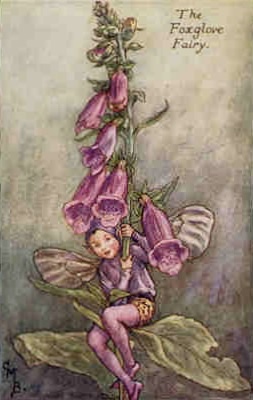
While fairy stories or magical fantasy for children, in book form and CGI adaptation, present a picture of rude health, it would seem, at first glance, that adults have moved on. Fairies are just not tough enough. A closer look, however, persuasively supported by the book ‘Meet Mr Product’ – trailed below – makes it clear that, having disconsolately disengaged from their bluebell blooms and the comforting shelter offered by the foxglove, the tinkling creatures did not languish for long in their far flung island retreats before being lured into service by the advertising industry.

It’s odd that even today advertisements for all sorts of products are adorned with snappy, winsome little homunculi. They seem entirely anachronistic and fundamentally infantilising. More often than not these sirens from the nursery are captured in mid and urgent gesture, as if bearing not only a full bladder but bursting with magical news. In kids’ cartoons it is almost obligatory for the characters to radiate a restless, electrical readiness that will translate, within moments, into the manic fulfilment of desire or the bug-eyed evasion of annihilation.

Regardless of whichever may prevail, the funny body will elasticate, atomise, petrify, desiccate or bounce off the walls. In fairyland ethereality preserves the bodies from the rigid indifference of Newtonian physics but some of the lesser denizens – I’m thinking of the goblins, brownies and pixies here – are more robust and had already lent some of their aspects to figures such as Outcault’s pioneering 1895 comic-strip character The Yellow Kid.

The latter, a shaven-headed, gap-toothed slum-dwelling boy clad in an outsize yellow shirt has some of the mischievous simplicity and oddness of a creature moving between the worlds of the socialised and the wild. Ironically, the Kid was so hugely successful (for the ‘New York World’ then the ‘New York Journal American’) that his image soon came to adorn a wide range of products quite unrelated to the slum.

The fairies did get some of the plum jobs on offer (this one endorses a carbonated beverage) but their waftiness was too dreamily inward and abstracted for wide application. The little people – the goblins and their ilk – held on to their cunning and their spitefulness (although some of this was absorbed into computer games) but cashed in their helpfulness, their indefatigability, their childlike stature and their magicality. The deal was that at the level of the image some of the more wizened aspects would be shed and the more enlivening ones modelled onto a great range of spritely product mascots.

Were the fairies and their associates duped? Not at all – they merely shifted their allegiances from nature to cleaning products and comestibles. Products, after all, are magical. They have a special aura and they can change what you’re like as soon as you pay for them. If goblins were given vouchers and let into supermarkets and department stores they would certainly be delighted by the great range of choices and the transformative capacities – even for goblins – of the rich array.

15.07.2009