Unplank & the Dog Eaters

There are so many reasons why I shouldn’t do this. Every time I think about it I think of fresh reasons. The fact that I’ve written about it before on Strength Weekly (a digital area), for example. The fact that everyone who has written about it says much the same things. They say, for example, many of them, that the whole thing is a pantomime. It’s an entertainment. We should not expect it to deliver substance or authenticity. It is, everyone agrees, not to be taken seriously. The people on it are clearly deranged but it wouldn’t work if they were not. And the people in charge are to a large extent only acting their sternness. They probably think that the other people on it are utterly ridiculous, as do we, but they appear to take them seriously and criticise them strongly in relation to criteria that people in their stern community take seriously.

It is as if the clowns, as one might regard the excitable entrants, would, if they responded constructively to the criticisms directed at them, be capable of improving their ways and become viable subjects of the ring master. As a hypothesis this only works if the clowns themselves are not pretending to be clowns. This need not be seen as an obstacle to their conversion, however. It can be argued that the clowns are, in fact, heralds of a new post-psychological personhood, sent among us to ease passage into new, simplified ways of being. In the new, or emerging, state of affairs, distinctions between pretending to be something and being something do not have the relevance that they are currently awarded.

But first the clowns must be sourced. The pre-project preparation could work two ways: in the hunt for a clutch or hilarity of suitable clowns the hunters will say things like “Even though you’re a team player under what circumstances would you throw fellow team members to the lions in order to advance your own cause? That is to say: can you reconcile your strong and, for some, unedifying, sense of entitlement with the requirement, felt by some at least, to be a social being?” Or, and this would be the other way, the hunters, having accumulated a collection or irritation of clowns in order to assess them would do this rather more straightforwardly by asking “Would you be prepared, for the purposes of the project, to pose as or enact the role of one who is so excavated by greed that he or she shows every sign of sociopathy even as the condition is understood in tabloid newspapers?” The latter enquiry immediately prompts the question of where the depravity – whether or not it is authentic – actually comes from. Upon what do the clowns, or wretches, as one might regard them, found their agitated displays?

Again, there may be two ways of coming at this. The wretches may simply take their cues from alpha wretches who, despite the veneers and polishes acquired in the field, have become masters of acquisition. This is certainly what the programme wishes to establish. It is more likely that if capitalism is what is left when more promising systems have been tried, then the non-psychology of the wretch is what is left when depth models of human potential have been systematically disparaged then abandoned. In the absence of psychology (not to mention socialisation) instinctual forms of expression may come to the fore.

Such is the greyness of the area pertaining to the distinguishing between modes of modern presentation that I find myself on the brink of suggesting that in the panicked, pantomimic and agonised exudations of the aspirants there is actually to be found an unproblematic authenticity. The sundering of psychology from behaviour is such that Behaviour 2.0, as it will come to be known, can only be authentic because it is derived from a radically de-complicated base, unlike the earlier ‘Dark Behaviour’ in which contradiction and ambiguity are present in an abundance that is acknowledged to be confusing. In those Dark times you had Elvis and you had Elvis impersonators.

A personality structure that is authentically degraded, through no fault of the owner, becomes the site of an array of urgent, unrooted compensatory behaviours. It is probable – as suggested above – that the wretches consider these behaviours to be credible imitations of those who are alphas in a slurry of omegas. It is just as likely that they simply perform them unreflectively because their sense of urgency is considerable and they must do whatever pops up. In both cases the unedifying behaviours are authentic. It is, after all, wretched to consent to enact wretchedness, to comply with the requirement to appear wretched. Those who comply will, by definition, already be authentic wretches. The hunters’ assessment, therefore, is not that hard. You just have to be sure that those who comply will do it well – you’re not trying to weed out malingerers. It’s not as if there’s a dearth of aspirants.

In the age of psychology, a phenomenon of the 20th Century, considerable attention was paid to matters of identity, which was viewed as a product of knowingly maintaining oneself in a framework over significant periods of time. With the passing of psychology, premised largely upon access to contents that were not necessarily evident, we see an emerging personality structure that is platformless – lacking a stable ground on which to perform. This unplanked condition is paradoxically fertile and subject to turbulence. Back in the day the hippy said “I am the wind that passes through me.” When he said it, however, it was understood to refer to the fact that he was so singularly lacking in block or barrier that nothing he experienced could be distorted by the taints of his ego. The 21st century winds are markedly more toxic and require a less wispy counter. What comes to pass, though, as those gusts howl through, makes the hippy look rather rugged. The 21st century wretch is instantly intoxicated and he stays that way. When he comes back to the house after a hard but successful day in front of the tribunal, his colleagues applaud him and he says, referring to his supporters, “From now on it’s dog eat dog.” He smiles. They smile too, congratulating him on his forthrightness in matters of cannibalism.

02.12.2014

Physics with Christ

I was gratified by the volume of feedback received after the recent post titled ‘Plate‘. I had not realised that my account of the serendipitous purchase of a green towel in as-new condition would strike a chord with so many readers of ‘Strength Weekly’, an online entity. It is true that towels are comforting and also of great use. Were they sentient, they would know us intimately and be repositories of our secrets.

I was sitting in a café reading A Certain Tendency in Hollywood Cinema 1930-80 by Robert Ray and from time to time I would glance up to think. It was a sunny afternoon and the café was open to the street. Immediately in front of me sat two women and a little boy. The women were talking to the boy and he would say things to them. I realised after a while that the boy was deaf and that the women were mouthing their speech to him without speaking out loud. I continued reading.

When Ray said that most American films followed themes first established in westerns I looked up to think again. A man at a table next to the women and child had been greeted by another man. The man standing in the street talked animatedly to his seated friend. Despite being perhaps six feet away from them I realised I could not hear what they were saying. Clearly these two were also deaf. I wondered what it was about the café that attracted members of the deaf community.

Ray said that the classic objective of the western, and many western-like films, was to demonstrate how the individual could preserve his individualism at the same time as acting for the good of the community. But as I raised my head again I was seized by the irrational thought that I had myself become deaf and I swung my head round to scan the clientele inside the café. Their hubbub was exactly what would be expected moreover none of the patrons appeared to be deaf. I turned back to the deaf people ranged before me. Then I noticed a certain play of the light in the sky. It was an effect of the very clean plate glass window fitted between my table and the tables in the street. Very very clean.

I asked the waiter Who cleans your windows? They are exceptional. He said I don’t know – a guy comes once a week. I don’t know his name. We all like his work. We don’t do windows ourselves.

At the party later the hosts had a beautiful swimming pool in their garden. As it was a warm evening they had pulled open the big glass doors of the sitting room, effectively removing one wall of the space. One could walk across the flagstones onto the patio, which was similarly paved. Carrying a glass of prosecco, I made my way to the buffet laid out beside the pool. As I pressed past some of the guests I became aware that my right foot was wet. Within a moment my left foot was wet. Now things were happening at great speed, particularly within my nervous system. I was standing in the pool and there was not a moment to be lost. And then, on the tail of that moment, I found myself on dry land, still clutching my prosecco. My shoes and socks were soaked but the darkness only reached an inch up my trouser legs. I didn’t really mind. The warmth of my feet would dry everything out. My host asked if I was all right. I reassured him. I realised I had contacted my inner Christ. This, for an atheist fundamentalist such as myself, is no small beer. I had walked on water. My body, loath to become sodden, had, if only for a trice, overcome conventional physics. In my mind, hopefully not in a patronising way, I complimented my body.

A few minutes later, by which time the poolside had become crowded with guests loading plates, a woman in high heels, carrying a plate of various salads, cried out. She was sinking quite fast into the pool. Lacking, I supposed, my own fortunate if unlikely inner supernatural resources and not helped by her heels, she was already calf deep. A man leaned over and extended his arm. As she leaned over and extended her arm, they made contact, the effect of which was to tip the woman onto her side, after which she sank, if only momentarily, completely beneath the surface. The man at the poolside somehow had her salad but he also had her arm. My hostess took the woman, whose mood was gamely upbeat, upstairs where they discovered that they had sizes in common, including shoes, both pairs of which, the doused and the dry, it happily transpired, were in the style called nude. The woman towelled herself down and returned to the patio looking perfectly smart.

In a documentary film the other night about the war time codebreakers of Bletchley a woman takes a strip of paper and licks it in order to stick it in a logbook of some sort. I was surprised to note that I was shocked by this image.

In my time I have licked a quantity of envelopes, many stamps and, in the years before adhesive tape, length after length of brown gummed paper, known to we children of Austerity 1.0 as brown sticky paper. The white heat of subsequent adhesives technology has, of course, taken us all beyond the need to use our tongues to facilitate the adhesion of, say, paper and package. So common was such licking in my youth that I would often consider and sometimes practise the licking of unsuitable materials. I licked metals and woods, the latter sometimes still attached to trees or shrubbery. Often the tastes would make me smile in a way that was quite unconnected to pleasure, rather it was what my face muscles did in reaction to the chemical assault.

I had a cousin, cousin Gareth, from the Welsh side. He wasn’t actually my cousin but some relation or other. Gareth told me not to eat soap. He was staying with us for a day or two and came into the bathroom as I was conducting a curious experiment. This involved licking a bar of soap in order to see whether I could bear the taste, which I could not bear. I had been carrying out tests for a number of days: just one lick followed by noisy gagging. Gareth’s words were “David, you know you shouldn’t do that.” I can’t remember if I thought he thought I was mad. Is it possible for someone to be that imperturbable? Perhaps Gareth had licked soap in his youth and knew that it was just a phase.

At the time I couldn’t not lick the soap. I wanted to not lick it and I also wanted to not feel that I must lick it. If I didn’t know what licking it would be like – which is an unlikelihood – then after the first lick I very much knew.

But I went on licking. I think I may have been testing the limits of my manhood. This suggests that my idea of a man was one who can regularly survive the introduction to his body of vileness. Given the manhood models available even back then, my gagging was entirely inappropriate. Kirk Douglas, for example, would slide the bar into his mouth and routinely bite the end off. He would then munch the chunk and swallow the slippery surfactant without the trace of a grimace, let alone a convulsion. A few years later, Clint Eastwood would do much the same – Clint would not be copying Kirk, he would simply punish personal feeblenesses as they arose on the trail by passing his tongue across a red bar crudely hewn from a larger slab kept in a cool place in the shadows of the ranch house. So thorough was his application of the unbalm that weakness would flicker only briefly at the periphery of his consciousness before guttering then expiring.

But when the woman from Bletchley licked the paper strip I thought not of manhood but infection. And not even in a sensible way, where because you don’t know where it’s been the paper gives you germs. Everything gives you germs, of course, but they are usually harmless. I thought ‘She will give germs to the paper.’ This is clearly nuts. But I understand it. In my mind, for which I take only partial responsibility, we have all become infectious because we do not lick enough inappropriate surfaces. This starts to sound less nuts when one considers the importance of reinforcing the immune system – in our infancy, at least – by exposing ourselves – usually inadvertently – to a wide range of pathogens.

I must confess, however, that in a part of my mind that is, let’s face it, primitive, we have all become toxic. To a point where paper should give us a wide berth. It would be odd to suggest that we should get back to more catholic licking styles but it wouldn’t hurt, I think, if they showed, for example, more stamp licking on television. The under 20s would have to have the practice explained to them but it would serve to compensate for the only partially conscious realisation that in an unrelentingly consumerist society our mouths have become obsolete insofar as the goods now consume us. We should cultivate passivity in order that we do not contaminate those goods.

In another Oxfam I was poking about when it occurred to me that if I was ever to obtain a non-Swedish language edition of Stephen King’s ‘11.22.63’ (see ‘Plate‘) it would help to be confident of the category under which it might be shelved. My snobbisme told me that it wouldn’t be under ‘Fiction’ because that means Not Genre. (Many critics feel that Non-Genre Fiction cannot be held to be a genre. How could it be? they say.) As for Genre, it could not be Horror, the writer’s most widely employed category, nor was it Fantasy because that usually denotes a casual attitude to the laws of physics. As a time travel and alternative universe story it would count as Science Fiction, the only other genre category besides Thrillers to earn shelf space in this particular Oxfam. As I mused on these rather uninvigorating matters I spotted some fat books lying on their sides. ‘I wonder…” I wondered. Yes. There it was. These things only happen when you’re ready for them. Rubbish.

The jovial man with glasses who runs the till was pulling a big box on a trolley towards the back. I said ‘Nice box.’ He said ‘I bet you say that to everyone’. Yes, I know. But he did say it.

On a stool a woman gazed out of the window in the café further down the road. They had opened the window because it was warm. You could hear the traffic outside. She was just gazing and I was just looking.

She leaned forward and took the leaf of the pot plant between her finger and thumb and rubbed it. Then she grasped the stem and brusquely bent it towards her. When she released it it sprang away from her. It was too good to be true or not true enough to be any good. That this was clear to her was clear, even across a crowded room.

Next door was the shop which, it seems, will often be there and in it the box in which was the lovely blue towel that I seized and purchased. Now I had two, not including the ones I already had anyway, from other occasions.

I took it home and felt that I should raise it to my face in order to report on it for Strength Weekly, an enduring journal and platform. As if having washed I lifted it to my face and pressed it so that the light dimmed. In that darkness my eyes were closed anyway but did not, I suppose, have to be. I waited for sensations to do with the loop, softness and absorbency but instead there came pieces of thought and flashes of pictures, racing feelings as if glimpsed from a train window, voices some of which sounded like me others not

02.10.2014

The Telltale Glass

In an earlier post about tennis on TV I wrote about how the sport, when televised live, is adulterated in order to shore up incomplete narratives. The adding of narrative filler is but one aspect of a pervasive mode of interference associated with the live editing of broadcast material. A subtler form of intervention, designed to diminish narratives that are complete but too revealing, is to be found in television programmes that feature presenter-led interviews. So modest are the adjustments wrought in this territory that, if noticed at all, they may be written off as insignificant. They are, however, aspects of a concealed system that, like the fantasticated Deep Web and its fearsome contents, is hard to uncover. This is not because the portal to the territory has been cunningly rendered invisible to search engines but because it is located beneath our noses.

The phenomenon that defines this shadowy realm can be called the Performance of Unperformance. In itself it is not a new phenomenon but one that has acquired a pervasive presence – a veritable Japanese Knotweed of deportment – its behaviours gradually overwhelming the flora of native conduct. It is readily researched and will be found thriving on a television near you.

Outside the realm of the actual actor employed in dramas there are individuals who come under daily scrutiny and of whom the highest standards of presentation are expected. The current affairs programme presenter must not only operate within conventional performance criteria but he or she must also regularly deal with interviewees from public life who may not be polished public speakers.

A similar protocol pertains when a studio visitor, having completed a response to a question, reaches for a glass of water. The vision mixers are invariably impressive – they rarely allow us to see such transgressions for more than a split second before cutting to another shot. A hand is extended, it moves towards a glass then pouf! It’s history. The mixer’s skill preserves the viewer from a sense that what is being viewed is in any way artificial. The viewer, it is assumed, will like to see people who can function without being compromised by nervousness. An inverted system of values is introduced in which to be seen reaching for a glass of water is not understandable but a sign of weakness. It is instructive to compare the team effort required to maintain these studio presentation values to the efforts of a football team, whose every mistake is fully visible and cannot be edited out.
The broadcast conventions generate images of individuals who appear to be at ease with performance conventions. They resemble, therefore, thoroughly confident and accomplished beings emptied of any compromising psychology that might have the unintended effect of suggesting that the studio situation is fundamentally untenable, by which I mean the notion that the mode in which they appear to function so well is absolutely not suitable for everyday life. Such beings are admired but there is a risk that they are seen as wholly spontaneous, that is, they do not think, they only utter. They have no interior, no mental process. Their powers of analysis and agility in argument are outwardly directed and focused but function without recourse to private knowledge.

Strictly speaking, it is possible for a presenter (but not an interviewee) to be wholly without knowledge if the director supplies them with a steady stream of information and instruction through a concealed earpiece. It is equally possible, of course, that the presenter is a well briefed professional but even if this is the case, the level of professionalism will be such that a drink of water or a quick scan of the notes can be pulled off while the camera is momentarily directed elsewhere.

Viewers know that people on television are performing but the polish that is consistently constructed around this mode of performance is seductive: it is easy to imagine that people on television are not performing because they perform nonperformance so well. The next logical step is to assume that this is how ordinary people who are not on television should also behave. It may even be assumed that most people do behave in this way and that oneself is the unfortunate exception.

If television viewers do not notice the sanitising activities of the vision mixer, they still, I am sure, experience them subliminally. The interventions fall beneath the threshold of conscious perception but their significance is noted. One effect of this will be to make physical indications of uneasiness seem shameful. While it may be considered simple common sense not to stutter or look panic stricken on live television, the editing out of reflexive behaviour – that which acknowledges the mechanics of the studio setup – is executed not by the presenter but by an invisible, unidentified agent whose activities may seem disapproving and punitive. This can be compared to a hypnotic injunction the content of which the subject internalises then experiences as their own view.

Such is the predatory nature of the point of view shot – it becomes our point of view rather than that of the interviewer, who functions as a (personable, quick thinking) prosthetic extension of our own position – that not only do we imaginatively appropriate the skills of the interviewer but we are also compelled to regard the interviewee as a potential repository of the tics and twitches that we, in our other imagined role as interviewee, must work to suppress.

The experience of watching interviewers and their subjects at work is not quite as exciting as this – the anxious and uncharitable thoughts are moved to the periphery of consciousness as they are when we watch a tightrope walker or lion tamer and ponder on the possibility of their falling off or being eaten alive.

The gaze of the television camera is carefully and skilfully constructed. The edits occur in real time before one’s eyes but they are largely imperceptible. The seamlessness is sufficient to persuade us that what we see is the product of our gaze. If this is the case then it is we, not the servants of the broadcaster, who are continuously modifying what is seen. It is we who are suppressing evidence of psychology and frailty.

Such a state of affairs will contribute to a rigid definition of what constitutes performance and to the elevation of the performer to the level of an opaque, human-like machine rather than a psychologised being. Performance itself comes to be seen as a purified, optimised behaviour that is implicitly disparaging of unpolished, unprepared and hesitant conduct. Performance actually acquires the status of the nonperformed while the latter loses all its connotations of authenticity and becomes the repository of shameful behaviours.

If we subscribe to this notion of widespread subliminal messaging we are within a hair’s breadth of the widely reported delusion of the paranoid schizophrenic that the television is sending him secret, personalised messages that are controlling his behaviour. In addition to the content delivered by the programme itself there is, in the view of the complainant,  an extra level of communication which is no less meaningful than the programme. The paranoid schizophrenic, in this model, is not only trying to impose some sense on an elusive internal phenomenon but is picking up on something going on in the real world that he also finds destabilising.

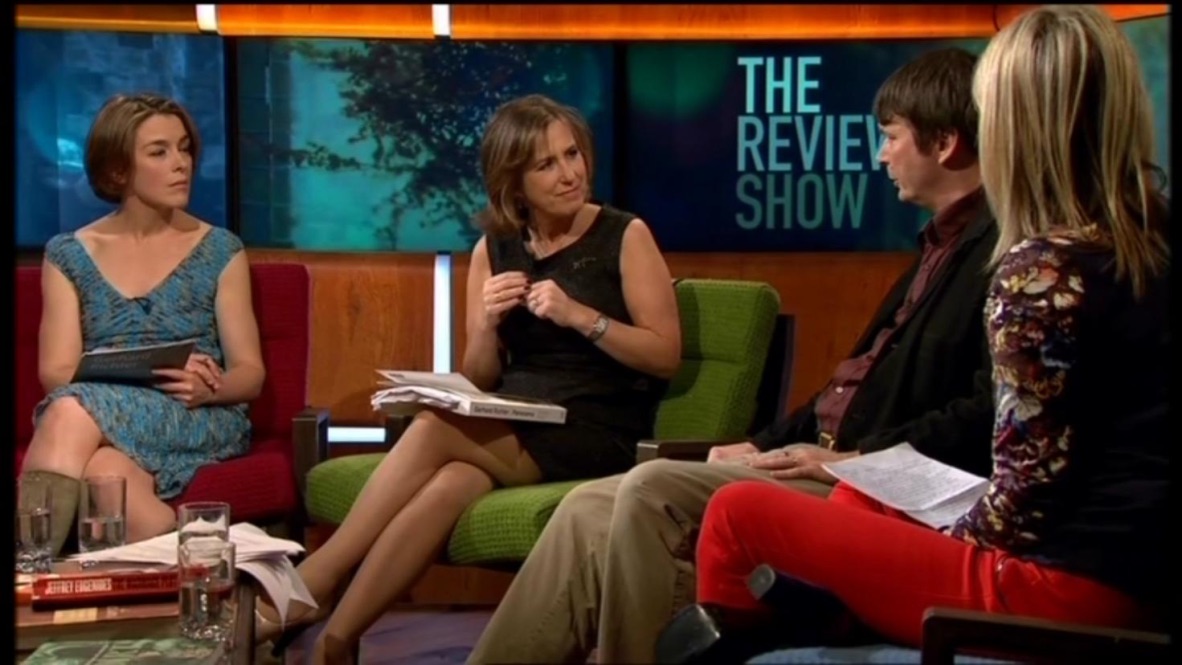
BBC2’s ‘Review Show’ is fertile ground for anxiety spotters because the guests are seated close to each other, often in a crescent, which makes it difficult for the director to isolate speakers without repeatedly going into a tight shot. The guests are not always aware that they are being included when attention appears to be focused on a speaker so they will often stray from the attentive ideal.  On this occasion everyone is performing their attention quite well:​

On this occasion the presenter, Kirsty Wark, seems less interested than she would wish to appear and has acquired a glazed expression. Her female guest, however, is being ideally attentive.
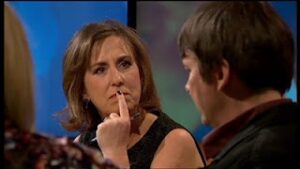
Attentiveness is obviously highly desirable. Here Kirsty – a highly experienced presenter –  has come up with an excellent version of attentiveness that could almost pass for the real thing. Possibly slightly too intense but pretty good.

The professional presenter, as distinct from the actor of dramas, must perform the unperformed with aplomb. The actor of dramas has, in some respects, an easier job because her objective is transformation – if she gets it wrong it will be seen as an insufficient conversion but if the presenter is seen to perform the unperformed then the shortcoming is a betrayal of the authenticity of the entire programme.

The unperformed of the presenter is not informal – we need it to be unwaveringly focused and efficient and we know that the autocue will often support this effect. Even so, the fantasy, I think, is that despite the fact that we know that it is the presenter’s experience plus the technical support of the team that gives him the requisite polish, we simultan­eously believe that he is a being of perfect confidence and self-belief.

We know it’s artificial but we want to see the subjects denying this, both in the name of professionalism – we appreciate a polished production –  and of self improvement, whereby we are able to study and learn from individuals who are being closely observed in real time as they make public presentations. In these studies we can distinguish between the consummate professional – Jeremy Paxman, say, and those interviewees who are not schooled in studio behaviour but are aware of the rules. This isn’t a purely voyeuristic exercise  –  the TV professionals are an educative presence – they not only teach us what’s going on in the world, if they happen to work in current affairs, but they also show us the minute details of artificial composure, the  moment by moment maintenance of a fluid, attentive, integrated surface. They demonstrate that you can go a long way with an edited, smoothed, heightened, repurposed version of what is normally regarded as your self.

03.07.2014

Peachy: Ad: 28.10.10

The Peachy Coochy Nite, about to inaugurate its fourth season, has a transformative effect upon those who have presented on its low podia. Here is a man or woman, I must not disclose which, because of secrecy, who, before cooching – the whimsical term given by David Gale’s Peachy Coochy Nites’s David to the act of delivery within the widely advertised constraints – was, in their own view at the very least, ordinary:
“Yes it is true my life was filled with elements rubbed to a high finish by repeated use, their surfaces like a conker in the pocket or some wood grasped a lot as a handle and smoothed. Then David curated me. At first I said ‘What? You’ve got to be kidding about with me – nothing would persuade me – nothing!’ Well, modern curation has come a long way since the days of arranging for a van to come round. It was something in his overall approach. ‘No,’ he said. ‘Really.’ Well, that did it. There was no more to say.”
After this happened above, the person did one and the next day funnily enough someone gave them a surprisingly large amount of money, just out of the blue, nothing to do with the the Peachy Coochy directly, just came up to them and said “There’s about ten large here. It’s not stolen. You can have it.” And they didn’t even know the person it was a chance occurrence.
So if you want to see more people do this (the Peachy Coochy presentation as earlier) then on Thursday October the 28th you can. By knowing about this:


David Gale’s Peachy Coochy Nites
The projector projects 20 images for precisely 20 seconds each. The Coocheur (or Presenter) speaks for precisely twenty seconds per image. Randomness is discouraged but narrative linearity is not automatically esteemed.
David Gale, having launched a nationwide performance must-have, continues to curate this series of Peachy Coochy events at ArtsAdmin’s stylish yet reassuring Bar. Each event features six Coocheurs, or Presenters, drawn from many walks of life. Each Coocheur will compose a verbalresponse to 20 images of their choice. Each presentation lasts 6 minutes and 40 seconds. There will be gaps between presentations for drinking and light conversation.
David, something of a Black Belt in these matters, will both compere and present the rich mixture that falls short of a compote insofar as its constituents are adjacent rather than prised liquidly from their defining envelopes.
This is a typical audience member response that came up:
“It’s all quite brisk. The compere tends intermittently to the indulgent. I would trade again.”
(Mikey 6/5/10)
Peachy Coochy Nites subscribes to the the National Belief System and is therefore committed to the provision of a wide range of contributors such as the evader, the pretender, the sleightist, the sharp, the smooth talker, the licker, the sucker.
The next Peachy Coochy Nite will be held, as usual, in the Bar at Toynbee Studios on Thursday October 28th at 7.30 pm. Tickets £5.00. Booking advised but walk up welcome.
more details here:
http://www.artsadmin.co.uk/projects/project.php?id=3D211
and a map here:
http://www.artsadmin.co.uk/contacts/
The Guardian catches some cooch:
http://www.guardian.co.uk/stage/theatreblog/2008/nov/17/theatre-peachy-cooch=y-performance-art
Some of you, pleased by the Nite, may wish to compose your own presentations. See me afterwards.
The Nites will run on the last Thursday of each month. You will be notified.
all the best
David

Peachy: Ad: 27.11.10

Peachy has no voice in his head. This is the shocking thing that he disclosed at the place where he lives when I went there to interview him about his work as a text and image entertainment next week in the location that I put below.
First I will set the scene:
Peachy, in a dressing gown, quite the Noel Coward, was lying with his entourage of other, more impressionable, forms of entertainment on a sofa at his place in the feudal woods where people believe just about anything. He affected languidness but I’m afraid it cut no fudge with me insofar as I had learned that to anthropomorphise him is to invite trouble in aces and spades.
“So, Peachy,” I began, “what I’m looking for is a status update.”
True Stories Told Live, an ingenue on the short form scene, adjusted her capacious gown. Peachy placed his underdeveloped arm on her shoulder. Without, boars were snuffling and, off and up in the high forest, cattle lowed.
“I used to have this thing where when you had a thought it was like a voice in your head and I thought is there a mouth in there is anything moving isn’ t that a bit weird is my tongue moving very slightly when I think I mean how can you have a voice there you must have ears in there but have scientists said ‘Yes we have found the ears that people have been wondering about at last they are small but definitely in the head now it’s just a matter of getting in then cutting them out and seeing if you can still hear the voice and frankly if you can then it’s all a bit too weird we’d ideally do it on dogs or some such first but we have no evidence that they hear anything in the head in the particular sense to which we are meaning’? Well, no. Scientists haven’t.”
Peachy looked a bit spooked. I took advantage of this, having read Naomi Klein’s ‘Shock Doctrine’, by giving him the map references necessary (he has GPS) to place him in Toynbee Studios at 7.30 pm next Thursday November 25th for Season Four, Part Two of David Gale’s Peachy Coochy Nites (I am David) which are like this:

David Gale’s Peachy Coochy Nites
The projector projects 20 images for precisely 20 seconds each. The Coocheur (or Presenter) speaks for precisely twenty seconds per image. Randomness is discouraged but narrative linearity is not automatically esteemed.
David Gale, having launched a nationwide performance must-have, continues to curate this series of Peachy Coochy events at ArtsAdmin’s stylish yet reassuring Bar. Each event features sixCoocheurs, or Presenters, drawn from many walks of life. Each Coocheur will compose a verbal response to 20 images of their choice. Each presentation lasts 6 minutes and 40 seconds. There will be gaps between presentations for drinking and light conversation.
David, something of a Black Belt in these matters, will both compere and present the assortment that strains against the cellophane yet knows no tin.
A man came up in the street enthusiastically:
‘I am going to tell people about what you do.’
(Cerith 12/10/10)
Peachy Coochy Nites subscribes to the the National Belief System and is therefore committed to the provision of a wide range of contributors such as the raconteur, the bon viveur, the flaneur, the short order cook, the tall teller, the accumulator, the bettor, the wearer of worsted, the fabricator, the sufferer from capgras syndrome wherein a person holds a delusion that a friend, spouse, parent, or other close family member has been replaced by an identical-looking impostor.
The next Peachy Coochy Nite will be held, as usual, in the Bar at Toynbee Studios on Thursday November 25th at 7.30 pm. Tickets 5.00. Booking advised but walk up welcome.
more details here:
http://www.artsadmin.co.uk/projects/project.php?id=3D211
and a map here:
http://www.artsadmin.co.uk/contacts/
The Guardian catches some cooch:
http://www.guardian.co.uk/stage/theatreblog/2008/nov/17/theatre-peachy-cooch=
y-performance-art
Some of you, pleased by the Nite, may wish to compose your own presentations. See me afterwards.
The Nites will run on the last Thursday of each month. You will be notified.
all the best
David