Serial III
originally published hourly in Facebook 28.10.2018



originally published hourly in Facebook 28.10.2018
originally published in Facebook 29.10.2018 > 03.11.2018


The first time I saw the black plastic lapel badges they had been pinned to two well groomed young men on the Tube. The men wore dark suits and had the pleasant, alienated directness so irresistibly simulated by Kyle MacLachlan as Agent Cooper in Twin Peaks. They were sitting either side of a student with a laptop yet did not appear to be accompanying him. As I idly watched they started chatting to their fellow passenger. They had good teeth and all of their conversation took the form of questions. They seemed very pleased to make his acquaintance and more or less took turns asking him pleasant things whilst smiling.
Because this was London and we don’t talk to strangers my interest was piqued. Where was all this going? At the next station the student got off. The badged Jimmy Stewarts from Mars continued to look quite pleased and I turned my attention to their badges. One bore, in incised white letters, the words ‘Elder John’ and the other was similar, with a name I couldn’t read. I felt I should know what this meant but I couldn’t place it.

On the train back from Dorset with my younger daughter and her friend we found ourselves sitting across the aisle from two American women in their early twenties with pleasant smiles and black badges pinned to their dresses. One was Sister Harriet and the other’s chest wasn’t in my line of sight. They smiled at me and my teenage companions. I donned my headphones and started reading my book. Some decades ago I would have allowed them to question me pleasantly in order to rebut them spiritedly but that was then and now I can’t be bothered. Reading is much more fun.
The teenagers plugged a headphone set into an iPod and took one earpiece each. They could pretend to be engrossed in Taylor Swift whilst actually listening to what was going down in stereo nearby. Unfortunately for the man sitting right behind me his son of perhaps five was sitting with him. The boy was saying things quite loudly. Sister Harriet and her sister Sister beamed at him and asked him questions. His responses were apparently delightful. The Sisters congratulated the father and began asking him questions. According to my daughter, who had been rolling her eyes and mouthing conspiratorially to me throughout this leg of the journey, they had secured the names of father and son, the occupation of father and wife, the town in which the family lived and, the cherry on the cake, a phone number. By the hesitant way in which the father gave the number to the Sisters, it was plain to my daughter that he was making it up.
The Sisters disembarked at somewhere or other, presumably to work the town, leaving the father to contemplate his good luck. Just before they left they asked him “Do you believe in the message that family is for ever?” The father mumbled his reluctant acquiescence. The Sisters said they looked forward to talking more on the phone. If it was a fake number then that shouldn’t be a problem – they could work whoever answered.
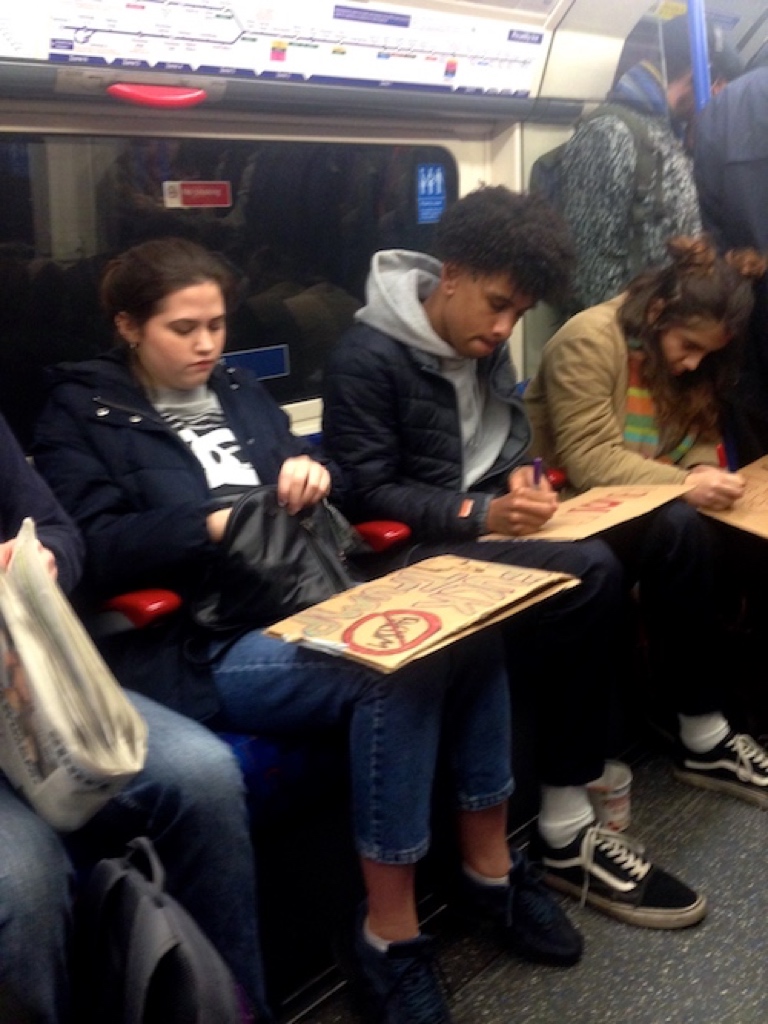
Saturday: Piccadilly Line: en route to the Women’s March. Passengers call out “Good Luck!” as six young protesters exit with their placards.
24.01.2017
On the radio DJ Zane Lowe was talking about a song and he made some comment or other then said ‘No pun intended’. He didn’t want us to think that his sense of humour was so underdeveloped that it would lead him to stoop to the use of puns. Personally, I don’t mind them. You get good ones and you get bad ones. Certainly they have a strong association with the tastes of children and the insides of Christmas crackers, but in that context they are hardly worthy of more than a mild wince.
Children find the pun empowering, it demonstrates that they are getting on top of the language project to the point where they can enjoy its elasticity. They can deliberately misuse what they have learned and no one will think they are making a mistake. But the apologetic, muttered, adult utterance ‘No pun intended’ is delivered as if a breach of etiquette as applied, say, to table manners, had taken place. As if one had inadvertently expelled from one’s chewing mouth a small piece of food or hiccuped in mid sentence. There is clearly something disconcerting about the pun, especially when it arises artlessly, without intention, when apparently it has the potential to shame its originator. ‘Chance produces stupid puns’ (Emile Augier). Alice, pressed by the March Hare to ‘Say what you mean’, asserted instead that ‘I mean what I say’ then added ‘…that’s the same thing, you know.’ To mean what you say is the easier part – it simply describes an attempt to get something across by closely and firmly aligning language with intention. Saying what you mean, on the other hand, can be dangerous if what you mean is at odds with what you are actually prepared to say. In such a situation, you run the risk of being understood. It might be preferable to insist that you mean what you are saying. The artless punster has no choice in the matter – language has caved in around him.
The pun, when credited with the autonomous capacity to intervene unbidden in speech, can be the very devil. It draws together two sets of meanings and, in the moment before it is laughed or shrugged off, introduces the threat of ambiguity hence the risk of being, in this case, misunderstood. It is the last ditch before the abyss of the Freudian slip wherein, and this is true, a vicar introducing 50s blonde bombshell film star Diana Dors, who was born Diana Fluck, to an audience at a fete held in her home town of Swindon, referred to her as Diana Clunt.
The punster – the purveyor of the lowest form of humour – is generally not considered to be clever but he or she who alliterates is seen as trying too hard to be clever. In an earlier Strength Weekly post I wrote about a tendency in the editing of live television to eliminate behaviour – such as reaching for a glass of water – that draws attention to the artificiality of the studio interview. She or he who alliterates – in a written medium – draws attention to language itself rather than to what the language is designed to convey thereby breaking the rule that language is an invisible conduit that reflects upon itself at its peril. It is as if the pun and certain other types of linguistic play have a capacity to induce autoimmune conditions in which language turns upon its generator and renders them pitiable. It’s not that the punster should apologise for the pedestrian quality of their humour, rather they have momentarily exposed the possibility that the elements of language might coalesce into unwieldy, unreliable, multiple merged masses by means of which nothing and everything, too little and too much, might be communicated.
Back in 2007, in the very first year of Strength Weekly (a digital display), I wrote here about neurotic vegetarianism and its spectral nemesis, the Meat Ray. In the course of a routine disparagement I mentioned a book my mother had bought in the USA in 1951: ‘Fun Fare – A Treasury of Reader’s Digest Wit & Humor’. In the collection, which I read avidly as a seven year old, was the following jewel-like item:

“The late Senator Charles B. Farwell claimed that this was the only perfect triple pun in the English language: A woman’s three sons went to Texas to raise beef cattle, sheep and hogs. Stumped for a good name for their ranch, they wrote home to mother for suggestions. NAME IT FOCUS, she telegraphed. Puzzled, they wired for an explanation. The reply came immediately: FOCUS – WHERE THE SUN’S RAYS MEET.”
29.12.2014