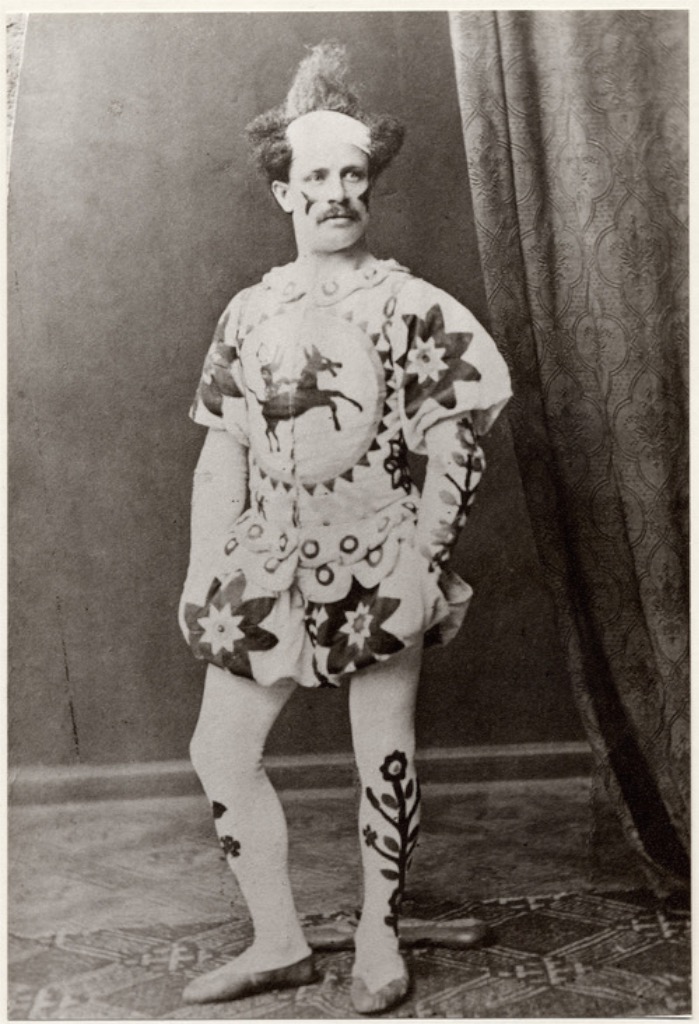
Dandyism – some background

‘Dandyism’, for these purposes, is the quality of being ‘Dandy’ rather than being ‘a Dandy’. In 1999 I wrote and directed a play called ‘I Am Dandy’. The title referred to a state of feeling ‘just fine’. The play took three years to write, ninety per cent of which involved making notes. I love the play. In 1994 I got a job. For the previous thirty years I had been either a free-lance or the co-director of my own theatre company. These do not count as jobs because the work was not alienating. The job I got was as a Senior Lecturer at a provincial university. Of the many shocks I experienced in my first employment, the most profound involved the discovery that there were people ‘above’ me who could tell me what to do. I hadn’t experienced this to any significant degree since leaving my family home at the age of 18. I was now an employee with a number of employers. I was expected to want only the best for the institution that employed me.

Since I didn’t really care very much for the institution, a degree of pretence was called for. Many readers will find these observations rather commonplace. I can only further observe that, largely as a consequence of a twenty year spell of writing and, initially, performing with Lumiere & Son Theatre Company, I had become sequestered from the experience of workaday subjugation.

Anyway, for five years I went into shock and didn’t write a thing. One day an affable colleague in charge of ‘research’ asked me how my research was going. I had no idea what he was talking about. I saw myself as an ex-theatre writer and, most recently, journalist. I didn’t do research, that was something my father, a biochemist, did. I told my colleague this, I insisted I was a journalist. His face fell. You have to do research at universities or else your department doesn’t get enough money the following year. As a result, a great deal of research material of no great use or importance is generated. Rather like the Dutch government, which used to buy artists’ work off them to give them a living then put it in storage, universities maintain libraries in which a lot of nicely bound research outcomes sit, unbothered by human contact.

I told my colleague that I had just done a programme for BBC Radio 4, in which I had interviewed a number of writers and commentators about their view of the future. ‘That’s national exposure!’ he cried. ‘Is there a book in it?’ What do you mean? ‘You could publish the interviews in a book, couldn’t you?’ Not one that people would wish to read, I thought. Yes, I said.

So began the promotion of a piece of radio journalism into a fund-worthy venture that eventually, thanks to the system-savvy persistence of my colleague, generated a sum of money large enough to mount a play. I had tagged the notion of writing a play onto my application, recognising that I had just been offered a way back into doing what I do best. The book fell by the wayside, politely declined by publishers who knew that few would wish to read it.

Despite my feeling that employment was synonymous with the end of art, I had been making notes for a show that I imagined I would put on one day, whenever circumstance delivered me from the day job. I wanted to present a succession of non-narrative scenes that examined aspects of contemporary hysteria. Blessed with a profound atheism for as long as I can remember, I found myself increasingly fascinated, as the Millennium approached, by the persistence of irrational beliefs in an age that boasted of its technologised victory over nature and superstition. I was bored with reading about UFO abductees and accounts of the interesting past lives of the currently dull, however, and more concerned with the extent to which everyday transactions were suffused with a vagueness that was justified as a form of spirituality.

In the programme for the show, which opened at the Festival of British Visual Theatre on the South Bank in October 1999, I laid out some of the ideas that I wanted the play to articulate.


I Am Dandy – the First Section

The show was written in separate sections. At the time of writing I had no firm sense of the proper order of the sections, I found this out through rehearsal. The section below, however, was intended to open the show.
Writing in this modular way helped me to avoid narrative, which I consider inappropriate for theatre. I don’t mind it in films but that’s another story.
Theatre scripts shouldn’t be a great read, they should be an okay read. Otherwise why go to the theatre?
This script only describes some of the action. Between each section the actors had to get from place to place. These movements were evolved in rehearsal. If you wrote them into a script it would be tedious to read.
The characters are called A, B, C, D, E, F, G and H in the script. This was because initially I wanted to eliminate writing for gender. The company comprised four women and four men and roles were allotted in rehearsal. From the point at which roles were taken up the actors gendered their roles according to their gender. Similar attitudes pertained to the notion of character. In rehearsal it sometimes became convenient to give, say, a couple of B’s lines to G. If you write strong, psychologically rounded characters you can’t do this. The actors were all very skilled and intelligent. They overcame the writer’s reticence in matters of character and gradually imposed characters on their roles. This always happens. Character is over-rated. Structure is what counts.
In the play the characters have proper names, like Mark and Cherry. Several of them have more than one name. This is because they aren’t necessarily the same person all the time. Sometimes they are the same person but other characters ignore this and give them different names.


Lost in Thought
The cast of eight – four women and four men – is discovered seated on chairs arranged in a row upstage. A, B, G and H are men. C, D, E and F are women.
The women wear elegant dark dresses and high heeled shoes, the men wear smart dark suits and white shirts with ties. All are well groomed.
They look personable, pleasant and keen. They are in neutral mode – not frozen or very still, just not doing anything yet.
This opening tableau is held for quite a long time. After a while one of the performers, A, puts his hand up to his face, assuming, in a low key way, a thoughtful pose. The others notice this and study him with interest. One of the performers asks him a question.
B Mark? [A appears not to hear] Mark? What are you doing?
[Pause. Still no response] What are you doing?
A looks up.
A I was lost in thought.
B What do you think about?
A I think about the past.
A longish pause as the performers consider this intelligence.
C Really? [A appears not to hear.] Mark? [A looks up.] Do you really?
A What?
C Do you really do that?
A I’m sorry?
C What you just said – was it true?
A Did I say something?
Pause
The performer C [Pauline] assumes a thoughtful pose. The others notice this.
B [To E] Pauline is lost in thought.
E appears not to hear. B assumes a thoughtful pose.
D What is there in the past, Mark? Can you remember?
F His name isn’t Mark.
D assumes a thoughtful pose. By this time A, B, C, D and E are all lost in thought.
Pause
G [With sudden excitement] It would be marvellous if… [G’s voice trails off and he becomes lost in thought. After a while he has another idea] Wouldn’t it be terrific if the…if the…
[His voice trails off again and he becomes lost in thought]
G’s reverie is interrupted by H
H If the…?
G turns his attention to H
G Wouldn’t it be terrific if people had more in common!
G becomes lost in thought again
H Tom! That would be marvellous! [H becomes lost in thought for a moment then, with sudden excitement, has another idea] If people had more in common… [H becomes lost in thought for a short moment then completes his statement excitedly] If people had more in common then a lot of terrible things would never come to a head!
G snaps out of his reverie excitedly, as do all the others who are lost in thought i.e. A, B, C, D and E.
In loose unison the performers rise from their seats, moving into an enthusiastic, animated cluster. They laugh gaily, shake hands, kiss and bear hug each other – lifting one another off the ground and whirling round, greeting each other like long lost friends. G and H are congratulated heartily for their ideas.

the first section ends

§§§§§

Bexhill Bummer – Intro to ‘What Did De La Warr?’

It sounded good on the phone. My partner from the days of Lumiere & Son, Hilary Westlake, asked me if I fancied writing a speech for an event to be held in Bexhill-on-Sea on August Bank Holiday, 2005. The De La Warr Pavilion, a 1930s Modernist architectural gem on the seafront of that town, had been refurbished and an enterprising producer had approached Hilary and some other artists and performers with a view to commissioning them to devise an entertaining opening ceremony.

My job would entail writing one single speech, to be used by an actor impersonating a VIP who had been invited to open the building. The VIP would prove to be so incompetent that the building itself would be affronted and attempt to silence him by flashing its lights, rumbling its plumbing and finally erupting with gouts of water and clouds of steam. Live music would be provided by French performance group Les Grooms while the building would be animated by Avanti Display. One of the perks of the job would involve a trip to France for a week’s discussion and rehearsal.

I started thinking about just what sort of incompetence the VIP might demonstrate. I concluded that he hadn’t done his homework and had arrived under the impression that the Pavilion was of the sort used by cricketers in the course of a match. This would cause him to digress dramatically from an appropriately themed opening speech.

I spent several hours on the first few paragraphs then sent them to Hilary to get some feedback before proceeding any further. I also wrote to the producer, requesting a portion of the money up front, as per standard practice. A day later I learned that the funding for the entire project had fallen through.

It felt a bit like a film experience – the one where you write outlines and treatments and sample scenes for no money and nothing whatsoever happens. It had never happened to me on a live performance project. And I had half a speech that would never get used. I’m mounting it on the site because I quite like parts of it and it would only go off otherwise.

2005

(Warr is pronounced wear or ware. I didn’t know that until I was told. I was pronouncing it war or waugh. 01/2024)

What Did De La Warr?

an unfinished monologue commissioned for a celebration to mark the completed refurbishment and re-opening of the De la Warr Pavilion, Bexhill-on-Sea in 2005. The celebration never took place as funding fell through. I stopped writing at that point but I quite like some bits of the first draft hereunder.

All the geographical and some of the historical references in this monologue are to real places, institutions and events. I imagined this fastidiousness might lend the text a frisson communicable to locals in the audience.

The VIP speaker has not done his research and thinks that the Pavilion is used to house cricketers.

Ladies and gentlemen, it is with a sense of tremendous pride that I am able to welcome you this evening to the opening of the splendidly refurbished De La Warr Pavilion. We are gathered here, in this elegant and inspiring entrance area, to pay tribute to the vision and indefatigability of a number of highly motivated individuals, civic groups, local supporters and national benefactors. Before acknowledging the contributions of these dedicated people, I would like to invite you to consider some of the rich associations conjured by the idea of the ‘pavilion’.

Those of you here, and there will, of course, be many of you, with a passion for cricket, particularly that generated within the hallowed precincts of the Sussex County Cricket Club, which has thrust forth such legendary national team captains as C. B. Fry, who, it will be remembered, did much to foster international relations when he suggested, in 1934, to Herr Hitler that Germany might take up test cricket, a suggestion that the German leader did not put into practice although he did see to it that a group of boys from the Hitler Youth would visit our country where they were made welcome on the HMS Mercury training ship at Southampton which dear old CB ran with his wife of 48 years, Beatrice. Southampton is, of course, readily accessed from Bexhill by the A259 which leads, after a few miles, to the junction with the A27 at Polegate, after which it’s a pretty straight run along the South Downs through to Hampshire. This, of course, forcibly brings to mind Rother Council’s splendid Polegrove Recreation Ground in Brockley Road, Bexhill, site of the Bexhill-on-sea cricket club, which returns me to my theme and our common purpose here tonight.

I was a Number Six man myself but I had among my retinue boys who were partial to Senior Service, Kensitas and even the rather racey Peter Stuyvesant. There we would gather, of an early morning perhaps, or during break time, sheltered from authority’s gaze by the bike sheds on one side and, on the other, the Stanley Evershed Pavilion, donated to the school by that renowned industrialist from Lincoln who did so much to establish the tubeless tyre in this country to the extent that the term ‘tubeless tyre’ is now in broad household use. Lincoln, founded by the Romans and formerly known as ‘Lindum colonia’ from the Celtic for pool, itself a popular pastime even to this day and easily reached via, largely, the A21, M25 and A1.

Cupping our hands around the forbidden ‘fags’ as we called them – this was before the gay community had commandeered the term, nothing wrong with that, I hasten to add, if cricket has taught us one thing it is that every team needs its Deep Fine Leg and must be prepared to deploy a number of unconventional positions in the field – we would inhale deeply, thinking nothing of the very real possibility that we were stunting our growth.

Indeed, as we are gathered here in celebratory mood, I can say that I have enjoyed a number of cigarettes a day since the age of fourteen and can report no significant developmental arrestation, as my smiling and recently refurbished wife will aver. Only joking, of course, she is a lovely woman and sports the same firm, regular bodily features that drew me to her so hotly when she was a youngster, if I may refer again to sports, that great binding theme that glues us to this large opening.

So there we have it – a place where groups of men may slip out of their workaday garments, ease into a protective box then don the distinctive whites before striding out to seek the sweet spot on the wooden bat before the slender stumps. And afterwards, regardless of what has been notched up, these tired but limber teamfolk, now stained at the knee with chlorophyll and at the groin with red leather, will troop into the welcoming hall clitter clatter the sounds of spikes upon doughty concrete where the players’ wives have laid out a terrific spread “Oh well done Margery!” the cry of the captain as he spots the neat sandwiches and bright fancies. And Arthur ‘Girly’ Brickham, useful medium pace bowler, turns to me and jovially calls, as he always does, “Come on, ‘Smutty’, Inky pinky parlez vous!” referring to the slightly saucy song beloved of sportsmen around the English-speaking world, I’m sure you can all remember a verse or two:

(SINGS) Two German soldiers crossed the Rhine – Parlez vous
Two German soldiers crossed the Rhine – Parlez vous
They kissed the girls and drank the wine. (BREAKS OFF)

Actually, they didn’t ‘kiss’ the girls but there are children present, surprisingly, considering the late hour, but I think you’ll get my meaning if you’re from Effingham in Surrey. Which is, of course, the headquarters of the Effingham and Leatherhead Cricket Club.

2005

not to be continued…


Jokes

A ‘lecture’ commissioned by Forced Entertainment for ‘Marathon Lexicon’ (2003)

I like a laugh, me. I’d do anything for a laugh. I look for opportunities. You have to. You have to watch out, be tuned. After a while you’re joking all the time. Which could be fucking sad. A person that can’t stop joking. You read about them – famous ones that were sad all the time when they weren’t telling jokes or doing their act. What is better is to know that if a situation arose in which it was advisable to joke all the time then you could handle it. This is very satisfying, like running the marathon. If you’ve run the marathon you know if someone fell off a cliff and was trapped halfway down you would be able to run reliably to the coastguard. In the same way, the fulltime joker would be able to stay with the person and tell them a great many entertaining jokes until help came.

At this point I need to tell you about Bobby Sands. Bobby Sands was a member of the IRA who had been interned in Long Kesh, one of the notorious H-Block prisons set up by the British in their war against terror. He died in a prison hospital after a 65 day hunger strike. Once I was sitting with some people outside a pub on a nice day in north London. We were all involved in making a film with Sally Potter and were waiting for the next setup. Around a table were six of us, including my dear friend Keith, although he was not particularly dear then, and his then girlfriend Marie. I began to tell a joke that I was fond of. You should tell them fairly soon after hearing them because they are usually gone after three days. It seems that when Bob Marley died he went straight to heaven, as you would expect of such a gifted artiste and who should he meet and he’d only been there a few minutes but Elvis. Wow, Elvis, I’ve always really loved your work said Bob and Elvis said That’s very kind of you Bob, I have enjoyed your music greatly as well. In fact said Elvis why don’t you come over to my place tomorrow we’re having a bit of a do. Fantastic Bob thought, I’ve only been in heaven a short time and already I’m going to Elvis’s place for a do. So next day he goes across to Elvis’s part of heaven and there are tables laid out with white cloths and everything but to his surprise he finds Elvis in a corner, crying. Hey what’s the matter Elvis said Bob. It’s that fucker Bobby Sands said Elvis he’s eaten all the sandwiches.

At times the dedicated and adventurous humorist will make mistakes, often in the area known as ‘going too far’. This is an occupational hazard. In the area of sick humour, the humorist enters a rich domain in which schadenfreude, glee and the depraved eternally return, bursting forth under the intolerable pressure created by the unthinkable. The risk is that for every chorus of glee vented by those who are so appalled that they crave the exhilarating double shot of moral amnesty and anaesthesia, there is present in the house someone who has simply done the work, stared unblinking into the horror and suffered the suffering. These are the people who just don’t get it.

Having finished my Bobby Sands joke, I smiled complacently, awaiting the laughter that would be my reward. There were, indeed, some titters, but my enjoyment was curtailed by the look of profound unease on Keith’s face. As I turned to examine him more closely, I noticed that Marie had gone white. Her hand was clutching her glass tightly and her gaze had suddenly become baleful.

“Do you want this drink in your face, David?’ she enquired, rather quietly.

I began to stutter. Marie was obviously upset by the Bobby Sands joke. I had got it wrong. Not the joke, the audience. Without moving, all the figures around the table receded. As they drew into the distance, I noticed that they all appeared to be ill. Marie continued to glare at me coldly.

“Um…I…I’m sorry…that you didn’t like the joke,” I squeaked.

Marie got up and walked away from the table. Keith was the first to speak.

“Oh dear.”

And then he said, “Marie works on the H-Block Committee.”

This committee, in case you’re in any doubt at all, was formed by Republican sympathisers to support those imprisoned in the H-Blocks.

Over the next few days I told people about my joke and Marie. They couldn’t see why I was upset. “Fuck her,” they said. “Tell her to get a sense of humour,” they said. And “Why on earth are you worried?”

Those who live by the joke know that when you go bog-snorkelling you do not glide above the mud, you wriggle through it. You cruise close to the coast of the unthinkable, taunting it with the unsayable, toying with the moral obliteration, saying the unsayable, gasping with glee in the temporary moral vacuum. So I wrote Marie a little letter, conceding that her presence in the firing line was unfortunate and that I was sorry. I couldn’t say that I had not meant to give offence because patently the giving of offence was very much the thrust. Ideally the gift is followed by its conversion into nervous energy: it backfires. On this occasion the gift fired.

My father died last year at the age of 90. He had no memory at all. Not just short term, everything. You’d say stuff and it was gone – straight through, never stopping. He was also very frail. Just a little bird of bones and shakey legs. I was leading him across the dining room in the retirement home. A lot of oldsters were eating lunch or sitting around. I let go of my Dad for a minute to retrieve my youngest daughter. I kept an eye on Dad though. Suddenly his trousers fell down. He’d forgotten to put a belt on. He was wearing battered old white pants with his shirt and vest tucked into them. His legs were very thin and shiny, with sores on them where he’d scraped his shins and they were taking ages to heal. His thigh muscles were wasted. I ran across the dining room and took hold of the trousers and pulled them up. Dad was muttering something like “What’s going on here?” Most of the old people were silent but two old ladies said “Oh dear” and laughed.

2003

§§§§§

I Must Be Joking – Intro to Jokes

I got a call from Tim Etchells of Forced Entertainment. The company had been touring a show called ‘Marathon Lexicon’ for which pieces of writing had been commissioned from a variety of writers and academics. The pieces had simple titles and were assembled into an alphabetised collection. The show would run for several hours, during which some but not all of the lexicon would be presented. The audience could come and go throughout the presentation if the prospect of sitting still for twelve hours unsettled them.

Tim asked if I would write a piece on jokes. As I’m rather keen on jokes I was pleased to take the commission.

I knew I had a couple of unused joke-related bits somewhere on my hard disk so I dug them out. The text for the anecdote about Bobby Sands was adapted from the outline to an as yet unwritten autobiography, as was some of the material on humour and risk assessment. The rest of it was fresh.

I haven’t seen the show yet – I’ll have to wait until it comes to London again.

2003

Note: the ‘autobiography’ stalled at about 140 pages. I tried calling it a ‘memoir’ in order to make it feel less burdensome. It didn’t make a lot of difference. (2019)

Note: I have finished it. (2023)