Excursion in 3 Panels


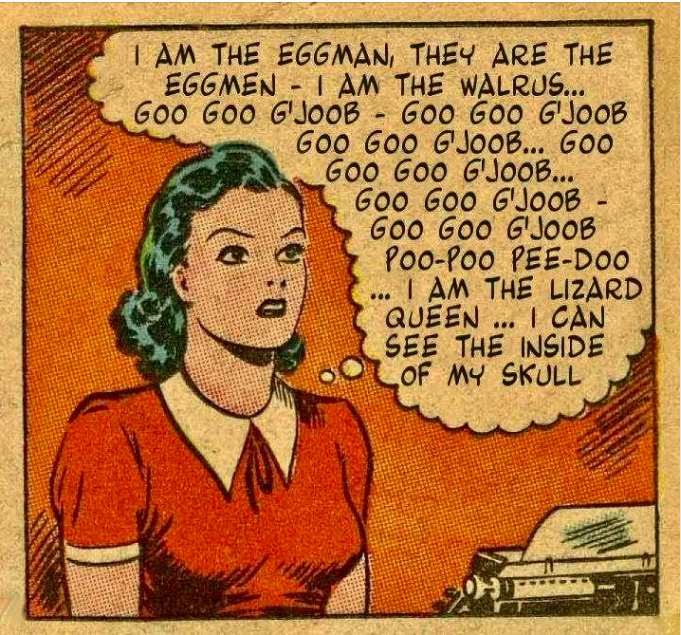


Peter and Susan went to see Peggy McFarrell’s “A Not So Final Curtain” with its accounts of theatre life and those who lived it. After the opening within this show of (the fictional) Dan Mulcahy’s (fictional) show “Dappled” there was an interval and Peter and Susan, in the Circle Bar, bumped into some friends and discussed the play so far. Eloise, one of the friends, said that the play was quite Pirandelloesque. Peter didn’t know what that meant so he asked Eloise to explain. It was after this Italian playwright, Pirandello, who wrote a famous play in which the characters were in an unfinished play and were wandering around trying to find its author. Peter said “Perhaps it wasn’t a very good play.”

Even so it started them thinking. Perhaps they could take the initiative more. But although they discussed how they might do this, every time they determined to ‘up sticks’ or ‘do something about it‘ Peter would get a headache and Susan would fall asleep.

But ‘Peter and Susan’; ‘Peter and Susan Strike Out’; ‘Peter & Susan Spend a Day at Amper Sands’, ‘Peter and Susan start to feel somehow not really real, substantial or present at all ’ – these were all things that happened to them. And more or less, these things ended properly. Things were tied up. Except, as you might expect, for those situations in which open-ended anxious feelings were closed down without resolution as in the fourth volume as in the list above. They would be closed down because Peter and Susan did not enjoy the fatigues, the staring, the flaccid restlessness, the intermittent sense of a lack of project. You and I might think they should suck it up isn’t this just what it’s like? but they thought at times that you should press it back down and at other times they thought that it should be possible to let it flow out – how bad could that be?
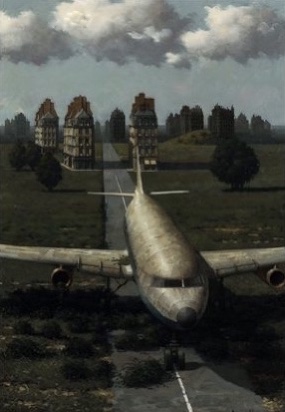
In “Peter and Susan go to the Eiger” the two of them got quite far up, about halfway through, and probably they could have gone on but Peter said “We’ve done quite a lot” and Susan said “It’ll be much the same” and they agreed to “Come back another day and do the second half.” They said to each other “Even from here you can see for miles.”



Julian’s ‘madness’ – diagnosed at the time as a variant of paranoid schizophrenia – seemed to involve two modes of suffering. One comprised an immersion in complicated fusions of London geography, centres of power and the pervasiveness of dark forces that sought to foment a race war. He saw evidence of such conspiracies everywhere during his long, daily wandering through the city and had devised a special circuit that took him past powerful places, enabling him to develop some sort of immunity against the darkness. He clearly passed much of his time in a state of great anxiety but there were times when he was mad and an ironic commentator on his condition at the same time.
Buckingham Palace, for example, was an important power point and Julian would push through the crowds of tourists, grasp the gates and roar “Mummy!” with all the vocal force that his actor’s training afforded him.
He told me of these exploits in one of his ‘down’ periods and I laughed out loud. Not only had he crystallised and exploited some of the normally occluded mechanisms of the joke engine but he’d overridden the popular notion that crazy people don’t know what they’re doing. Julian was immensely entertaining at the best of times and now, when things were dreadful, his wit and his skills remained intact, countering the assumption that to be mad was to be comprehensively out to lunch.
07.08.2021


Peter is unworldly. You see Peter you think ‘What happened there?’ or ‘What didn’t happen there?’ Did he grow up never having to be afraid and this made him unquestioning or was he treated in such a way that he shrank from the world lest it eat him? And Susan is unworldly. And with Susan were there gardens and fresh air and close family or was something so protractedly shocking that it was best to look away and stay like that? But they had charm and you thought I wish I could be like that. But in a way it’s luxurious. You never have to think. But if that were all there was to it then many people would be charming and they’re not.
But I can think of a charming guy called Guy, many years ago, who seemed to drift through the world never catching his elbows on the corners and I remember thinking even at the time ‘I’d really like to be like that.’ He was probably 13. I was too. He did not lack personality, indeed, what it mostly was, I think, was that he had what we might now call a style of masculinity – I certainly never thought about things like that back then, in a way it wasn’t possible to – quite unlike so many other guys. In a sense he was less masculine, in that the available styles at that time were all minor variants on capability: some physical, some cerebral, some jack the lad or jack the wit. Guy was laid back – dreamy, smiley. Not a div though, not a village idiot. Arty. Or destined to be. Not that I had any advanced models of that for reference at that time. With hindsight I can see that the same applied to Richard, who had no academic skill but became a designer of successful chairs. Richard was also laid back perhaps slightly more emphatic. I often wonder what happened to Guy when the 60s came round. If he managed to remain laid back he would have effortlessly walked into the whole beat thing and flourished. I knew posh boys who pulled this off but it was a class-based languor – the world was already theirs so no hurry, really. But it did seem with Guy that he had a position, an attitude, an evaluation. Not because of what he wasn’t taking up but what he was like as a result of not having taken up anything that was being offered.
Reminds me of Charlie this kid my girls were at school with – he had the dreamy thing too. One time Charlie was in a race at school sports, about 60 meters maybe. The kids pelted off and Charlie walked it. Not in the sense of winning easily but in the sense of refraining from running at all. Just strolling. Not truculent. No swagger. Not grinning about it, just politely, not resignedly, doing the absolute minimum. I was with his mum and she laughed affectionately. 15 years later my younger daughter told me she’d seen him in the street and, like everybody said, she said, he was so immensely cool. Unbelievably good looking and cool. I don’t know if he had acquired a swagger. You couldn’t blame him if that were the case. But pleasing if he hadn’t.
Magnificent qualities. Despite the popular rise of sociopathy, there has been, over the last two or three decades, a softening of the male. In some quarters at least. I remember starting to come across young guys, initially in shapeless pullovers, whose performance impact was low. They seemed reserved. Modest. This was not to be confused with dull or humourless or retiring or unexpressive. Or dreamy. (Dreamy is fine but only one mode in an array defined by the absence of a fetishisation of capability. Not that these people were not capable. That’s not what I’m saying.) Even ‘cool’ carries the notion of arrogance, distance, not deigning to descend, probably petrified. But these were young men who had somehow sidestepped the gauntlet.


Given the clairvoyant accuracy of J. G. Ballard’s assertion in the 1990s that ‘The 21st century will be the century of the psychopath’ it is not surprising that over the last couple of decades these largely male, white and profoundly disturbed figures have come to populate a significant and steadily increasing portion of TV and film thrillers and high finance dramas.
In the second season of the Danish psychological thriller series ‘Those Who Kill’, titled ‘Blinded’, we see an emerging variant of the ‘high-functioning’ psychopath who has already become prominent in such finance dramas as ‘Billions’ and ‘Devils’. In these latter are found ruthless businessmen (and some women) for whom betrayal is routine and there is no such person as the colleague who cannot be professionally destroyed if the full realisation of scruple-free schemes is to be achieved.
These financiers are charismatic, well groomed and dressed, have nice families whom they love and sometimes a dog. At this level of analysis they could pass for ordinary bankers and fund managers. Importantly, they don’t look mad or bad, their faces are handsome and unscarred and they are often seen being pleasant to people who are not their employees.
In ‘Blinded’ the variant in the high-functioning class of psychopaths features a family man whose low status job is cutting timber in a sawmill. His high-flying wife wants a divorce and he is left to care for his son. Despite the domestic setbacks he has a relaxed, low-key manner and is liked by his friends. He does, however, capture men and torture them at length before killing them. So in terms of variance, he largely eschews the women and children first template for TV psychokillers and, importantly, he doesn’t look like a bad man.
It certainly wouldn’t be the first time that a screen psychopath is goodlooking and amiable, of course, but when he chats to his son, or his male chums or his boss or does the school run, there isn’t a hint of the currently most fashionable of evils in either his general demeanour or his micro-expressions. This is meticulously controlled throughout the series, with the actor (Tobias Santelmann) only facialising derangement when he is actually torturing his victims. Even when the net closes in on him he registers only a stern determination – a nice man experiencing some pressure.
Nevertheless and as we would expect, his days are numbered. Karina (Helle Fagralid), the police chief in Odense, meets Louise (Natalie Madueno), a criminal profiler, and asks for her support in tracking down the serial killer who, after a five year break, is on the prowl again. We are relieved of the need to endure the tiresome trope of ‘Cop resents sharing her case with an outsider’ because Karina and Louise get on well and respect each other’s skills. This seems to signal the production’s acknowledgement that women are capable of working relationships based on trust rather than competition.
There’s a key scene in Episode 2 when a forensic pathologist shows Karina and Louise the deep cuts that have been made on the soles of the feet of the killer’s latest victim. The women leave the lab and walk slowly down a corridor.
LOUISE He cuts Ricky’s feet and unties him. His escape wasn’t an accident.
KARINA Did he want to hunt him? Why take that risk?
LOUISE I don’t know. We might be wrong about the motive.
KARINA So it isn’t sexual?
LOUISE It’s always about control and dominance. This guy also punishes his victims.
KARINA For what?
LOUISE I don’t know, but when we find the common denominator we’ll find the motive.
Somehow a relatively procedural scene, one that has to take place, acquires a much wider frame of reference. The corridor removes the women from the investigative environment and briefly becomes a liminal space in which the lifting of plot and genre constraints elevates their discussion to a measured analysis of a pandemic toxic masculinity that underlies the totality of social experience and consigns women to a leached and wearying game of pathologised whack-a-mole.
12.02.21
I’m not so interested in people’s meals or holidays or pets but I do find Facebook a useful location for small-scale publishing of images, text and text & image work. If I ever get to large-scale, I’ll let you know. I would say my readership is currently manageable. I do not anticipate engaging an intern. At least not for the next ten years or so.
Despite my deep reservations about digital enslavement, from the point of view of the producer of clickables and from that of the consumer of the bait whose subsequent clicks reinforce the compulsions of the producer, causing the latter to feel both fulfilled, albeit for a few minutes, and incrementally anxietised, I feel held in thrall as soon as I publish.
It wears off quite quickly though. If I get likes I tend to revisit my work and admire it. Sometimes I admire it again with every subsequent click. If I get very few or no likes I often conclude, reasonably enough, that the product was insufficiently communicative. Sometimes I conclude that it wasn’t any good. Then I withdraw it.
The piece below created scarcely a ripple. I know that this is because it went too far. Not in an interesting way, however. The piece contains too much information. It is not legible.
I posted it a few days ago:
One couple of chinos my dear lady Peter said to the barrister at the counter point. Anything on top? the chirpy reply to this question. The parrot cocked its head to one side. Strictly speaking there should not be any sort of animal in this sort of establishment. The lady laid out the casual garments on the zinc. Peter liked what he saw. Pleased to see the french fly he said to her. Well it is important to have reliable closure one does not want zipper gape said the lady. I should say not! He quipped. Would you like a negroni with that she wondered? Well I would not have thought of it but now you mention it you have stirred a need yes please. I will.

I like it when a piece has more than one level of coherence. When it can mean two or three things at once. Sometimes these things are separate and discernible, sometimes they coalesce then separate again. This is an ideal, though, exemplified perhaps in the quotation at the foot of this post.
A cappuccino is close to a cup of chino: a café and a clothes shop have fused.
The barrister and a barista have the same pronunciation, almost: the barista is usually seen behind a counter and the barrister serves at the bar and, in refuting an argument, will make a counter point: a court of law has fused with the café and the clothes shop.
In asking ‘Anything on top?’ the barista refers probably to chocolate powder. But in a café and in a clothes shop goods are laid on top of counters for collection or inspection. In a bar they may be laid on zinc.
The head-cocking parrot is a novelistic, scene-setting incidental. An inducement to picture the picture.
Some of my trousers have a french fly. Extra buttoning is required but the tailoring device works well and can be reassuring.
Given that he is in a bar fused with a café fused with a clothes shop Peter sees no reason to decline the negroni offer. I went to a vintage clothes shop in Lisbon with my younger daughter and while she perused the racks I had a coffee with a glass of ginjinha the dark red, sour cherry liqueur served at most Portuguese bars. In the same shop. My daughter was happy and I was very content.
So far, so legible. Maybe. At this point we have a gewgaw that may be a source of harmless, frothy fun. But then I took a reckless swerve off what was already a perfectly capacious piste. What if the french fly were an aspect of fly fishing? And to what extent might it fuse with the bracing fusion of gin, campari and red vermouth that is the negroni? What if, indeed, there were rocks tumblers (a variant on the whisky glass) that actually bore the imagery of fly fishing?
Of course there were. Several types, courtesy, as usual, of Google Images. And the best were to be found in a boxed set of four, each engraved with a hooked and feathered fishing fly. Each nestling in a bed of crepuscular green satin.
And that was where it went south. The tumbler set was indeed enigmatic. But not in a good way. You could just about make out the engraved fly. Flawed to a fault. Illegible. Irritating.
This morning I deleted it from Facebook, having moved it first to the gated community of Strength Weekly.
I am more than comfortable with this though:
Impossible as it may be to fathom as an obscure totality, even at the level of a page, particles of immanent sense will stand out from the dark foil against which they are set, in turn to suggest connections with others, and still others, until – not necessarily in linear order – out of a web of items drawn together by association, a knot of coherent nonsense will begin to emerge; and upon this coherent nonsense, as upon the shards of a recollected dream, some interpretation will have to be practiced in order to discover an underlying sense.
Bishop, J. James Joyce’s Book of the Dark p.22. 1986 (re Finnegans Wake)