Lots: Episode 5

This post is in a series: please start at Episode 1

My agent was invariably cheerful. “Not to worry,” he said, “We’ll see if we can place it somewhere else.” And then he said “What I think we should do is you should write another one for them.” “Another play?” I squeaked. “Yes. Show them that you’re still keen and you don’t give up.” “A whole other play?” “Yes. Just write one and we’ll send it in then you’ll be in good standing with them.”

The trouble was I was annoyed with them. They had failed to recognise that I had placed the future of television drama at their disposal. They had made the Monkey Assertion. This latter had been made before, almost at the beginning of my playwriting career. Lumiere & Son had had the good fortune, quite early in its history, to present a play at the Bush Theatre in London, after a spell mounting work at the legendary Oval House Theatre. We opened a show called ‘Jack…the Flames!’ at the Bush and, for the first time, reviewers from national newspapers came to review us. (They were loath to travel south of the river unless it was for shows at the National Theatre or the Old Vic. The Bush was north of the river, in Shepherd’s Bush.)

Michael Coveney, then writing for the Financial Times, saw the show and was moved to observe that “This is the sort of show designed to make a monkey out of reviewers.” Michael, who for several decades we could only refer to as Coveney, was to be even ruder about subsequent shows, but that’s another story. After twenty years or so of pointedly ignoring him at openings and parties I found myself, towards the end of the 20th Century, able to greet him stiffly and then, a couple of years ago, at a Christmas party held for contributors to The First Post, an online newspaper to which we had both been contributing, we held a perfectly pleasant conversation in the course of which he actually almost disarmed me by mentioning that he was about to run a half marathon and, when I asked him why, said “Well, I’m a short, fat little bastard and I need the exercise.”

I felt that I’d been buoyed up by Roger then stiffed by Robin. I didn’t question Roger’s motives for a moment – he was a risk-taking producer. Robin wasn’t. With heavy heart I dragged out the Olympia and tried to imagine what on earth I might do. I wrote plays because I had ideas for plays, not because a play needed to be delivered to prove a point. While it was clear that whatever I wrote would be rejected, I still felt that I couldn’t fill the sheets of A4 unless I had something mildly exciting to motivate me. I knew that I had to cut corners – the next play must take no more than a week to write and it shouldn’t involve difficulty (‘Lots’ featured the studied removal of conflict, its successor should actually be a lo-conflict writing task). I also reminded myself that I wasn’t being paid the second time around.

On occasion I have used sentences like this in Strength Weekly: ‘Then I made up my mind.’ Such slightly stylised assertions have, I think, generally been used to introduce matters of moment. Not in this case. Then I made up my mind. I would use Jean and Max again, not only that, I would call the play ‘Jean Pool’, a title I had already used for the stage. Then I wouldn’t have to think up a new title, which either takes ten minutes or three days, nothing in between. I would write a crime mystery that gets solved by detectives. There would be a problem but this time it wouldn’t go away, the detectives would have to solve it. There would be clues and deductions, I decided, irritably. They’d like that, it wouldn’t make monkeys out of them.

Episode 6: Some pages are covered with writing. A broadcaster is sent a packet.

Lots: Episode 4

This post is in a series: please start at Episode 1

I wrote the script on my pale blue Olympia portable typewriter because, in the olden days, there were no computers small enough to get into a room. As with my writing for Lumiere & Son, I used carbon paper to make copies. In order to save on photocopying costs I wrote my plays on eight sheets of A4 interleaved with seven sheets of carbon paper. This was the most you could wind around the roller without it jamming. In order that the final sheet did not comprise simply a series of faint grey marks I typed very hard, pounding the keys forcefully with every stroke. The director got the top copy, myself the second copy, the actors the next six copies. ‘Lots’, however, was merely duplicated. One copy for me and one for my agent who would copy one for Roger.

In common with most of my script work the writing part was the easiest. The thinking part takes between three years and three days depending on prevailing pressure systems. Once the thinking has advanced to what we, in the trade, call the ‘right’ point (I will not burden the reader with too many of these specialist terms) I say to myself “That’s enough thinking. Let’s write!” The writing is accompanied by thinking but it is of a detailed rather than broad-stroke character. If I remember correctly (and who does, these days?) writing ‘Lots’ was thoroughly enjoyable, especially on those occasions when I broke through into ever more extreme progressions of my regressive scheme.

When the teleplay was finished I gave the top copy to Roger, who would get back to me by the end of the week. During the intervening days I imagined myself on various chat shows and polished my witty yet telling ripostes and responses. A few days later Roger rang me (phones were attached to the wall by a wire in those days). He said that he had enjoyed the script greatly, as had his assistant and script editor who was called either Tatiana or Sally or possibly even another name. We went to dine in a restaurant adjacent to Sloane Square. I clearly remember thinking “The world is my oyster” as I navigated the Kings Road on my old yellow Claud Butler.

Over luncheon on linen, the first of many such that I was now destined to enjoy, Roger and Sally told me of their favourite scenes and moments. I told them that my favourite line in the script was ‘The car is red.’ Roger did make one critical comment, however. “You know, when you put a piece of paper over the left side of the page, covering up the characters’ names, you can’t tell who is who.” I told him that I wasn’t overly concerned with character and that, anyway, the actors would make it perfectly clear as they developed their roles. (I still believe this.)

In a few days we would get a response from Roger’s boss at the BBC, who may have been called Robin and was in charge of Play for Today or Playhouse, whichever series it was. In the intervening days I contemplated the better bicycles, the sharp suits and the frequent visits to America.

Robin said “He is making a monkey of us.” That was that.

Episode 5: My agent has an idea.

10.02.2008

Lots: Episode 3

This post is in a series: please start at Episode 1

Let my imagination go. Uhuh. Roger was very likeable and I was flattered by his view that the eccentric work of Lumiere & Son – or something like it – would be viable in the centricity of BBCTV. I would pull out all the stops on this one. I would go where I had not gone before. I had long been irritated – as suggested from time to time throughout Strength Weekly – by the received wisdoms of playwriting, especially those which asserted the primacy of well rounded character, credible dialogue and a good story. While, as a consumer, I was often content to savour the accomplishments of playwrights, screenwriters and novelists who had no axe to grind with regard to these matters, when it came to producing my own stuff I was hardcore and became increasingly so as the years went by.

I mused on the notion of just how much could be removed from performance before it vanished. Peter Brook, of course, had said “A man walks across an empty space, whilst someone else is watching him and this is all that is needed for an act of theatre to be engaged” but it’s not really a night out, is it? Besides, I wasn’t a minimalist, I wanted busy, fast, imagistic theatre.

Then it came to me. One of the wisdoms I had received was that drama could not exist without conflict. Who said? And how dare they? I would write a (television) drama without conflict. I would open the screenplay with some characters facing an insurmountable problem which they would proceed to surmount without developing as characters. Having removed the plot engine about a quarter of the way in I would then guide the characters – the detectives Jean and Max and their client Anna – through a series of situations that delivered modest challenges which were almost immediately resolved for no reason connected either to the nature of the principals or their efforts or some mysterious yet beneficent quality of the phenomenal world. Shit, then, would just happen.

As I noted this down I began to realise that this was what Britain was waiting for: thanks to the perspicacity of Roger, a young 39 year old playwright would storm the small screens of the country with his moreish avant-gardism and quite quickly find a snug abode in the nation’s hearts. He (I) would become the Bleasdale of the New Bleak, the uncompromising author of works of hilarious sad violent beauty that eschewed irritating wisdoms.

Fortunately I have always been calm in the face of heck and was able, despite my dizzying prospects, to continue applying myself to the compositional task. I decided that not only would conflict be removed wheresoever it arose but that the characters would move backwards through time because, as everybody knows, the olden days were so much better in all ways except for medical science in particular anaesthetics. As scenes progressed, the characters’ costumes would regress through the styles of the centuries. Not only that, I decided, but – following my own insistent logic – the species would travel backwards to its origins in the Garden of Eden after which the women would disappear into the mens’ bodies via a wound appearing just below the site of their sixth rib.


Episode 4: The draft is borne into the world. It makes an impression on representatives of the BBC.

09.02.2008

Lots: Episode 2

This post is in a series: please start at Episode 1

One of the most moving images that Strength Weekly – in an admittedly inward moment – has published.


In Episode 3: what’s so interesting about all this anyway?

09.02.2008

Lots: Episode I

I’m in the front room of Hilary’s old house, which she is probably going to sell. All around the walls, on shelves, in boxes, cabinets and crates she has stashed a great archive of the papers of Lumiere & Son, the theatre company we ran together from 1972 to 1992 when the still Thatcherised Arts Council withdrew our grant in response to our failure to attract large audiences. The V&A want the archive so we’re meeting to determine if there are any items that should be retained by us for any reason.

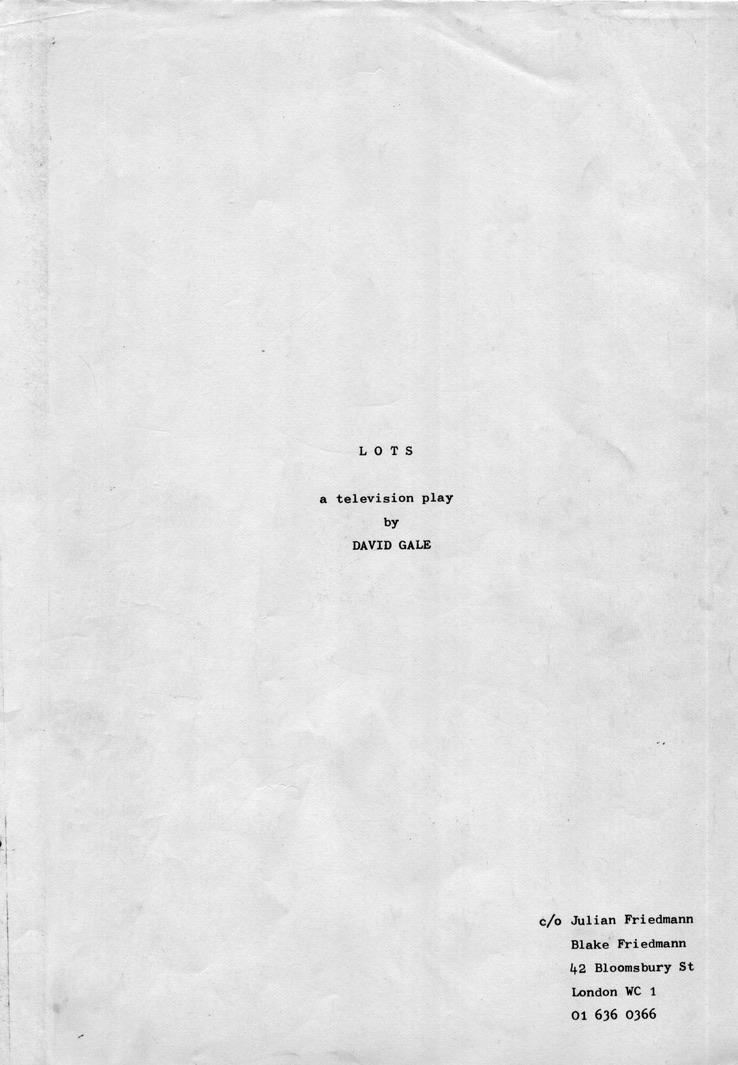
“Would you want this sort of thing?” Hilary says, reaching for an old folder. She opens it up and I can see some foolscap scripts secured with black plastic spines. She holds up a script. On the cover it says “Lots – a television play by David Gale”. I am staggered. My eyes fill with tears. “Lots! Lots?! My God!”

It is necessary to scroll back to 1983. A man called Roger contacted me. He was a producer from the BBC, had seen some of Lumiere’s work and wondered whether I would like to write a play for television. I was pleased to take on the commission that would make me a household name and, after my agent had fixed things up, I sat down at my typewriter in an abandoned house on the edge of Bath, amongst other places, and began wondering what I might dramatise for the nation. Roger had said “Just let your imagination go, David.” Right, then. I was drawn to a couple of characters I had come up with for a 1979 Lumiere play called ‘Jean Pool’. Max Cope and Jean Pool were private detectives – Max tending to the terse and pragmatic and Jean abstractedly to the abstract. I thought I had a good thing going between them and so would revive them for TV.

Given that the tale I will unfold is of enormous personal significance – yet of little public moment – I think I will serialise it. It needs a bit of care and attention and I don’t want to try to get it all down in one go. Also Morrissey is on ‘Later’ and I want to see Vivienne Westwood on Jonathan Ross.

08.02.2008

Set Pieces

I shall carry the images to my grave. In one of the two shows I’ve written and directed for presentation at Wimbledon College of Art this week (previewed here), the designers proposed a set, described in the playlet text here,the walls of which were built to be leaped through. Large, thin, rectangular sheets of polystyrene were papered with wallpaper then mounted in frames between a series of doors. The walls thus formed looked entirely solid. The audience had no clue as to their fragility. Two minutes from the end of the show, which had featured a great deal of farce-style dashing in and out of six doors, the actors played a scene behind the set, not visible to the audience, who could only hear their voices. A dangerous situation requiring instant escape arises…

But first, the prototyping. In a rehearsal and building process which compresses two weeks’ work into three days, it became necessary to see just what might happen when an actor took a run and jump at a wall. We ran a scene back to the top so that the designated jumper, Jude Barrington, could arrive at the wall with the full weight of the drama behind her. The production team stood back to watch the test. At the appropriate moment, Jude dove through, from frontstage to back. With a satisfying crack, the wall gave, leaving a gaping hole through which one could see an actress slowing down. All present cheered and clapped.

By the following day it had been decided that rather than jumping through the wall away from the audience, the actors would jump towards the audience. Michael Pavelka, supervising the designers, had suggested loading the backs of the exploding panels with cement powder, which would hang cloudily in the air as the wall exploded. In the dress rehearsal the office scene is enacted and a dangerous situation requiring instant escape arises. The air is rent with twin explosions and the empty fore stage is suddenly littered with chunks and graced with the spectacle of two figures dancing fiercely to the pounding strains of Novaspace’s mix of ‘Beds Are Burning‘. The actresses have gone through. A second later the centre panel blasts apart, sundered by the flying body of Chris Newland, who, as soon as his feet hit the ground, starts dancing. Fade to black.

Not bad – could be better. The panel on audience right has not shattered because Katie Roberts – who didn’t get a test dive because we were low on polystyrene – ran at it without putting her arms up, thereby pushing it aside rather than wrecking it. This is discussed and arm positions are demonstrated. The crew has twenty minutes to install fresh, pre-papered panels.

Two hours later ‘In the Bosom of Roy‘ is under way with a packed house rammed right up to the very edge of the stage. A dangerous situation requiring instant escape arises. A deafening and utterly startling explosion delivers, almost into the laps of the front row, two actresses, hazed around with dust, dancing in front of two gaping, Tom and Jerry-style black holes. To the further astonishment of the audience, Chris hurtles out a moment later and the cast dances dementedly in the debris of the formerly pristine set.

18.01.2008