What Was Said

Driving west along the M4 in the early 70s with Ian. He says “You’re very close to that car in front.” I say “Yeah.” He says “What if his brake lights weren’t working?” I had never had a thought like that. I had had anxious thoughts but none with the special intricacy of Ian’s thought. A whole new way of looking at the world – a dull way – opened up. You could be in a situation which contained the potential for risk – take any situation, for example – and you could analyse its components with a view to identifying weaknesses that could precipitate disaster.

This is, of course, not without its merits. However, as I have observed, it is dull. That the snippet often comes to mind is, however, mildly unsettling. It suggests that one is cruising off the coast of a very worrying place. On the plus side, I suppose, is the fact that sometimes when I’m driving along the motorway the thought comes up and I brake slightly in order to recede from a car in front. This has to be a good thing.

05.02.2009

This Will Teach You

At a nearby table in the pub two women, one early twenties one early thirties, are dining on burgers and chips. Beside the younger woman, in a high chair, is her pretty child of perhaps ten months. The mother, as I took it, turns to her friend and says “Look at this.” She holds up a chip near her baby girl’s mouth then withdraws it. She pushes it forward again then withdraws it. The child bursts into tears. The mother smiles and continues with her meal. Some minutes later she gives the girl a chip.

Educational. From the Latin educare, to bring up or rear and the Latin educere, to lead out. The latter is a compound of ex, out and ducere, to lead.

05.02.2009

The Mind

The manager of Strength Weekly would like to apologise for the lack of posts over the last calendar month. This was due to the editor’s mind becoming empty. The process of everyday thinking was not suspended so much as diluted. His thoughts were unexceptional. He considered presenting unexceptional thoughts in a way that would somehow excuse or disguise their lack of exceptionality. It was found that even thoughts of this especially ordinary nature were not forthcoming. This is not to say that things were not happening. Many things were happening. Interesting things.

05.02.2009

Gardening Gloves by Celine Dion

The latest chapter in a a grimly unfolding drama is trailed in an article in The Guardian titled ‘Too late? Why scientists say we should expect the worst’, wherein respected climatologists agree that ‘carbon emissions (are) soaring out of control’. The piece opens with a description of the scene at a recent climate conference when Kevin Anderson, a senior research fellow at the Tyndall Centre for Climate Change Research, tells his audience about certain current findings that left ‘Even committed green campaigners …terrified.’

Anderson had every reason to be gloomy but there is a chance that, if he had purchased for his archives a copy of The Guardian containing the report, he might have had his mood pleasantly lifted. Folded round the paper’s G2 supplement is a sheet of wrapping paper for Christmas designed by Sienna Miller. It is the latest in a series of wrapping papers designed by people who are very famous today. Such as Johnny Depp. Johnny Depp designed a sheet of wrapping paper only the other day. Another famous person who designed wrapping paper on another day was Kylie Minogue. Kylie’s had ribbons on. Sienna’s had red lips on. They were probably her lips, there is no way of knowing for sure. And Victoria Beckham. She did one.

These wrapping papers. They are all shit. They are a disgrace. They are mad. I wouldn’t wrap my bottom in them.

When you are very famous there is a kind of light that shines all around you. The light means that you have so much value that it comes out of you. The light will light up everything that you do and give it value too. For example suppose you have had no training in anything. It doesn’t matter. Suppose for example you had had no training in graphic design or illustration or drawing or photography. Suppose you had no skills in these fields despite not having been trained in any way. That wouldn’t really matter.

I think Johnny Depp would be a very good surgeon. He is certainly very attractive. I think Victoria Beckham would be a good middle distance runner in the Olympic Games in London in 2012. She is certainly very well dressed.

It’s quite possible that training is overrated. And skill. You just need a sort of light that shines all around you.

09.12.2008

Captivated

In order to model human movement for incorporation into film animation Max Fleischer, in 1915, devised a system called rotoscoping that would allow animators to trace over live-action film. Koko the Clown was the first figure thus generated. The apparatus was refined over the decades and by the late 70s came to be used in such special effects as the lightsabers in the first three ‘Star Wars’ features.

In the early 80s computers began to be used for the analysis of movement. The process involved attaching potentiometers to a body and using the output to drive computer animated figures for choreographic studies and clinical assessment of movement abnormalities.

In order to model human movement for incorporation into film animation Max Fleischer, in 1915, devised a system called rotoscoping that would allow animators to trace over live-action film. Koko the Clown was the first figure thus generated. The apparatus was refined over the decades and by the late 70s came to be used in such special effects as the lightsabers in the first three ‘Star Wars’ features.


A little later, to quote from this useful article, optical tracking systems were developed. ‘Optical trackers typically use small markers attached to the body – either flashing LEDs or small reflecting dots – and a series of two or more cameras focused on the performance space.

A combination of special hardware and software pick out the markers in each camera’s visual field and, by comparing the images, calculate the three-dimensional position of each marker through time.’ By 1994 the operation was digitised and by 1996 could be seen comprehensively threaded through the effects in ‘Titanic’.

The technology continues to develop, of course, and increasingly assumes a cultural importance quite distinct from its technical achievements. Two of my students pointed out that the use of the ‘bubble suit’, worn by actors in current motion capture practice, features the actor transformed into a puppet for the purpose of modelling realistic movement for a puppet.

The actor will enact the moves that are, effectively, imprinted on to the screen figure. The puppet thus animated will have movement capacities that border on the uncanny and will, in excitable circles, prompt the already fatigued assertion that ‘Computer Generated Imagery will soon replace real actors!’ We can dispense with this non-debate by coolly observing ‘It will never happen.’

The technology continues to develop, of course, and increasingly assumes a cultural importance quite distinct from its technical achievements. Two of my students pointed out that the use of the ‘bubble suit’, worn by actors in current motion capture practice, features the actor transformed into a puppet for the purpose of modelling realistic movement for a puppet. The actor will enact the moves that are, effectively, imprinted on to the screen figure. The puppet thus animated will have movement capacities that border on the uncanny and will, in excitable circles, prompt the already fatigued assertion that ‘Computer Generated Imagery will soon replace real actors!’ We can dispense with this non-debate by coolly observing ‘It will never happen.’

What, however, is happening, in part due to neo-folkloric attitudes to CGI, is an inexorable process of abasement in relation to animated figures and their imagined power. Despite using movement that is not their own, the CGI figures have an efficiency that results in their being experienced, at some level, as a species of vampiric contender. Puppets and dolls in popular culture (get box-set here) have long been associated with having murderous designs on their unsuspecting human stewards (see definitive scholarly study here). The imprinting of these malignancies onto cartoon characters has been a slower process, impeded by the narratives and personalities attached to the colourful 2Ds masquerading as 3Ds – a cartoon villain is clearly villainous and therefore not to be found in any way uncanny.

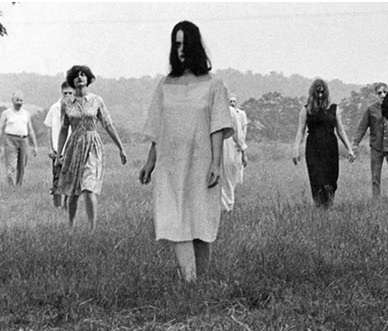
At the point where borrowed or ‘captured’ movement becomes acceptably realistic, its bearer – the animated figure – becomes unsettling, regardless of character imprinting and physiognomy. It is more goblin than elf and, insofar as it seems to have substance rather than mere spirit, more zombie than spectre.

If we persist with the fairyfication, then the animated figure is an embodiment of  an advanced and complicated technology that may be viewed as a stealer of souls, a producer of doubles and an adept at the switcheroo previously practised by the fairies that took your baby away and left you with a spooky changeling. The industrial champions of CGI compound all this with their ‘soon be better than the real thing’ boastfulness.

The animation technologies are themselves embodiments of technological slave systems, in the sense that a machine or component may control another machine or component. To be controlled by a machine is to be forcibly machinised and might suggest a condition in which one’s movements were constantly surveilled or even captured. The term ‘motion capture’ is efficient, especially when shifted from the movies to the experience of having the status of a component.

28.11.2008