
Roger, Syd & the Batman – the Dark Night of Cool
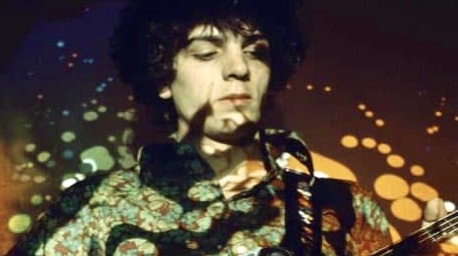
This is the text of a talk I gave at Borders in Cambridge in October 2008, in the course of the weeklong ‘The City Wakes’ , Cambridge’s tribute to Syd Barrett of the Pink Floyd.
I lived round the corner from Syd Barrett in Cambridge in the late 50s and early 60s. We attended secondary schools a few hundred yards apart in the leafy Hills Road, hung out in Cambridge as the Beat scene slouched into sight and then moved up to London. Syd was the first to leave town, in early 1965, finding a cheap room in a house in Tottenham Street off the Tottenham Court Road. The house was owned by Ella O’Connell, mother of Seamus, a schoolfriend of Syd. A few months later, towards the end of 1965, I moved up to London and stayed on a mattress in Syd’s room for a few weeks before acquiring my own cold-water space next door.
By this time was Syd was playing underground clubs with the Floyd and starting to become well-known. We moved down the road to Cambridge Circus, on the edge of Soho. Syd was taking LSD from time to time. So was everybody else. The flat in Earlham Street was a hotbed of 60s experimentation, in which emigrants from Cambridge met kindred spirits who were streaming in from other towns in order to settle in the British capital of consciousness expansion. A year later I left my West End flat, along with Storm Thorgerson, a close friend from Cambridge and one of the founders of Hipgnosis, who were later to design all the Pink Floyd’s album artwork. We found a place in South Kensington near the Royal College of Art, whose Film School we would attend for the next three years. It was in this flat, in 1967, that Syd came to live with Lyndsey Corner when he had entered the penultimate phase of his troubled years in London. After Syd, by now sullen, silent and staring, left for his final flat in Earl’s Court, I never saw him again.
That outline, ladies and gentlemen, is the most compact account I have ever delivered of the part of my life that I shared with Syd. I usually bang on at rather greater length.
Every time a new book about Syd Barrett or the Pink Floyd is proposed I am ritually interviewed, along with a number of other denizens of the Cambridge and London scene. I enjoy it. I’m aware, nevertheless, that our recollections have proved unreliable and inconsistent and more than one researcher has pointed out to me that in terms of dates, geography and serial order, our contributions are chronological rubbish, almost as if a curious intoxication had gripped those groovers from longhaired yesteryear, impairing valuable memory functions. As the books continue to emerge I have become aware that the standards of research are consistently improving and more and more witnesses are being unearthed. This is obviously a good thing not least because it may eventually provide an underpinning for an analysis of the issues that, in my view, naturally arise from the stories and myths centred on Syd.
I want to talk about some of those issues today. I’m not going to anecdotalise about Syd much, nor will I dwell overlong on the remarkable Cambridge scene that is being recalled in ‘The City Wakes’ tribute. As the 60s steadily recedes and my ruminations on it continue, I’ve become absorbed by the notion that it might be possible to relate Syd’s plight not only to the drugs, the local circumstances and the rock’n’roll but to currents, contradictions and splits running through the 60s that are usually sidelined in the increasingly stark stereotypes of the period that are offered by the media. Syd, like all of us at that time, was living in an environment of new ideas and changing values that encouraged and, indeed, made fashionable, alternative ways of looking at the self, society, responsibility, work, creativity, the family and madness, among others. These are what I’m going to try to examine.
There are some issues very close to the heart of the matter that actually cannot be further explained with reference to the 60s. I think there’s an important psychiatric conundrum relating to Syd’s sad demise that is impossible to resolve. Did LSD materially damage the mechanisms of Syd’s brain or was his condition purely psychological? If Syd sustained brain damage, then from the period at which this occurred onwards he was beyond the reach of the most sophisticated therapies. If, though, he fell foul of a complex of malign circumstances then we are tempted to imagine that during his years of reclusiveness he was recoverable – we could get him back.
Given that a great deal of romanticising surrounds his legend, the second possibility is the more attractive. It makes Syd more tragic and more interesting: he is the victim of impossible conflicts, one who buckled and bowed out but might have been resurrected. Somewhere behind the 1000 yard stare is a tortured individual who may be, as Antonin Artaud, another madman hero, put it ‘like a victim burnt at the stake, signalling through the flames’. The idea here is that our reality is too unforgiving, too cruel, for a person who is truly alive. Where some will, as a consequence, retreat behind mirror shades, the hardcore madman hero is walled off behind a mask of blankness, spurned by a world incapable of appreciating him. I’m not belittling Syd’s experience here, rather the melodrama that is often constructed around the figure of the troubled artist.
Melodramas of madness were not uncommon in the 60s. The revolutionary psychiatric or ‘anti-psychiatric’, as it was called, thought of Ronald Laing was extremely influential in this country throughout the decade. R.D. Laing published seven books in the period, the first of which, and possibly the most influential, ‘The Divided Self’, came out as early as 1960. Without attempting to summarise the sophisticated and compassionate therapeutic ideas laid out in the work, it can be said that the most powerful Laingian notion was that the schizophrenic patient is not a purveyor of gobbledygook and nonsensical behaviour so much as an individual in an extreme dilemma attempting to communicate in ways that are intelligible if the analyst is prepared to listen closely and interpret.
In ‘The Conquest of Cool’, Thomas Frank’s study of the changes in the American advertising industry that took place between the 50s and the 60s, the author observes that the innovation and adventurousness of the alternative culture was regarded by the advertisers as both an inspiration and a gift. Frank said that ˜What happened in the 60s was that hip became central to the way American capitalism understood itself and explained itself to the public.’ Advertisers took the symbols and imagery of the counterculture and played them back to the youth, suitably refocused, in order to channel their energies towards consumption.
Throughout the 50s an intensely conservative sensibility had prevailed in advertising and the more nonconformist and creative types were frozen out. When the restlessness of the early 60s began to declare itself some of the suppressed admen outed themselves and rejected the stifling, hierarchised ways of the big agencies. They dissolved the almost military demarcations that had separated copywriters from art directors and inveighed energetically against conformity. They experimented widely with different office layouts and team structures. They admired rebel youth, coveted their fluid way with language, clothes and music and sought to enrich their own lives by emulating the laid-back tone of the kids.
One of the big breakthroughs in 60s advertising was the evolution of the ad that knocked ads. Understanding that new hip youth was profoundly distrustful of the old-fashioned hard sell that assumed widespread idiocy in the citizenry, admen began flattering the potential consumers with copy that congratulated them on their scepticism and plied them with material that attacked not just the solemnity and insincerity of the 50s ads but their corporate ideology.
Sometimes the assiduous arselicking would get out of hand: the most infamous and cringe-inducing example was Columbia Records’ grotesque bid for authenticity, in 1969, with its slogan ‘The Man Can’t Bust Our Music’. The real message seemed to be ‘Buy this to escape consumerism’
The admen believed not only that youth were an energetic new market but that youth’s liveliness could revitalise their own commercial practice. Frank notes that ‘By 1965 the Creative Revolution (that’s the revolution in advertising) had turned the industry’s theories and management practices on their head as Madison Avenue entered a period of unrestrained rule-breaking and idol-shattering.’ The parallel with the convulsions in the emergent counterculture is striking.
So stifling had the 50s been for Americans of many persuasions that when the valves blew it wasn’t only the hipsters that were cut loose. It wasn’t even that the admen slowly realised the commercial potentials of the hipsters. The admen got there at the same time as the hipsters and set about appropriating their language in order more efficiently to stimulate then satisfy their needs. The hipsters were keen for new sensations, they craved authenticity, they disdained emotional restraint, they wanted to act on their impulses and they turned their backs on history.
The admen realised that a new style of consumerism could be cultivated: hip consumerism. Before too long the hip advertisers had conjured a group entity that compensated for the nonconformity of the hip youth by defining their tastes and thereby enabling producers of product to supply appropriate goods. The longer term impact of advertising’s own 60s revolution was to be found in the widespread promotion of youth in advertisements for products in which youth had little interest, such as family cars. The hipsters had helped the admen to realise that the energy of youth appealed to consumers for whom it was just a distant memory.
So what does all this have to do with the tribulations of Syd Barrett? I don’t suppose that Syd was any more aware of the recruitment of his values to the cause of consumerism than anyone else among his peers. What he and his friends in Cambridge at that time had in common was an appetite for new ideas and their cultural manifestations. I look back fondly to the times spent in flats and bedsits when my fellow Beatboys and I would read plays by Beckett and Ionesco out loud together or intone spontaneous poems into reel to reel tape recorders. Many happy hours were spent in avid absorption and discussion and, thanks to the shoplifting skills of certain friends from surprisingly good families, there was no shortage of the latest books by the Beats or volumes dealing with the dadaists and Surrealists. These evenings bore an odd resemblance to Victorian parlour gatherings although I doubt that those gathered round the piano would have been quite so blasted on Dr Collis Brown’s Chlorodyne – an opium-based cough mixture – and they certainly wouldn’t have been zonked on dexies and grass.
Our enthusiasm for all that the new scene had to offer extended also to music. The combination of dope and jazz was potent and deepened a musical appreciation already primed by the wonders of rock’n’roll that had arrived in the mid 50s with Elvis and evolved into the Beatles by the early 60s. When ‘Sgt. Pepper’s Lonely Hearts Club Band’ was released in the Summer of Love in 1967, an awed hush fell over the flat in South Kensington as Storm Thorgerson removed the cellophane wrapper from the album that had become legendary within hours of its release. Two months later the Pink Floyd released ‘Piper at the Gates of Dawn’ and it felt for a while, in London at least, that the cultural revolution had changed up into overdrive.
A few thousand miles east ‘Operation Rolling Thunder’continued in North Vietnam as American bombers entered a second year of continuous bombing designed to force North Vietnam to cease its support for the National Front for the Liberation of South Vietnam (NLF) by threatening to destroy North Vietnam’s air defenses and industrial infrastructure. In 1968 ex-Chief of Staff General Curtis Lemay would recommend bombing North Vietnam ‘back to the Stone Age’.
And we also needed clothes. The early Beat look could be constructed from Levis purchased from American servicemen in the fearsome Criterion pub in Cambridge and shirts and military fatigues found in Milletts. By the time the Summer of Love came round it was necessary to hunt down paisley shirts, velvet trousers and afghan coats from Kensington Market, Granny Takes a Trip and their ilk, with coloured leather, zip-sided, cuban-heeled boots purchased from Gohil’s in Camden Town.
That was a pretty cheap juxtaposition that I just offered. But, as Coppola’s ‘Apocalypse Now’ was to point out in 1979, dope and dexies were not just being consumed by hipsters but by grunts, at the same time, with the same music, on the other side of the planet. The cultural revolution wound down precisely because its agenda for change was politically disconnected. The hippies didn’t have the full picture, they had decamped to a less material world.
In 1970, a period presided over by President Richard Nixon, the faultline opened up irreversibly when the Ohio National Guard, called to the campus of Kent State University, shot and killed four students and wounded nine others. The most famous photograph from this dark night of cool shows a young woman screaming over the body of Jeffrey Miller, a student who had been shot in the mouth. The young woman was a fourteen-year old runaway, Mary Ann Vecchio. It is highly probable that Vecchio had run away as a result of Timothy Leary’s initially exhilarating injunction to’Turn on, tune in, drop out’. She was, however, apparently one of those who had straddled the faultline for she had been involved in the campus demonstrations against the invasion of Cambodia and was near Jeffrey Miller who had been standing closest to the Guardsmen of all those killed or wounded.
The iconic photograph was retouched for magazine distribution. It was felt that a vertical fence post apparently rising from the back of Vecchio’s head was unnecessarily distracting.
Syd Barrett was one of hundreds of thousands who were engrossed in the culture shifts but whose political engagement, as I recall it, was modest, and typically so. The Vietnam War was deplored but in some unspecified way it was not as pressing a concern as the cultural forces inexorably moving society towards transformation. Emancipated youth, in the mid 60s, fell broadly into two camps, the hippies and the politicals. Both camps were radical, in their way, and both felt a strong sense of entitlement. Hippie aspirations to a society transformed by culture gradually expired on both sides of the Atlantic as the Vietnam war ground on. It became clear that those with political connection could change the behaviour of the Man. 8 million students went on strike after Kent State, contributing further to the political division of the country.
‘Consumer culture is a gigantic fraud. It demands that you act like everyone else, that you restrain yourself, that you fit in with the crowd, when you are in fact an individual. Consumer culture lies and seeks to sell you shoddy products that will fall apart or be out of style in a few years; but you crave authenticity and are too smart to fall for that Madison Avenue stuff. Above all, consumer culture fosters conventions that are repressive and unfulfilling; but with the help of hip trends you can smash though those, create a new world in which people can be themselves, pretence has vanished, and healthy appetites are liberated from the stultifying mores of the past.’
Those last few lines are also a bit of a cheap stunt, insofar as they are taken directly from Thomas Frank’s ‘Conquest of Cool’ and, in the context of their chapter in the book, are prefaced by the following lines: ‘The central theme that gives coherence to American advertising of both the early and late sixties is this:…’ There then follows directly the critical stuff about consumer culture. Frank makes the point that American admen predicted the rise of an affluent youth that would be preoccupied with individuality and nonconformity. The admen surmised that despite their often stridently proclaimed antipathy to advertising, the youth would not be disinclined to consume.
From the early 60s then, advertisements in American magazines were pitched to an audience that distrusted them as a matter of course yet might respond well if they were addressed on their own terms. Ads pandered to the notion of the principled, nonconformist individual. For example: in 1967 the Oldsmobile Toronado – a car – was promoted with the line ‘Frankly, the Toronado is not for the average man.’ The notion of the authentic but unrecognised self was raised in the slogan for Colby’s furniture chain ‘The real you is alive and hiding out at Colby’s’. Suzuki’s 1969 motorbike copy borrowed hip slang to make its point: ‘To move. To grab at the wind. To get out of the “where-it’s-at” bag. Suzuki has the power to free you.’ Despite the crass obsequiousness of the Columbia Records ‘The Man Can’t Bust Our Music’ slogan, ads that promoted hip consumerism were ubiquitous. The admen were playing chess with the hipsters: they foresaw critical or resistant stances, ran around them and played them straight back to a burgeoning demographic that craved clothes, music and books. Not only that, they used the idea of youth to sell goods to people who had lost their youth, still yearned for it and were not, therefore, averse to being addressed as if they were young.
In an explanation of the psychiatric notion of the double-bind, R.D. Laing offered the example of the mother who dangled her child from a high balcony and exclaimed ‘See how much I love you: I don’t drop you!’ Laing suggested that the protracted experience of comparably irresolvable conflicts – ‘double binds’ – within a family setting was an aspect of the schizogenic power of the family. He might have observed also that the experience of having ‘The Man’ warn you against ‘The Man’, or the utterly conformist advertising industry side with you in your critique of the conformism of the advertising industry was sufficiently confusing to induce chronic destabilisation. It could drive you nuts.
For many, if not most, of my own hippy acquaintances, such pandering was all too obvious. ‘Jesus, how stupid do they think we are, those advertising shitheads?’ But I wonder if such indignation is quite the point. British advertising is probably some of the most reflexive and ironic in the west and connoisseurs of those ads have enjoyed decades of feeling, if not superior, then very much ‘in on the joke’. If this self-congratulation is admitted then the ad has already won the contest. Our connoisseurship is our Achilles heel. Sliding stealthily beneath our declarations of knowingness are persuasive forces that appeal to the pre-ironic individual and make him or her feel like a valued confidante.
Those ads in which ordinary housewives profess their unaffected amazement at the power of a detergent are strangely powerful. The housewives are so real, surely they can’t be actors. But they are. Really good ones. Really really good ones. I remember Nick Mason telling me that Syd was taken aback by the chores that attend the business of being a famous pop star. You have to get up in the morning and do a photo shoot then go to see your accountants then discuss tours with your manager then do interviews with magazines. It goes on and on all day and Syd didn’t like it.
When he turned up late for ‘Top of the Pops’ he said that John Lennon didn’t have to do that programme so why should he? Perhaps Syd was taken in by the really good acting of John Lennon and other stellar figures. When he had to step on stage, both literally and figuratively, perhaps he was taken aback by the increasingly work-like quality of the experience. When he stood on stage and strummed an out-of-tune guitar not only through the numbers but between the numbers perhaps he was describing an experience, not resisting one. This was towards the bitter end, when he was particularly bitter.
The Piper at the Gates of Dawn, the figure drawn from a chapter in Kenneth Grahame’s ‘Wind in the Willows’, would not come to Syd’s aid. The Piper is the god Pan who legendarily caused terror and confusion – panic – when encountered in lonely places. In his benign mode he is the god of shepherds, fields and fertility, places where Emily can play, where little gnomes stay in their homes, eating, sleeping, drinking their wine. Syd encountered him in a lonely place, only months after the release of the album that bears Pan’s name. By January 1968 Syd was out of the band. Panic, perhaps, had seized him and the only recourse was to back off. For forty years.
Syd had repeatedly taken heroic doses of a strong hallucinogenic drug that temporarily dissolved egos and resistances and, one imagines, exposed the subject to the full force of any normally muffled messages that might have been circulating among his friends, in the music industry, in the fashionable end of radical developments in psychiatry, in the culture at large. The hip scene in England took many of its cues from the USA and, in Cambridge and London at least, were many visitors, emissaries, artists, zonked saints and evangelists of vagueness from across the Atlantic whose impact was part of the remarkable, ceaselessly transmuting cultural landscape.
Some of these value systems were fragile. The worldliness that the hipster was required to evince was based on a world that he was vacating. The disdain for connection produced a synopsis of the world that was low on detail and failed to acknowledge its great weight, other than in declarations of dismissal. It was in this weakened world that counter-countercultural forces were slowly but surely leading the hipsters back into the consumerism that would possibly form their behaviour and exploit their compliance for much of their subsequent lives.
It was in this world weakened by defection that transcendental projects were readily confused with regression to childhood and spiritual endeavours served further to dematerialise the place that you found yourself in when you woke up in the morning, namely the world that provides the earth upon which your house is built. This was a place in which widespread and wilful misreadings of the value of madness made being fucked up attractive and interesting. In this rickety world Syd became a rock star, an icon of whom it was expected that, simply because of his artistic and commercial achievement, his beauty and his genius, he would weld together all the splits that defined the age. Asking a bit much, really.
I hope I haven’t tried to understand Syd’s psychological makeup. This has not been my purpose. I’ve attempted to link him into a context that, in tandem with whatever he was like, may shed some light on why he lost his way.

To dismiss the patient’s communications as evidence of an underlying disorder was to medicalise a condition that did not require medicine. The patient was on a journey and should be helped to complete it, not subjected to electroshock or vegetalising tranquillisers.
Laing also insisted that schizophrenia often arose when an individual became the scapegoat for unspoken tensions in the family. This proved to be an extremely attractive analysis well outside of the community of the clinically affected. Suddenly one’s difficulties with the aliveness of life could be attributed to’schizogenic’ forces circulating around one’s formative years and, by extension, in society at large – the society that had maddened the parents who had driven the patient mad.
The idea that society could be considered ‘schizogenic’was breathakingly exciting at a point in the 60s when it seemed that a whole generation was turning pointedly against the conservatism of the parent generation, constructing not just an alternative culture but a counterculture. We had the analysis we needed. And it was sound. A psychologised politics, a politicised psychology – we could see that these were tools that would hasten the various modes of revolution, largely cultural, it must be said, that we envisaged. Madness became fashionable. Mad was the new black. It was cool to be incoherent, overwhelmed and vague, the victim of a violent and anti-psychological society, a victim on a shamanic journey towards wisdom and insight. It was also cool to use certain drugs to hasten and intensify the detachment that seemed to be a basic prerequisite of the new maddened insight.
This detachment assumed a number of styles. Timothy Leary’s injunction to ‘Turn on, Tune In, Drop Out’ encouraged a secession from conventional social structures and behaviour and spawned an inventive search for alternative lifestyles. LSD, the drug championed by Leary, endowed many users with the sensation that society was in some way transparent and therefore illusory and/or without worth. For some users, LSD delivered the experience of other, nonmaterial levels of existence that appeared to have spiritual significance. Access to these levels would be difficult were the user to become too enmeshed in the material world. It further became apparent that the material world itself was susceptible to being renewed – it was a site of potential beauty, meaning and rich experience. Such a transformation could be effected if, in turn, a contaminating contact with the straight world was minimised.
My purpose here is not to disparage these possibilities but to attempt to evoke an expanded territory in which certain novel values were circulating. These values would certainly have enveloped and engrossed Syd as they did so many of us in the Cambridge scene.
It has been remarked that in Syd’s world, insofar as it is detectable in his music and lyrics, there was a clear split between regressive and progressive. Some of the songs are turned towards the nursery and are concerned with gnomes, unicorns, rainbows and clouds – invariably delivered with an uncompromised jolliness and bounce. Perhaps the imagery dates from the days when Syd was Roger (his given first name). If that is the case and Roger is Syd’s past then what of Syd’s future? If Roger were to lose his innocence and idealism then what would Syd become? An answer is readily available on the Floyd’s 1967 debut album ‘Piper at the Gates of Dawn’.
Alongside whimsical tracks such as’The Gnome’ and ‘The Scarecrow’, is the longer, musically more experimental track ‘Astronomy Domine’ in which some of the outer reaches of the newly expanded territory have already lost their charm. This is where there is a ‘A fight between the blue you once knew’, where ‘Neptune, Titan, Stars can frighten’, and ‘Floating down, the sound resounds/ Around the icy waters underground’.
The threat is best summed up in the line ‘Blinding signs flap,/ Flicker, flicker, flicker blam/ Pow, pow’, where a progression from meaningfulness to arbitrariness to a threat of annihilation is achieved in the course of a few words. It is as if the loss of Roger made Syd comparable to Bruce Wayne who, isolated and embittered by great personal loss, donned the cape of the Batman, concealing his disillusion behind a mask of sullen detachment.
Eventually this stance proved insufficiently protective; Syd left the Batcave in Earl’s Court and, for the rest of his life, rejoined Roger, in whose forlorn embrace he could nurse his wounded idealism in retirement from society. (The idea that he could really ‘rejoin Roger’ is itself far-fetched.)
One of the dilemmas facing the hipster in the 60s was the obligation to appear open, innocent and childlike at the same time as being unshockable, sceptical and worldly. Both modes were permitted and valued. Some could ride this beast with two backs, others were unsuited and unseated. A faultline ran through the impassivity of Cool. The poles were not manageable. A split was inevitable.
In ‘The Conquest of Cool’, Thomas Frank’s study of the changes in the American advertising industry that took place between the 50s and the 60s, the author observes that the innovation and adventurousness of the alternative culture was regarded by the advertisers as both an inspiration and a gift. Frank said that ˜What happened in the 60s was that hip became central to the way American capitalism understood itself and explained itself to the public.’ Advertisers took the symbols and imagery of the counterculture and played them back to the youth, suitably refocused, in order to channel their energies towards consumption.
Throughout the 50s an intensely conservative sensibility had prevailed in advertising and the more nonconformist and creative types were frozen out. When the restlessness of the early 60s began to declare itself some of the suppressed admen outed themselves and rejected the stifling, hierarchised ways of the big agencies. They dissolved the almost military demarcations that had separated copywriters from art directors and inveighed energetically against conformity. They experimented widely with different office layouts and team structures. They admired rebel youth, coveted their fluid way with language, clothes and music and sought to enrich their own lives by emulating the laid-back tone of the kids.
One of the big breakthroughs in 60s advertising was the evolution of the ad that knocked ads. Understanding that new hip youth was profoundly distrustful of the old-fashioned hard sell that assumed widespread idiocy in the citizenry, admen began flattering the potential consumers with copy that congratulated them on their scepticism and plied them with material that attacked not just the solemnity and insincerity of the 50s ads but their corporate ideology.
Sometimes the assiduous arselicking would get out of hand: the most infamous and cringe-inducing example was Columbia Records’ grotesque bid for authenticity, in 1969, with its slogan ‘The Man Can’t Bust Our Music’. The real message seemed to be ‘Buy this to escape consumerism’
The admen believed not only that youth were an energetic new market but that youth’s liveliness could revitalise their own commercial practice. Frank notes that ‘By 1965 the Creative Revolution (that’s the revolution in advertising) had turned the industry’s theories and management practices on their head as Madison Avenue entered a period of unrestrained rule-breaking and idol-shattering.’ The parallel with the convulsions in the emergent counterculture is striking.
So stifling had the 50s been for Americans of many persuasions that when the valves blew it wasn’t only the hipsters that were cut loose. It wasn’t even that the admen slowly realised the commercial potentials of the hipsters. The admen got there at the same time as the hipsters and set about appropriating their language in order more efficiently to stimulate then satisfy their needs. The hipsters were keen for new sensations, they craved authenticity, they disdained emotional restraint, they wanted to act on their impulses and they turned their backs on history.
The admen realised that a new style of consumerism could be cultivated: hip consumerism. Before too long the hip advertisers had conjured a group entity that compensated for the nonconformity of the hip youth by defining their tastes and thereby enabling producers of product to supply appropriate goods. The longer term impact of advertising’s own 60s revolution was to be found in the widespread promotion of youth in advertisements for products in which youth had little interest, such as family cars. The hipsters had helped the admen to realise that the energy of youth appealed to consumers for whom it was just a distant memory.
So what does all this have to do with the tribulations of Syd Barrett? I don’t suppose that Syd was any more aware of the recruitment of his values to the cause of consumerism than anyone else among his peers. What he and his friends in Cambridge at that time had in common was an appetite for new ideas and their cultural manifestations. I look back fondly to the times spent in flats and bedsits when my fellow Beatboys and I would read plays by Beckett and Ionesco out loud together or intone spontaneous poems into reel to reel tape recorders. Many happy hours were spent in avid absorption and discussion and, thanks to the shoplifting skills of certain friends from surprisingly good families, there was no shortage of the latest books by the Beats or volumes dealing with the dadaists and Surrealists. These evenings bore an odd resemblance to Victorian parlour gatherings although I doubt that those gathered round the piano would have been quite so blasted on Dr Collis Brown’s Chlorodyne – an opium-based cough mixture – and they certainly wouldn’t have been zonked on dexies and grass.
Our enthusiasm for all that the new scene had to offer extended also to music. The combination of dope and jazz was potent and deepened a musical appreciation already primed by the wonders of rock’n’roll that had arrived in the mid 50s with Elvis and evolved into the Beatles by the early 60s. When ‘Sgt. Pepper’s Lonely Hearts Club Band’ was released in the Summer of Love in 1967, an awed hush fell over the flat in South Kensington as Storm Thorgerson removed the cellophane wrapper from the album that had become legendary within hours of its release. Two months later the Pink Floyd released ‘Piper at the Gates of Dawn’ and it felt for a while, in London at least, that the cultural revolution had changed up into overdrive.
A few thousand miles east ‘Operation Rolling Thunder’continued in North Vietnam as American bombers entered a second year of continuous bombing designed to force North Vietnam to cease its support for the National Front for the Liberation of South Vietnam (NLF) by threatening to destroy North Vietnam’s air defenses and industrial infrastructure. In 1968 ex-Chief of Staff General Curtis Lemay would recommend bombing North Vietnam ‘back to the Stone Age’.
And we also needed clothes. The early Beat look could be constructed from Levis purchased from American servicemen in the fearsome Criterion pub in Cambridge and shirts and military fatigues found in Milletts. By the time the Summer of Love came round it was necessary to hunt down paisley shirts, velvet trousers and afghan coats from Kensington Market, Granny Takes a Trip and their ilk, with coloured leather, zip-sided, cuban-heeled boots purchased from Gohil’s in Camden Town.
That was a pretty cheap juxtaposition that I just offered. But, as Coppola’s ‘Apocalypse Now’ was to point out in 1979, dope and dexies were not just being consumed by hipsters but by grunts, at the same time, with the same music, on the other side of the planet. The cultural revolution wound down precisely because its agenda for change was politically disconnected. The hippies didn’t have the full picture, they had decamped to a less material world.
In 1970, a period presided over by President Richard Nixon, the faultline opened up irreversibly when the Ohio National Guard, called to the campus of Kent State University, shot and killed four students and wounded nine others. The most famous photograph from this dark night of cool shows a young woman screaming over the body of Jeffrey Miller, a student who had been shot in the mouth. The young woman was a fourteen-year old runaway, Mary Ann Vecchio. It is highly probable that Vecchio had run away as a result of Timothy Leary’s initially exhilarating injunction to’Turn on, tune in, drop out’. She was, however, apparently one of those who had straddled the faultline for she had been involved in the campus demonstrations against the invasion of Cambodia and was near Jeffrey Miller who had been standing closest to the Guardsmen of all those killed or wounded.
The iconic photograph was retouched for magazine distribution. It was felt that a vertical fence post apparently rising from the back of Vecchio’s head was unnecessarily distracting.
Syd Barrett was one of hundreds of thousands who were engrossed in the culture shifts but whose political engagement, as I recall it, was modest, and typically so. The Vietnam War was deplored but in some unspecified way it was not as pressing a concern as the cultural forces inexorably moving society towards transformation. Emancipated youth, in the mid 60s, fell broadly into two camps, the hippies and the politicals. Both camps were radical, in their way, and both felt a strong sense of entitlement. Hippie aspirations to a society transformed by culture gradually expired on both sides of the Atlantic as the Vietnam war ground on. It became clear that those with political connection could change the behaviour of the Man. 8 million students went on strike after Kent State, contributing further to the political division of the country.
‘Consumer culture is a gigantic fraud. It demands that you act like everyone else, that you restrain yourself, that you fit in with the crowd, when you are in fact an individual. Consumer culture lies and seeks to sell you shoddy products that will fall apart or be out of style in a few years; but you crave authenticity and are too smart to fall for that Madison Avenue stuff. Above all, consumer culture fosters conventions that are repressive and unfulfilling; but with the help of hip trends you can smash though those, create a new world in which people can be themselves, pretence has vanished, and healthy appetites are liberated from the stultifying mores of the past.’
Those last few lines are also a bit of a cheap stunt, insofar as they are taken directly from Thomas Frank’s ‘Conquest of Cool’ and, in the context of their chapter in the book, are prefaced by the following lines: ‘The central theme that gives coherence to American advertising of both the early and late sixties is this:…’ There then follows directly the critical stuff about consumer culture. Frank makes the point that American admen predicted the rise of an affluent youth that would be preoccupied with individuality and nonconformity. The admen surmised that despite their often stridently proclaimed antipathy to advertising, the youth would not be disinclined to consume.
From the early 60s then, advertisements in American magazines were pitched to an audience that distrusted them as a matter of course yet might respond well if they were addressed on their own terms. Ads pandered to the notion of the principled, nonconformist individual. For example: in 1967 the Oldsmobile Toronado – a car – was promoted with the line ‘Frankly, the Toronado is not for the average man.’ The notion of the authentic but unrecognised self was raised in the slogan for Colby’s furniture chain ‘The real you is alive and hiding out at Colby’s’. Suzuki’s 1969 motorbike copy borrowed hip slang to make its point: ‘To move. To grab at the wind. To get out of the “where-it’s-at” bag. Suzuki has the power to free you.’ Despite the crass obsequiousness of the Columbia Records ‘The Man Can’t Bust Our Music’ slogan, ads that promoted hip consumerism were ubiquitous. The admen were playing chess with the hipsters: they foresaw critical or resistant stances, ran around them and played them straight back to a burgeoning demographic that craved clothes, music and books. Not only that, they used the idea of youth to sell goods to people who had lost their youth, still yearned for it and were not, therefore, averse to being addressed as if they were young.
In an explanation of the psychiatric notion of the double-bind, R.D. Laing offered the example of the mother who dangled her child from a high balcony and exclaimed ‘See how much I love you: I don’t drop you!’ Laing suggested that the protracted experience of comparably irresolvable conflicts – ‘double binds’ – within a family setting was an aspect of the schizogenic power of the family. He might have observed also that the experience of having ‘The Man’ warn you against ‘The Man’, or the utterly conformist advertising industry side with you in your critique of the conformism of the advertising industry was sufficiently confusing to induce chronic destabilisation. It could drive you nuts.
For many, if not most, of my own hippy acquaintances, such pandering was all too obvious. ‘Jesus, how stupid do they think we are, those advertising shitheads?’ But I wonder if such indignation is quite the point. British advertising is probably some of the most reflexive and ironic in the west and connoisseurs of those ads have enjoyed decades of feeling, if not superior, then very much ‘in on the joke’. If this self-congratulation is admitted then the ad has already won the contest. Our connoisseurship is our Achilles heel. Sliding stealthily beneath our declarations of knowingness are persuasive forces that appeal to the pre-ironic individual and make him or her feel like a valued confidante.
Those ads in which ordinary housewives profess their unaffected amazement at the power of a detergent are strangely powerful. The housewives are so real, surely they can’t be actors. But they are. Really good ones. Really really good ones. I remember Nick Mason telling me that Syd was taken aback by the chores that attend the business of being a famous pop star. You have to get up in the morning and do a photo shoot then go to see your accountants then discuss tours with your manager then do interviews with magazines. It goes on and on all day and Syd didn’t like it.
When he turned up late for ‘Top of the Pops’ he said that John Lennon didn’t have to do that programme so why should he? Perhaps Syd was taken in by the really good acting of John Lennon and other stellar figures. When he had to step on stage, both literally and figuratively, perhaps he was taken aback by the increasingly work-like quality of the experience. When he stood on stage and strummed an out-of-tune guitar not only through the numbers but between the numbers perhaps he was describing an experience, not resisting one. This was towards the bitter end, when he was particularly bitter.
The Piper at the Gates of Dawn, the figure drawn from a chapter in Kenneth Grahame’s ‘Wind in the Willows’, would not come to Syd’s aid. The Piper is the god Pan who legendarily caused terror and confusion – panic – when encountered in lonely places. In his benign mode he is the god of shepherds, fields and fertility, places where Emily can play, where little gnomes stay in their homes, eating, sleeping, drinking their wine. Syd encountered him in a lonely place, only months after the release of the album that bears Pan’s name. By January 1968 Syd was out of the band. Panic, perhaps, had seized him and the only recourse was to back off. For forty years.
Syd had repeatedly taken heroic doses of a strong hallucinogenic drug that temporarily dissolved egos and resistances and, one imagines, exposed the subject to the full force of any normally muffled messages that might have been circulating among his friends, in the music industry, in the fashionable end of radical developments in psychiatry, in the culture at large. The hip scene in England took many of its cues from the USA and, in Cambridge and London at least, were many visitors, emissaries, artists, zonked saints and evangelists of vagueness from across the Atlantic whose impact was part of the remarkable, ceaselessly transmuting cultural landscape.
Some of these value systems were fragile. The worldliness that the hipster was required to evince was based on a world that he was vacating. The disdain for connection produced a synopsis of the world that was low on detail and failed to acknowledge its great weight, other than in declarations of dismissal. It was in this weakened world that counter-countercultural forces were slowly but surely leading the hipsters back into the consumerism that would possibly form their behaviour and exploit their compliance for much of their subsequent lives.
It was in this world weakened by defection that transcendental projects were readily confused with regression to childhood and spiritual endeavours served further to dematerialise the place that you found yourself in when you woke up in the morning, namely the world that provides the earth upon which your house is built. This was a place in which widespread and wilful misreadings of the value of madness made being fucked up attractive and interesting. In this rickety world Syd became a rock star, an icon of whom it was expected that, simply because of his artistic and commercial achievement, his beauty and his genius, he would weld together all the splits that defined the age. Asking a bit much, really.
I hope I haven’t tried to understand Syd’s psychological makeup. This has not been my purpose. I’ve attempted to link him into a context that, in tandem with whatever he was like, may shed some light on why he lost his way.
[/et_pb_text]


