No Respect

I was ugly, very ugly. When I was born, the doctor smacked my mother.

One night I came home. I figured, let my wife come on. I’ll play it cool. Let her make the first move. She went to Florida.

When my old man wanted sex, my mother would show him a picture of me.

I get no respect at all – When I was a kid, I lost my parents at the beach. I asked a lifeguard to help me find them. He said “I don’t know kid, there are so many places they could hide”.

I’ll tell ya, I don’t get no respect… The other day, I got back from a business trip. I got in a cab and said to the driver, “Hey! Take me to where the action is!” So ya know where he took me? He took me to my house!

A girl phoned me the other day and said… ‘Come on over, there’s nobody home.’ I went over. Nobody was home.

I told my psychiatrist that everyone hates me. He said I was being ridiculous – everyone hasn’t met me yet.

My mother never breast fed me, she told me she only liked me as a friend.

My psychiatrist told me I was crazy and I said I want a second opinion. He said okay, you’re ugly too.

A t first glance he’s neat and smart – usually a sharp blue suit, a white shirt and a red tie. The outfit rarely changes. Neither do the mannerisms that threaten to compromise the overall composure. The left hand straying to adjust the tie knot, a knot that does not require adjustment. Every few seconds the hand flies there, fidgets needlessly then drops to the side again. And then, after a short while, the sweating. It’s real. It shines under the lights. He’s obviously working hard but part of the attraction of what he does lies in the contrast between the smart outfit and the material that he’s producing. The sweat is therefore a little jarring, perhaps a product of that contrast. It’s not quite right. He will reach inside his jacket or into a back pocket, produce a handkerchief then mop his brow. Even when he’s finished and sitting next to the host at the desk, he continues to mop his brow. And that seems to suggest that he was tense and is still tense and while it helps the act perhaps in the beginning it wasn’t planned but it suited the act and has now become a part of it and, to some extent, is inseparable from it. Rodney has an urgency that reminds us that if you’re going to channel a stream of gags as if they’re just naturally popping into your head then it’s hard work – these things don’t come naturally. Is that what anybody is actually like? They walk in and these compact formulations are ejected twice a minute until time is up?

The gags are one or two-liners on the whole and must, obviously, be separated in some way if they are to make sense. Between each gag, then, comes this small fusillade of tics, the fiddling and dabbing bringing to mind the tugging of the shirt shoulder, the adjustment of the head band and the bounce after bounce after bounce of the ball before it is served by the tournament tennis player. While we don’t doubt that the tennis player wants very much to deliver, with Rodney we wonder if each new set of birth pangs will be the one that scuttles the enterprise.

So although he is superb his persona isn’t relaxed. It is shot through with tremors from the one who, from beneath its damp skin, animates the performance.  In this respect he’s subtler than Woody Allen. The physique  of the latter, his posture and his vocalisation are brought together harmoniously in the character of the whining weakling who will never experience a satisfying social transaction. But when Rodney pushes through the curtains the first impression is of one who is combative. He has a bullish demeanour, bulging eyes and he seems like a man in a hurry. It wouldn’t be all that surprising if he were packing a handgun. He’s wired.

Except that Rodney tells us, from time to time, ‘I don’t get no respect.’ This is his catchphrase. His act consists in his itemising the hundreds of instances in which he has been disrespected. It’s not observational comedy, the overrated genre which, in its disingenuous claim to derive from the clear and nonjudgmental eye of the portraitist, asks us rue our inability to see the funny side of life that’s beneath our noses. Instead it’s where Rodney, who may or may not suffer from low self-esteem when he’s at home, merely opens a vein of abjection then complains about it within earshot. He’s talking to us but you get the feeling that his internal monologue is not that different.

Oliver Stone clearly suspected that there was a thin line between love and hate when he was casting for Natural Born Killers (1994). The self-flagellation of Rodney’s humour could be turned outward, at which point he would become a psychopath rather than a stand-up. This proved  to be entirely the case. Ed Wilson, his character in the much underrated film, is Rodney to the max, unalleviated by nervous tics or the least indication that he may be domesticated to any degree. A masterclass in cartoonish, horrifying domestic sitcom parody, Rodney’s scenes as abusive, ogling, pawing, incestuous father to Juliette Lewis’s rebel girl Mallory are, despite the use of a sitcom laugh and applause track throughout, appalling yet exhilarating because somehow soon the slavering beast will be neutralised and his comeuppance will be as lurid as his fatherly behaviour is beyond the pale.


Towards the end of his amiable work in Cheers, Woody Harrelson was approached by Stone and took the role of Mickey, a natural born killer of a more suitable age for Mallory in the homicidal folie a deux rampage (52 victims) on which the couple embarks after Mickey has despatched Ed with a crowbar.

The first hour of the film is incongruously experimental for a Warner  Brothers product, both formally and in the nihilism of its moral instruction. It is pitched as a satire that will address the enthusiastic attention paid to celebrity killers but is so extravagant and poetic in its means that it becomes, in the same breath, an irresistible paean to unfettered recreational slaughter. The first 15 minutes do not so much test as erase the contours of sitcom convention, setting free an ordinarily muffled content that celebrates, within the frame of a passionate romance between two attractive and murderous young people with a lot in common, the amputation of  sociality that we are encouraged to believe is one of the great privileges of dedicated coupledom.

By presenting Ed/Rodney as the prime and incestuous transgressor Stone creates a space in which the abused and avenging Mickey and Mallory may outdo him as killers yet retain the charm of the natural born. Rodney Dangerfield’s stand-up comedy work is made palatable, furthermore, because it is presented as a species of self-harm but  in the menacing sitcom preamble to Stone’s movie this effect is redirected with the support of, amongst other things, the sound of manic laughter from the laugh track serving to remind us how uniquely thrilling are the pleasures of rupturing taboo.

17.08.2021

Vacant Possession

‘Sometimes a disappearance can be more haunting than an apparition.        Mark Fisher/k-punk – Nothing Happens. k-punk, 22/12/2006

http://kpunk.abstractdynamics.org/archives/008806.html

It is reputed that in the decades after the war, psychoanalysts began to report that there were fewer clients suffering from the classical Freudian disorders. The old Oedipus and Elektra complexes were thinning out, replaced by vague anxieties about not really being real, substantial or present at all.

Michael Newton – Lonely rangers: the dark side of westerns. The Guardian 06/05/16

https://www.theguardian.com/film/2016/may/06/dark-side-westerns-film-bfi-season-ride-lonesome

It had…no digestive tract, hence neither ate nor defecated, so required twelve-hourly infusions of a concentrated nutrient as well as regular hydration.                        William Gibson, 2020, Agency, Penguin Books UK Random House.  p.186

It wore black trainers with bright white soles, loose gray trousers cinched at the ankles, and a black kimono-cut jacket. And looked, in the confusing way of situations like, like Flynne. Not  that it actually bore anything more than a passing resemblance to her, but that he was so accustomed now to experiencing it as her physical avatar. ibid. p.187

…at any given moment consciousness includes only a small content, so that the greater part of what we call conscious knowledge must in any case be for very considerable periods of time in a state of latency, that is to say, of being psychically unconscious.

The Unconscious, S. Freud in The Unconscious (1915) ch.1 in Sigmund Freud – On Metapsychology vol II (1984) in The Theory of Psychoanalysis  series p.168. Penguin Books

“Have you seen Ash lately?”                     “We met her new partner,” Netherton said, “who Verity insists on calling a ‘woke’ peripheral. He’s entirely autonomous, not to mention very witty.” …                                        “Whatever makes her happy,” Lowbeer said, “in these times of ours.”               ibid. p.402 (the final page)

When Dick wrote Do Androids Dream of Electric Sheep? his key inspiration was not the dawning age of robotics but the real-life Nazi mass murderers whose diaries he had studied for his previous novel The Man in the High Castle. “For me android is a metaphor for people who are physiologically human but behaving in a non-human way” he told Paul M. Sammon, the author of Future Noir: The Making of Blade Runner, in 1981. “I use such terms as android and robot, but I’m really referring to a psychologically defective or malfunctioning or pathological human being.”

Steven Dalton, 2019. Blade Runner: anatomy of a classic, BFI.  www.bfi.org.uk/features/blade-runner

The human brain is the most complex entity in the universe. It has between fifty and one hundred billion nerve cells, or neurons, each branched to form thousands of possible connections with other nerve cells. It has been estimated that laid end to end, the nerve cables of a single human brain would extend into a line several hundred thousand miles long. The total number of connections, or synapses, is in the trillions. The parallel and simultaneous activity of innumerable brain circuits, and networks of circuits, produces millions of firing patterns each and every second of four lives. The brain has been described as a supersystem of systems.’

Gabor Maté, Scattered Minds. Vermilion. 1999. p.63.

Oh we’re so pretty
Oh so pretty
We’re vacant
Oh we’re so pretty
Oh so pretty
Vacant
Oh we’re so pretty
Oh so pretty
Ah but now
And we don’t care
Pretty Vacant (chorus). Sex Pistols (Paul Cook, Steve Jones, John Lydon, Glen Matlock). 1977

Some of the issues raised in the Strength Weekly essays Outlandish Inlandish Onlandish and Further to Outlandish, are complemented by futuristic fictional technologies that drive the narratives of the two most recent novels by William Gibson. The Peripheral (2014) and Agency (2020) respectively introduce then develop the notion of a connected array of devices that enable time travel by means of quantum tunnelling and remote control of humanoid avatars.

It’s possible that not even Gibson himself could explain with unwavering precision the ingenious but mysterious apparatus he has envisioned but it transpires that a person from the 21st century present (in this case a ‘present’ set in our own not-too-distant future) can socialise with another from the 22nd century by donning a headset enabling them to control a ‘peripheral’ body, a replica of the wearer’s body, that is materially apparent in the future. The headset is constructed in the present from plans transmitted from the future by ‘quantum tunnelling’ (this could be the point at which Gibson might be hard pressed to deliver any specifics; not that we necessarily crave this in speculative fiction).

As if getting dressed for an appointment, the 21st century human pilot of the peripheral puts on the headpiece which will transmit their speech and movements in real time i.e. with no timelag, to their humanoid avatar in the 22nd century. In the Gibson novels, the attitude of those in the 21st century towards peripherals is initially mistrustful – novice users  dismiss the experience as a sophisticated video game taking place in the present. 

It is probable that if we were actually confronted with an inhabited peripheral we would expect at the very least to be transfixed. The uncanny valley effect would be intensified by several orders of magnitude. If we did not know who or what was piloting the creature our sense of unease would be comparably heightened. If we knew that the avatar was piloted but nonhuman this would certainly be the case. If we only sensed that the avatar itself was nonhuman but had no means of confirming it our reluctant fascination would continue undimmed. In the latter case we might suspect that the person before us was ‘odd’ or ‘not quite right’ in some vague ‘mental health’ way. Vacillations between behaviour of any sort and its complete absence might even be construed as a terminal and virulent form of bi-polar disorder. A reflexive and irresistible othering would be in play. Not because of any overt monstrosity but because of its absence.

The nature of the peripheral when not being piloted is just as fascinating as its remotely animated state. It just sits there, uninhabited, in the next century. It doesn’t know ‘sit’. It has no sense of ‘there’. Whereas in the real world sometimes ‘The lights are on but nobody’s home’, in this case not even the lights are on.

Given that all science fiction is ultimately about the present, the fictional technology of the peripheral can be seen to articulate certain contemporary psychological dysfunctions with great eloquence.

An abiding anxiety associated with being a conscious being relates to the difficulty of quantifying being conscious. For example, how full should consciousness feel? Should there be a lot going on or just a modest amount? What does that mean? How would you measure it? Might it relate to how much is going on in the world or does that have only a marginal bearing on feelings of fullness or emptiness? Much of the time one feels there is no choice – regardless of the impact of external events the mind fills up anyway and thoughts compete, jostle and erase each other. But when, for example, the Sex Pistols announced their (Pretty) Vacancy in 1977 it seemed to apply not just to truculent Punks but to legions of the disaffected evenly dispersed across the nation.

The lyrics to the anthem could be taken further inasmuch as not just the emptiness but the Prettiness of Vacancy was acknowledged, albeit ironically. The Vacancy/Vacantness may have been a condition that grew out of political disgust – a refusal to take up any position of resistance on the grounds that it is demeaning to do so. This was not necessarily a bankrupt response so much as a disdainful riposte to bankruptcy. The absence of articulation was eloquent and is widely found to be attractively enigmatic.

Nevertheless, disdain is one of cool’s several attractive cousins and perhaps its most appropriated, serving to suggest an articulation that is withheld but may not actually exist. Strength Weekly has often dwelt on the allure of the unexpressed interior and the rich possibilities of projection that it offers.

The possibility of being empty is chronic. It never goes away.  While it is certainly the case that trauma can suppress even disruptive thoughts and depression can leach away distinctions, it is unlikely that any of us will ever encounter an ’empty’ person. The designation is figurative and the muted subject is able non-verbally to demonstrate desolate or diminished capacities for thinking, feeling and articulation itself.

It seems unlikely that the mind ever truly rests. Those who meditate claim otherwise but practitioners of my acquaintance say that the much sought ‘stilling’ can take years to develop let alone reliably maintain. We are familiar with the kind of information delivered in Gabor Maté’s quote (see sidebar) and without pausing to consider ‘how much of the brain is used in thinking’, it is clear that this unimaginably complex organ would have no capacity selectively to deactivate the various functions that synergetically produce thought. Death or damage will do it, of course, and the irreversible state known as ‘brain death’ or ‘brain stem death’ is only another way of describing death – it’s a medical euphemism.

Notwithstanding all of the above both the figurative and the literal ‘cases’ of ’emptiness’ need an extreme illustration to conjure them in a way that is satisfying and dramatic. Gibson’s peripheral supplies this and in so doing outstrips in terms of thoroughness even the ‘Blade Runner’ (1984) replicants, whose uncanniness tends to  taper off as they persist in displaying human discontents. As far we can gather, a replicant or ‘skin-job’, from the Dick/Scott stable has blood and veins and is wholly organic, produced by genetic engineers. It is destined to be ‘retired’ after four years but given that it  does not run on batteries could probably maintain its own metabolism and, were it not destined for liquidation, enjoy a lifespan comparable to that of its masters,

A pilotless peripheral, on the other hand – the sort of thing kept in the mid-22nd century garage, presumably – is stone dead. The confusing part, however, is that the ‘meat’ part of the creature has to be properly maintained, just as you would regularly water a pot plant. So while the ghost has most certainly left the machine, the machine itself must be regarded as the most uncanny locus of vacancy that one might ever brush up against.

If the peripheral’s owner went away for the weekend, the peripheral would be stacked emptily in the dark until they returned. If necessary a neighbour would be asked if they could keep an eye on its metabolism and tweak it if necessary. The owner would be looking forward to their great-grandaughter, as yet unborn, animating the creature from her apartment in 22nd century Madrid  next Friday.

Heroin intoxication, heroin chic, non-intoxicated heroin-like affect; being dead inside, the affectation of being dead inside (as a species of achievement), cool; hypnotised affect and affectation, robotism; catatonia, being blissed out, above it all, not all there, absent minded,  distant, reserved, somnolent; haunted.

If some of these states often appear to be performed rather more than they are felt this should not disqualify them from being regarded as instances or representations of the contemporary psychic equivalent of the fictional and futuristic peripheral. All arrayed against a backdrop of what Michael Newton calls (see sidebar) ‘vague anxieties about not really being real, substantial or present at all.’

Like charging points for electric cars, sources of vitalising power seem scarce even when we are assured that there is plenty with which to engage. When this elusive plenitude is found to be socially,  politically, economically or therapeutically inert then the experience of peripherality may feature an asphyxiation by vagrant, noisy cultural debris to the point that distinctions and differences can no longer be apprehended. It is as if a manic, atomised solution to the fear of emptiness had been found. But as the military veteran with the thousand yard stare might attest, in the unlikely event that they might speak, the road of excess leads to a place of great and discomforting quietness.

09.08.2021


Radio Gaga

You have a lot of time on your hands as an only child and one thing I used to do was pull faces in the mirror to see how unlike me I could look. Another thing was to experiment with noises, sometimes using my lips and fingers, more usually just vocalising without equipment. Again, the goal was to create sounds that didn’t sound human. I never thought of it like that, of course. Just trying out shapes and sizes and pushing air through cavities, sometimes trapping it and squeezing it along with tongue clicks and tongue rolls and various vibrations. You see kids do this sort of thing in the street or in the classroom – you can’t tell if they’re only children or not – why would they be? Maybe they had competitions with their siblings. Maybe they even tried unhuman choral effects.

It may dawn upon the young vocal experimentalist with time on their hands that although foreign languages feature noises that are simply not present in the English language, these noises can be imitated and may have a generative effect on the youngster’s private work to the extent of introducing not just variants but invasive species. (It should, of course, be acknowledged that the learning of foreign languages involves precisely such exercises. It is arguable that if only a few ‘foreign’ sounds can be competently imitated then other unfamiliar sounds within that language will be more readily reproduced. As in ‘Good – you can get your tongue round that, now try this…’)

I think I have a reasonably serviceable French accent and I attribute this to being made to intone, along with my classmates, a series of French vowel sounds over and over at school, at least three times a week. Several of these sounds were weird and on each occasion some rogue class members were lured away from the exercise at hand in order to push these novel sounds further than required by the French language as conventionally constituted. To our East Anglian ears the proximity of these sounds to those of the farmyard and field was a gap eagerly to be closed. The squealing pig was the most sought after candidate and our teacher, obliged to remonstrate in French, as was already the progressive foreign language teaching protocol in the 50s, would attempt to re-herd the room with exasperated demands for ‘Votre attention, les élèves!’

Schoolboys would have derived some encouragement for their abuse of the spoken word from postwar radio comedies that were richly populated by actors with distinctive voices or the ability to maintain distinctive voices that were not their own.  Sid James, for example, stuck with his lecherous Cockney growl throughout his career, despite having been born in South Africa, while Jimmy Edwards presented bombastic variations on a voice that drew on his experiences as a choral scholar who subsequently became an RAF flight lieutenant in WWII. June Whitfield was a versatile actor adept at comic voice work who ranged from Eth of The Glums in Take It From Here to the fuller sitcom role of Edina’s mother in Absolutely Fabulous. Irene Handl specialised in a remarkable, slightly frail, lightly grumbly yet cheery working class barmaid or charlady persona whose voice was so eccentric that it won her small parts in over 130 films and countless TV series.

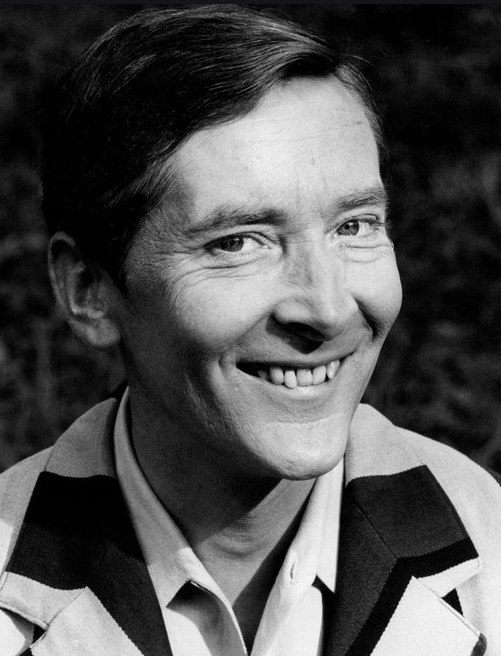
Although very much a signed up member of the 50s funny radio voice community, Kenneth Williams stands out insofar as his vocalisations moved beyond the parameters of sketch and sitcom scripts and seemed to strike out for shores at that point undefined. Williams found some possibilities for the ventilation of his concealed gayness in pushing what was, in the 50s and 60s, a standard camp drawl way beyond the limits established by other intrepid comic actors who had been given ‘tolerable because amusing pansy’ roles.

Williams responded to his scripts as if merely to analyse them sentence by sentence was a dereliction of duty. His view appeared to be that every single word was worthy of assault and if that meant respecting the meaning of the lines within the context of their location in fictional situations then so be it – it was a price worth paying and he had the acting skills to deliver what was required.

These line readings could, however, if one so wished, be lifted out of their radio sketch setting, stripped of their function within these frameworks and regarded as remarkable and unhinged exercises in a proposal for the almost human, the humanoid or the post-human – the latter in the sense that if a person could speak but had no world in which to express this ability then his vocalisations would still command respect and inspire awe in all those who came upon them from deep and outer space.

Williams’ voice would swoop, purr, croak, elasticate, shudder, nasalise, whinge, slide, climb, yowl, thunder and groan as he saw fit. Were there proper criteria for such achievements then he would certainly have been honoured with the creation of an annual Award – the Kenneth, perhaps – for outstanding contributions to the development of non-musical vocalisation in the service of higher post-syllabic communication.

It was in the mid 50s that my schoolmates and I became aware of The Goon Show, a radio comedy series that had been broadcasting on the BBC Home Service since 1951. This was a show without peer. It seemed to have no precedent at all. Other radio comedy programmes were amiable, intermittently a bit risqué, delivering a continuity, comfort and relief that recuperating post-war audiences deserved. They were not, however, fevered, free-form, comprehensively illogical or scrambled to the point of unrelieved delirium. The Goon Show was all of these and evinced a programmatic indifference to the conventions of ‘the programme’. In its eruptiveness and disorder it was a frenetic barrage that had some of the texture of war. In this respect it marked an early departure from the measured caution of a traumatised public withdrawing from years of dread and, in many cases, injury and bereavement. Among that public were younger listeners – perhaps in their late teens and early twenties – who had not seen military service and were ready for less cosy entertainments.

All of which is to say that if comic actors of the time who were blessed with voices and vocal effects of distinction had been exposed, in the early 50s, to writers and producers responding to early indications that a ‘post postwar’ sensibility was emerging, then The Goon Show might not have been, for several years, the lone rider in popular radio absurdism. It launched three years before Hancock’s Half Hour, also on Radio 1, set out an alternative to manic excitability with its droll celebration of the melancholy of a failed actor who barely believes in his enduring delusions of grandeur. In 1969, nine years after The Goon Show concluded, Monty Python first aired on TV.

The baton passed from the Goons had not immediately been seized but for those born in the early 50s, to be 15 years old or more in the Python era was to be ushered into an exhilarating expression of demented sketchwork that appealed especially to drugged youth and those who had enjoyed the cultural fruits of the final release from the PTSD caution of their parents that had characterised the 60s.

Where Williams had paved the way for what The Goon Show had to offer as far as decomposed speech went, he had also demonstrated what a visionary voice artist could achieve within sitcom scripts. The writer of the Goon scripts, Spike Milligan, clearly felt that there was no pressing reason to establish a recognisable bedrock sitcom reality – as obtained in Hancock’s Half Hour, for example – for comic actors to pitch up against. In radio you cannot see the walls. The imagination is relieved of any debt to theatre or the novel.

In the bike sheds of the mid 50s animated discussions of and noisy quotations from The Goons almost eclipsed the usual thrilling and outrageously folkloric lectures and debates on questions arising from an overheated fixation on female anatomy. School was tight back then and while The Goons was intermittently saucy it was the utter abandonment of plausible narrative in the shows that was revelatory and, for many, life changing. The war was ten years over and had been profoundly traumatising for all concerned but it had also provoked in some the view that the centre had just about held but mere anarchy was well overdue.

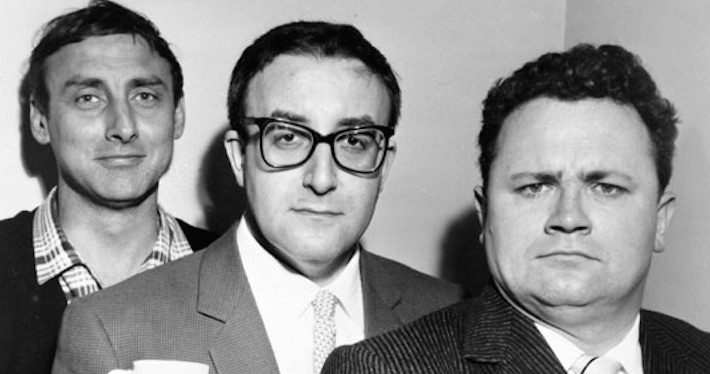
There are countless examples of coherent comedic incoherence to be found that are indebted, whether knowingly or not, to the epoch-making collaboration between writer Spike Milligan’s at times clinically marked mania, Peter Sellers’ mastery of so many funny voices that he once confessed, in all seriousness, that he could no longer remember what his normal voice was like, and Harry Secombe’s booming, screeching parodies of the straight (as in not mad) man to whom preposterous things Will Always Happen.

One magnificent vocalisation not usually found in the standard funny voice genealogies is actor Edward Tudor-Pole’s (aka Tenpole Tudor) contribution to Julien Temple’s The Great Rock’n’Roll Swindle (1980). Tenpole has doubtless been accused of wantonly mangling the lyrics and delivery of ‘Who Killed Bambi?’ but this would have been the not inaccurate view of people who know nothing.

28.02.2021

Thoughtless

I do not have an inner voice. I found this out by reading about mind exercises designed to stop you thinking, I found I did not have a voice to stop. I checked and tested some people and found they do have a voice and I was different. I have a reputation for just blurting out answers to problems and memorising data from long ago. I am INTJ* and highly functional in the technical area I work in. I have all the classic INTJ traits. I won’t say I have no inner voice, I just try to keep it out of the way and let my brain work on any problem I have submitted it. Sometimes when I blurt out an answer even I am surprised (whoever I is). I never believed a small little voice in my head limited to words could ever be an efficient thinking machine so perhaps I suppressed it.

Quote from a graduate with a Masters in Engineering & Software Engineering (1982), University College Dublin. Submitted to Quora in 2017. https://www.quora.com/I-do-not-have-a-subconscious-voice-inside-my-head-Is-this-normal

* INTJ (Introversion, Intuition, Thinking, Judgment) is an abbreviation used in the publications of the Myers-Briggs Type Indicator to refer to one of the 16 psychological types. According to Myers–Briggs the INTJ represents “The Mastermind”. INTJs are one of the rarest of the 16 psychological types and account for 2%—3% of the population. https://en.wikipedia.org/wiki/INTJ

Mental illness, at the risk of stating the obvious, is evidence of mental life. Mental life, when functioning well or otherwise, is experienced in part through the medium of thought. And the greater part of thought is experienced, by most people (there are exceptions – see above), as a species of inner voice or inner speech. A combination of mental imagery and inner language, in elusive and changing proportions, characterises most thought. The treatment of mental illness is hampered by a focus on symptoms as they arise rather than a policy of prevention. It is the view of researchers that ‘while the revolution in personal fitness, diet and medicine over the past half-century has transformed physical health, there have been few similar efforts to keep people well mentally.’  (‘Global call to step up earlier mental illness prevention’ by Mark Rice-Oxley, The Guardian, 08/06/19)

A reductive view of thought might be that it is the carrier or importer of illness – it is the mold on an exposed cheese. Setting aside the myriad and complex actual causes of mental dysfunction, the penultimate element in a causal chain of mental disruption could be seen as the array of thoughts or messages that appear to impinge on the mind. If this is the case then the possibility of shooting the messenger can arise. Thought is upsetting – how could it be neutralised?

Such a response is typical of the cognitive behavioural therapy school which, while dependent upon classical Freudian assumptions, chooses to minimise the significance of the unconscious by regarding disturbing or habitual thought patterns as suppressible and replaceable.

What gets thought a bad name is its unreliability, variability and unpredictability. Just as you start to use it to solve a problem or clarify a position, say, it turns on you like the bear in the Werner Herzog documentary ‘Grizzly Man‘ that ate the man who was confident he had tamed it. Thought may confront you with alternatives that block the path to an equilibrium in which the mind ambles along in an uncontentious way. Most of the time such inconveniences are manageable and are expressed by an inner voice that sounds just like your own outer voice. Sometimes inner speech is taken over by a voice or voices that are not yours. This may increase the leverage of contradictory or confusing messages but the phenomenon is still generally manageable. It need not be mistaken for its distant yet unsettling cousin, auditory verbal hallucination. Such a condition can be indicative of schizophrenia but the criteria for diagnosis are as pathologised as the pathology they purport to describe.

On occasion, when the inner voice is rendered in the wrong voice and mounts some sort of critical campaign it is tempting to characterise it as alien or even an alien. It can, equally, be regarded as an invasive spirit or as a ghost. The intensity of such ‘invasions’ can be mild and unperturbing or nagging, insistent and haunting. At such points, in the interests of preserving the thinker a distinction may be made between ‘thinking’ and ‘hearing’, where ownership of the latter is denied and quarantine is introduced.

We approach the possibility that thought comes to be regarded as a medium for the dissemination of fake news. It is a hoax. Clearly it has its uses – it would certainly be difficult to work things out without it. Nevertheless, it is unmannerly and impertinent insofar as it does not petition for entry – one moment it is not there and the next moment it is. There’s not much you can do about that.

Thought, as far as we tend to be aware, lacks the material qualities that render the body, to a degree, tractable. In addition to being impertinent, it is soft and difficult to grasp. It is teasing, coy, coquettish – it has feminine qualities. It is feminine yet it is found in male bodies. How can this be?

A luxurious possibility arises. Given that it is so slippery, it would be better to extinguish it. Not entirely, of course, you need some to work out train timetables, for example, but given its generally inconstant and ill-disciplined nature, the greater volume of it can be turned off.

It is at this point that true luxury is found. Little is lost. The grand hoax is trumped. Now we can get on.

Deface

When you’ve finished Netflix it becomes necessary to adjust the viewing criteria. I generally resist seeing films more than once but, with a few exceptions, will do so if cornered. A more enterprising move would be to seek out films that you don’t think you’ll like. An example would be the John Wick movies, with Keanu Reeves taking the titular role. Wick is some kind of agent or something and people are always after him so he shoots them. I liked the first John Wick but should have waited a few months longer before trying the second one, which I abandoned because it was just the same as the first one. Such fastidiousness is easily overridden in lockdown and John Wick Chapter 3 – Parabellum becomes singularly unpromising within the first ten minutes. So resolutely unpromising that you say to yourself things like ‘You’re kidding me. We don’t even know who he works for or what his mission is or who wants to kill him or why they do yet within minutes everyone is running and shooting the fuck out of everybody or to be precise they come at him with guns and kicks and he wastes every single one of them using skills with no backstory not the tiniest of pretexts.’ The skills consist of being good at kicks and ducking like his attackers are but he does have one thing over them which is his very special way of offing them. As with the movies of John Woo, the gun is not reserved for the remote resolution of irritating interpersonal conflicts but becomes a handheld propellant assisting flights through the air.

A lot of thriller/cop/gangster films make the mistake of showing you the broken marriages, clandestine affairs, wayward children, destabilising addictions, betrayals, debts and dreams of the principals, as though this were going to somehow disguise the fact that certain other quite basic things simply have to happen or else it wouldn’t be a genre but if they put in emotional difficulty and what are imagined to be complex travails then we won’t notice they are just put in but nine times out of ten these add-ons are so lame and bolted-on we just want the car chase and fuck everything else. Which only makes it worse but in John Wick they don’t make the slightest effort to pretend on your behalf that you are into higher things: he never had wives or children or a dying dog (maybe he did but who cares?) but he does this strange and entrancing thing with guns where despite his martial arts skills with kicks, chops and jumps, he will suddenly close with an adversary, apparently for fisticuffs, but still holding a gun and instead of punching him will hold the gun two inches from the person’s head and blow the head off. It’s kind of cheating but it’s terribly efficient. Reeves is fluidly adept and will be halfway through one of those flying kicks where you do a 360 with your leg raised when he will twist round in the air even as an assailant comes at him from behind and stick the gun in his face as previously described and blam no face.

This is daring stuff. It’s pure. They realise we don’t really pay attention to all the human context stuff and are quite content to watch characters with only, say, two characteristics act out the delirium of undomesticated impulses after which you don’t have to go to prison. John Wick 3 is a film poem – not that you would wish to share this insight with people like John Wick. It’s pure. It has absorbed the idea that often the ‘good bits’ are profoundly satisfying and doubtless help people not to act out bad things in an antisocial way etc etc and it has matched the immoderate urgency of the suppressed impulses with the suspension of the patronising polystyrene packing peanuts that serve to muffle and tease – as if unmuffled and unteased we will not appreciate the facetless force of the uncut, unshaped plasma that bursts forth once push having come to shove is loosed.

If Spiral, for example, is a faultless example of the proper integration of coplife and the extracurricular to the extent that you care, then the Danish procedural The Investigation can be seen as having some of the purity of John Wick 3 but with the psychopathy firmly located in a single character who is never named and whom you never see. The show features exceptionally skilled naturalistic acting from a cast whose members resolutely, almost sacrificially, eschew the pauses, tics and poses of good actors to the extent that were you to turn the sound down on some of the scenes you would conclude that you had chanced upon a well-lit passage from a CCTV installed in a rest room in which three or four people in pullovers sat dispiritedly and without charisma around a table doing very little indeed. This is because, with the sound turned back up, you would recall that the murder investigation is going exceptionally badly and none of the cops has any idea what to do next. There are no leads. It’s probable that a dismembered body has been scattered over a large area of deep water and the only way to determine cause of death is to send divers down to comb the vast acreage of the seabed hoping to find a head or leg or any part, really. Other scenes having a comparable lack of forward impulsion feature police divers repeatedly surfacing from their explorations and signalling to the escort boats that they have found precisely nothing. Over and over and over again. Or scenes in which various cops and experts discuss wind speeds, currents, depths and the fact that some things (arms, torsoes) will drift along the seabed and others (mobile phones) will sink into the sand. No drama. Nobody fancies anybody else. The worst thing in the extra-curricular is the main cop getting a phone call drawing him away from the dinner table just as his daughter announces that she is happily pregnant and he goes into the garden to take the call for several minutes and she is understandably very upset.

Again: this is daring stuff. And entirely gripping. Police work is made neither attractive nor unattractive. It’s a job. Certain positive outcomes are achieved whereupon some of the detectives and cops smile briefly. And the guy gets to hold his granddaughter which pleases his daughter. It’s refreshing.

08.02.2021

Further to Outlandish

Some afterthoughts on the recent ‘Onlandish Inlandish Outlandish’ essay

My re-viewing of Soderbergh’s  ‘Solaris’ (2002) was a lockdown choice at a point where I had finished Netflix. Both versions of the film have preoccupied me for years and this time round I continued to appreciate the suggestion that bereavement or loss can generate an intense yearning that may induce hallucination and this apparition, from the point of view of the bereaved subject, is real. The psychology of this phenomenon is long understood and is used to explain the fact that a great range of experiences that are preposterous to some are credible to others. The psychologised interpretation is benign to the degree that it is implied that the subject is the passive witness to the unusual phenomena: the subject is ‘seeing things’ but the things are actuated by psychological operations that cannot be detected by the subject.

The psychology is partially explanatory but the physiology is entirely mysterious: a very strong desire can somehow reconfigure perception to a degree whereby everyday perception is overridden. What are the neurochemical pathways and subsequent optical modifications involved here? I have no idea.

If it is the case that desire can never be satisfied then it may also be the case that this state of affairs is sufficiently destabilising to warrant banishment from consciousness. But there is always leakage. And this may contribute to the incubation of magical thinking wherein not only will desire be satisfied but the mind will strive to give material existence to whatever is desired.

It is at points like this that I tend to introduce a raft of examples that would give context to my claims. The examples in this instance would be of the many types of magicality that persist in a post-magical world. Rather than retread that territory and then fail to return to the starting point I will just submit my view that the ultimate objective of all thought is to give material existence to its figments. May all my dreams come true. I would like a big cake. Ah – there it is! I would like more trees in my road. Ah – see how shady they are!

Outlandish Inlandish Onlandish

I wrote a novel in 1988, called ‘A Diet of Holes’. It featured a man the objects in whose dreams would appear on the pillow beside him in the morning. Initially it was just pound coins but it escalated to the point where cascades of random items would pile up around his sleeping form.

I interviewed the prolific science fiction writer Michael Moorcock for something or other some years ago and was keen to ask him about his four-book series ‘The Dancers at the End of Time’ in which a group of eccentric immortals uses power rings to conjure into existence just about anything that takes their fancy. I wondered if he did not find this device so flexible that it would neutralise any event that took place in the fictions. How were you able to get round that? I enquired. He stiffened very slightly and replied, crisply, “Experience.”