Some of the issues raised in the Strength Weekly essays Outlandish Inlandish Onlandish and Further to Outlandish, are complemented by futuristic fictional technologies that drive the narratives of the two most recent novels by William Gibson. The Peripheral (2014) and Agency (2020) respectively introduce then develop the notion of a connected array of devices that enable time travel by means of quantum tunnelling and remote control of humanoid avatars.
It’s possible that not even Gibson himself could explain with unwavering precision the ingenious but mysterious apparatus he has envisioned but it transpires that a person from the 21st century present (in this case a ‘present’ set in our own not-too-distant future) can socialise with another from the 22nd century by donning a headset enabling them to control a ‘peripheral’ body, a replica of the wearer’s body, that is materially apparent in the future. The headset is constructed in the present from plans transmitted from the future by ‘quantum tunnelling’ (this could be the point at which Gibson might be hard pressed to deliver any specifics; not that we necessarily crave this in speculative fiction).
As if getting dressed for an appointment, the 21st century human pilot of the peripheral puts on the headpiece which will transmit their speech and movements in real time i.e. with no timelag, to their humanoid avatar in the 22nd century. In the Gibson novels, the attitude of those in the 21st century towards peripherals is initially mistrustful – novice users dismiss the experience as a sophisticated video game taking place in the present.
It is probable that if we were actually confronted with an inhabited peripheral we would expect at the very least to be transfixed. The uncanny valley effect would be intensified by several orders of magnitude. If we did not know who or what was piloting the creature our sense of unease would be comparably heightened. If we knew that the avatar was piloted but nonhuman this would certainly be the case. If we only sensed that the avatar itself was nonhuman but had no means of confirming it our reluctant fascination would continue undimmed. In the latter case we might suspect that the person before us was ‘odd’ or ‘not quite right’ in some vague ‘mental health’ way. Vacillations between behaviour of any sort and its complete absence might even be construed as a terminal and virulent form of bi-polar disorder. A reflexive and irresistible othering would be in play. Not because of any overt monstrosity but because of its absence.
The nature of the peripheral when not being piloted is just as fascinating as its remotely animated state. It just sits there, uninhabited, in the next century. It doesn’t know ‘sit’. It has no sense of ‘there’. Whereas in the real world sometimes ‘The lights are on but nobody’s home’, in this case not even the lights are on.
Given that all science fiction is ultimately about the present, the fictional technology of the peripheral can be seen to articulate certain contemporary psychological dysfunctions with great eloquence.
An abiding anxiety associated with being a conscious being relates to the difficulty of quantifying being conscious. For example, how full should consciousness feel? Should there be a lot going on or just a modest amount? What does that mean? How would you measure it? Might it relate to how much is going on in the world or does that have only a marginal bearing on feelings of fullness or emptiness? Much of the time one feels there is no choice – regardless of the impact of external events the mind fills up anyway and thoughts compete, jostle and erase each other. But when, for example, the Sex Pistols announced their (Pretty) Vacancy in 1977 it seemed to apply not just to truculent Punks but to legions of the disaffected evenly dispersed across the nation.
The lyrics to the anthem could be taken further inasmuch as not just the emptiness but the Prettiness of Vacancy was acknowledged, albeit ironically. The Vacancy/Vacantness may have been a condition that grew out of political disgust – a refusal to take up any position of resistance on the grounds that it is demeaning to do so. This was not necessarily a bankrupt response so much as a disdainful riposte to bankruptcy. The absence of articulation was eloquent and is widely found to be attractively enigmatic.
Nevertheless, disdain is one of cool’s several attractive cousins and perhaps its most appropriated, serving to suggest an articulation that is withheld but may not actually exist. Strength Weekly has often dwelt on the allure of the unexpressed interior and the rich possibilities of projection that it offers.
The possibility of being empty is chronic. It never goes away. While it is certainly the case that trauma can suppress even disruptive thoughts and depression can leach away distinctions, it is unlikely that any of us will ever encounter an ’empty’ person. The designation is figurative and the muted subject is able non-verbally to demonstrate desolate or diminished capacities for thinking, feeling and articulation itself.
It seems unlikely that the mind ever truly rests. Those who meditate claim otherwise but practitioners of my acquaintance say that the much sought ‘stilling’ can take years to develop let alone reliably maintain. We are familiar with the kind of information delivered in Gabor Maté’s quote (see sidebar) and without pausing to consider ‘how much of the brain is used in thinking’, it is clear that this unimaginably complex organ would have no capacity selectively to deactivate the various functions that synergetically produce thought. Death or damage will do it, of course, and the irreversible state known as ‘brain death’ or ‘brain stem death’ is only another way of describing death – it’s a medical euphemism.
Notwithstanding all of the above both the figurative and the literal ‘cases’ of ’emptiness’ need an extreme illustration to conjure them in a way that is satisfying and dramatic. Gibson’s peripheral supplies this and in so doing outstrips in terms of thoroughness even the ‘Blade Runner’ (1984) replicants, whose uncanniness tends to taper off as they persist in displaying human discontents. As far we can gather, a replicant or ‘skin-job’, from the Dick/Scott stable has blood and veins and is wholly organic, produced by genetic engineers. It is destined to be ‘retired’ after four years but given that it does not run on batteries could probably maintain its own metabolism and, were it not destined for liquidation, enjoy a lifespan comparable to that of its masters,
A pilotless peripheral, on the other hand – the sort of thing kept in the mid-22nd century garage, presumably – is stone dead. The confusing part, however, is that the ‘meat’ part of the creature has to be properly maintained, just as you would regularly water a pot plant. So while the ghost has most certainly left the machine, the machine itself must be regarded as the most uncanny locus of vacancy that one might ever brush up against.
If the peripheral’s owner went away for the weekend, the peripheral would be stacked emptily in the dark until they returned. If necessary a neighbour would be asked if they could keep an eye on its metabolism and tweak it if necessary. The owner would be looking forward to their great-grandaughter, as yet unborn, animating the creature from her apartment in 22nd century Madrid next Friday.
Heroin intoxication, heroin chic, non-intoxicated heroin-like affect; being dead inside, the affectation of being dead inside (as a species of achievement), cool; hypnotised affect and affectation, robotism; catatonia, being blissed out, above it all, not all there, absent minded, distant, reserved, somnolent; haunted.
If some of these states often appear to be performed rather more than they are felt this should not disqualify them from being regarded as instances or representations of the contemporary psychic equivalent of the fictional and futuristic peripheral. All arrayed against a backdrop of what Michael Newton calls (see sidebar) ‘vague anxieties about not really being real, substantial or present at all.’
Like charging points for electric cars, sources of vitalising power seem scarce even when we are assured that there is plenty with which to engage. When this elusive plenitude is found to be socially, politically, economically or therapeutically inert then the experience of peripherality may feature an asphyxiation by vagrant, noisy cultural debris to the point that distinctions and differences can no longer be apprehended. It is as if a manic, atomised solution to the fear of emptiness had been found. But as the military veteran with the thousand yard stare might attest, in the unlikely event that they might speak, the road of excess leads to a place of great and discomforting quietness.
09.08.2021



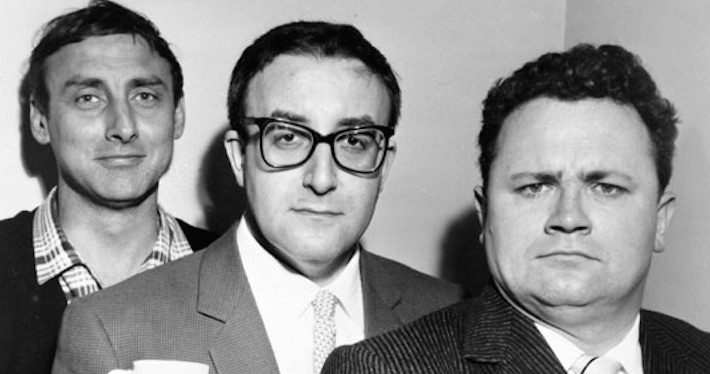


 Although very much a signed up member of the 50s funny radio voice community, Kenneth Williams stands out insofar as his vocalisations moved beyond the parameters of sketch and sitcom scripts and seemed to strike out for shores at that point undefined. Williams found some possibilities for the ventilation of his concealed gayness in pushing what was, in the 50s and 60s, a standard camp drawl way beyond the limits established by other intrepid comic actors who had been given ‘tolerable because amusing pansy’ roles.
 All of which is to say that if comic actors of the time who were blessed with voices and vocal effects of distinction had been exposed, in the early 50s, to writers and producers responding to early indications that a ‘post postwar’ sensibility was emerging, then The Goon Show might not have been, for several years, the lone rider in popular radio absurdism. It launched three years before Hancock’s Half Hour, also on Radio 1, set out an alternative to manic excitability with its droll celebration of the melancholy of a failed actor who barely believes in his enduring delusions of grandeur. In 1969, nine years after The Goon Show concluded, Monty Python first aired on TV.


