Pat & Viola

Jaye looks at Charlotte’s desk and giggles. “What’s funny?” I ask.
“Charlotte keeps her desk very tidy,” she says.
“Uhuh.”
“Whenever she tidies something up she gives it a pat. She’ll tidy all the edges of a pile of paper then pat it.”
Jaye mimes Charlotte’s pat and laughs a lot. Charlotte grins tolerantly.
In a Ren & Stimpy cartoon, ages ago, Ren or was it Stimpy presents something to Stimpy or Ren which he is proud of. “Viola!” he cries.

16.06.2007

Masquetry

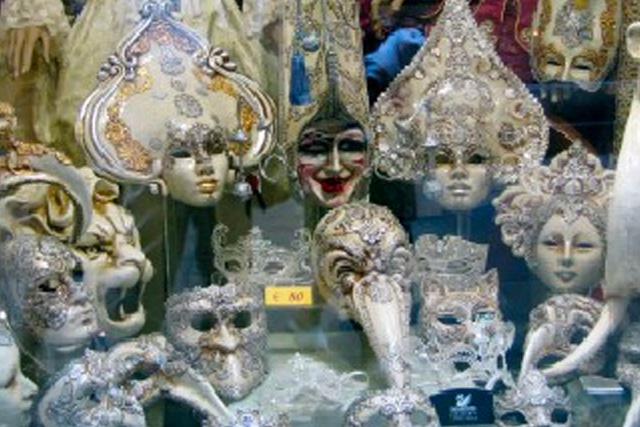
There are two main types of shop in Venice. One sells glass, the other masks. The latter comprise both straight copies of traditional forms and less straightforward souvenirs of the elaborate masks worn at Carnival. The traditional masks were in use at least as early as the 15th Century and some of them were originally part of the costume of commedia dell’arte characters.

It is the souvenirs that come to monopolise one’s attention. Where the traditional mask copies retain a degree of medieval mystery and grotesqueness, the souvenirs are a dramatic, not to say melodramatic, departure from anything that was ever worn at Carnival. Some are palm-sized, cast in solid plaster and made to be hung on the wall; others are in light plastic, papier maché or wood and can be fixed to the head.

Encrusted with glitter, costume jewels, lurid metallic paints, sequins and satins, the masks leer emptily from one shop in three, ancient faces obscured by a creeping, twinkling, radioactive mould. I have no doubt that in February, at Carnival time, they fly from the shelves to the streets where they may mingle with their older, more ‘authentic’ cousins. In this context the masks are masking not the tourist revellers but the function of Carnival itself. There was rather more to Carnival than just ‘being there’. It’s possible that those indigenous Venetians who wish to celebrate Carnival with grave abandon may welcome the opportunity to identify instantly the rubbernecking visitors and behave accordingly. The glitter masks then immediately lose their function as disguise and become badges that identify the wearer unequivocally.


Oddly, the manic tourism and the commodities produced to feed it serve to heighten the ever so slightly tedious (because commodified) ‘mystery of Venice’. The ubiquitous masks drive home the fact that you’re not getting the Venice behind Venice – you’re getting a hystericised Venice in front of Venice behind which may reside the true Venice. So elusive is this final quantity that it may be wiser to forego one’s first visit to the city – it may be only on the second visit that one is sufficiently deterred by the demented white noise of glittermasked Venice to put some work into getting off the beaten track, getting lost and, maybe, finding the mystery thing that everyone bangs on about.


It would be entertaining to think that somehow the Venetians endorse the dementedness because it diverts the tourists and prevents them from contaminating the mystery. It’s more likely that they need a quick euro in a sinking city that has only its beauty to offer. The agitated intensity of the glitter masks and the stylistic gap between them and their medieval forebears suggests that both the natives and the visitors are experiencing an impatience with the past. By plumping for the gaudy the visitors have voted against the past as a place where people were different and settled for one where they’re dancers on an international TV light entertainment. The advantage of such a past is that it doesn’t just sort of sit there getting more and more out of date, it is constantly unfolding, with the natives’ support, into a relevant future.

16.06.2007

‘The official resident population of the historic city of Venice shows a… marked fall, from a peak of 174,808 in 1951 to 60,208 in 2008. ‘ ‘…a research study center established by the City and Province of Venice (2008) concluded that the number of people present in Venice on an average day is 143,450 including the tourists. This is over 50% more than the total resident population of the “lagoon city” and over 100% more than the number of residents in the historic city, where the bulk of this transit population goes.’ Venipedia (Stats added to this post 2019)

Fizzingly

The Orange Prize is held in the wholly refurbished Royal Festival Hall this year. The atmosphere is bubbly and the Taittinger is being liberally dispensed. Once your glass has less than three inches in it a nicely groomed young person is at your side within moments.

“Would you like some more champagne?”
“I really oughtn’t notter. Tee hee!”
“Sir is such a card!” Glubglub.

When the Orange Broadband Award for New Writers is announced, the winner, Karen Connolly, author of ‘The Lizard Cage’, steps up to the lectern, does the “I wasn’t prepared for this but I’ll just whip out these notes” gag then, as is her perfect right, makes a speech. Her novel, I learn, is about the experiences of a Burmese protest singer arrested by the secret police and sentenced to twenty years’ solitary confinement. Not chicklit then. Connolly thanks people like you have to then extends her thanks to some of the Burmese people she has met, some of whom are also interned. Her voice breaks a little as she lists their names. Out in the body of the Hall hardly anybody is listening. Saturated with Taittinger (I do not except myself), the large crowd chatters merrily, scoffs the darling finger foods, hails its chums and kisses them.

A few minutes later the main award – the Orange Broadband Prize for Fiction – is announced. It goes to Chimamanda Ngozi Adichie for ‘Half of a Yellow Sun’, set in 60s Nigeria during the Biafra war. A great cry of exhultation fills the hall as Ms Adichie steps up to get the statuette (the big cheque comes later). The author is wearing an elegant white strapless dress and a colourful head wrap. She delivers a short, gracious and witty speech, thanks no one, pauses for photos and is out of there. The hall rings with enthusiastic applause.

Now, certain things can be pointed out: it was the main prize so you’d expect bigger applause. Possibly Adichie’s publishers and people were there in greater numbers than Connolly’s. People were drunker by the time Adichie took to the stage. That last one is silly – there was only a six minute gap between presentations. Why then, did Connolly get (almost) ignored? Was it because Adichie is more physically striking? Seems a bit of a cheap point. Was it because her book was better? I bet most people there hadn’t even read it.

Connolly’s mistake, I would venture, is that she made a speech. The old-fashioned sort that lasts more than 40 seconds, the sort the Oscar organisers, among others, are desperate to stamp out. Despite the fact that, in theory, winning an important literary prize is something you would wish to mark with an appropriately scaled response, many awards ceremonies as ‘occasions’ have been absorbed into the presentational priorities of television or the press and streamlined accordingly.

Speaking for myself, I love a good speech, be it at a wedding, funeral or presentation. I have the time for them and I can put up with unsuccessful ones. Watching, for example, the BAFTAs and the stream of potentially amusing or thoughtful or moving award winners hurrying through the statuette gate, I get increasingly frustrated. Surely the main point is to hear their reactions? Can they not halve the number of prizes and double the permitted speech length? What if you went to a funeral and the bereaved said “I feel very sad that my father is dead. He was a great man. Well, that’s enough from me.”?

The odd thing is that the Orange Prize was not extensively televised. It trimmed itself. This is the Stockholm Syndrome. You are not compelled to internalise the values of the broadcast media! Soon the original model will be lost – all ceremonies will focus on tailoring to the exclusion of everything but brief interludes of statuette donation.

I was at the do for about two hours. The presentations lasted about 25 minutes. For the rest of the time we glugged like bastards. Great. But why give us all that booze if all we do is collude in the muted but pervasive cry of “Fast forward!”

10.06.2007

So Fast They Named It Once

On the Tube, an ad for Rennie Dual Action Tablets – they alleviate heartburn and indigestion. The slogan accompanying the image of someone’s stomach seen through their tee-shirt is ‘No Dual Action Product Works Faster’. This is, for a few seconds, confusing. The ad seems to be suggesting that, compared, say, to Single Action Products, no Dual Action Product Works Faster. Or, indeed, that It Is Better not to take Dual Action Products because no Dual Action Product Works Faster.

07.06.2007

Bunfight at Doge City

The streets are rammed. Passage through the alleys is gruelling – so many tourists are gazing into shop windows that the space left for getting through amounts to just a third of the alley’s width. Down in St Mark’s Square only vertical gazing is possible – the panoramic options are blocked out by thick clusters of camera-wielding snappers. Tour guides are present in their dozens, each marshalling groups of twenty or thirty followers. To combat the incessant hubbub the guides speak into microphones attached to small P.A. systems that they carry round their necks. There is little individual movement, people shuffle in packs from place to legendary place. It’s the last week in May. The season hasn’t started yet.

So proud is Venice of its unique heritage provision that even building works, such as those currently being extensively carried out on the giant Biblioteca Marciana – the Library of St Mark’s – have been enhanced in order to deliver a seamless viewing experience. In the case of the Biblioteca the local council, or whoever ‘manages’ these operations, has suspended from the top of one side of the building a samesize photorealistic backcloth depicting the pillars and masonry you would have seen had they not been obscured by scaffolding and the backcloth itself. Not only that, it has placed a gigantic and colourful advertisement for Rolex golden watches in the centre of the cloth, as if the building works at the Biblioteca Marciana were obscuring not only elegant colonnades but a portal to a marvellous chronometer opportunity featuring uniformed men in a technologised futurescape.

A very rudimentary piece of theatrecraft is being essayed here. The Men from the Veneto clearly view the eager hordes as unsophisticated hut-dwelling folk who will welcome bigness and boldness in any context. Having completely taken us in with the realism of the colonnade megaphotos they will now entice us into a domain every bit as magical as the fabled architecture of Venice itself. Rolexworld is presented as continuous with the splendour and sublimity of the highest of the high arts. It is, furthermore, accessed via the olden fabric of the Library. The building works, as sometimes is their wont, have uncovered an unsuspected trove at the heart of an already valued site. For a few weeks only we may gaze into the timeless moonscapes that appear to be the habitat of the timerich Rolex Perpetual Explorer.

07.06.2007