
Lots: Episode 3

This post is in a series: please start at Episode 1

Let my imagination go. Uhuh. Roger was very likeable and I was flattered by his view that the eccentric work of Lumiere & Son – or something like it – would be viable in the centricity of BBCTV. I would pull out all the stops on this one. I would go where I had not gone before. I had long been irritated – as suggested from time to time throughout Strength Weekly – by the received wisdoms of playwriting, especially those which asserted the primacy of well rounded character, credible dialogue and a good story. While, as a consumer, I was often content to savour the accomplishments of playwrights, screenwriters and novelists who had no axe to grind with regard to these matters, when it came to producing my own stuff I was hardcore and became increasingly so as the years went by.

I mused on the notion of just how much could be removed from performance before it vanished. Peter Brook, of course, had said “A man walks across an empty space, whilst someone else is watching him and this is all that is needed for an act of theatre to be engaged” but it’s not really a night out, is it? Besides, I wasn’t a minimalist, I wanted busy, fast, imagistic theatre.

Then it came to me. One of the wisdoms I had received was that drama could not exist without conflict. Who said? And how dare they? I would write a (television) drama without conflict. I would open the screenplay with some characters facing an insurmountable problem which they would proceed to surmount without developing as characters. Having removed the plot engine about a quarter of the way in I would then guide the characters – the detectives Jean and Max and their client Anna – through a series of situations that delivered modest challenges which were almost immediately resolved for no reason connected either to the nature of the principals or their efforts or some mysterious yet beneficent quality of the phenomenal world. Shit, then, would just happen.

As I noted this down I began to realise that this was what Britain was waiting for: thanks to the perspicacity of Roger, a young 39 year old playwright would storm the small screens of the country with his moreish avant-gardism and quite quickly find a snug abode in the nation’s hearts. He (I) would become the Bleasdale of the New Bleak, the uncompromising author of works of hilarious sad violent beauty that eschewed irritating wisdoms.

Fortunately I have always been calm in the face of heck and was able, despite my dizzying prospects, to continue applying myself to the compositional task. I decided that not only would conflict be removed wheresoever it arose but that the characters would move backwards through time because, as everybody knows, the olden days were so much better in all ways except for medical science in particular anaesthetics. As scenes progressed, the characters’ costumes would regress through the styles of the centuries. Not only that, I decided, but – following my own insistent logic – the species would travel backwards to its origins in the Garden of Eden after which the women would disappear into the mens’ bodies via a wound appearing just below the site of their sixth rib.


Episode 4: The draft is borne into the world. It makes an impression on representatives of the BBC.

09.02.2008
Lots: Episode 2

This post is in a series: please start at Episode 1

One of the most moving images that Strength Weekly – in an admittedly inward moment – has published.


In Episode 3: what’s so interesting about all this anyway?

09.02.2008

Lots: Episode I

I’m in the front room of Hilary’s old house, which she is probably going to sell. All around the walls, on shelves, in boxes, cabinets and crates she has stashed a great archive of the papers of Lumiere & Son, the theatre company we ran together from 1972 to 1992 when the still Thatcherised Arts Council withdrew our grant in response to our failure to attract large audiences. The V&A want the archive so we’re meeting to determine if there are any items that should be retained by us for any reason.

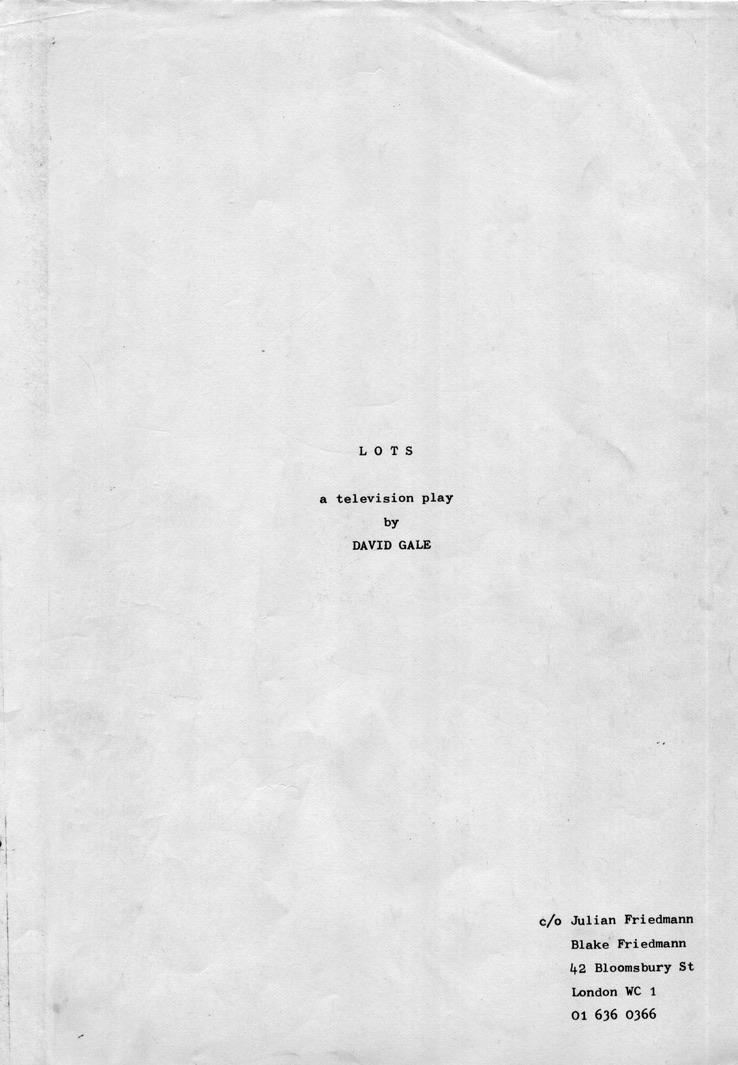
“Would you want this sort of thing?” Hilary says, reaching for an old folder. She opens it up and I can see some foolscap scripts secured with black plastic spines. She holds up a script. On the cover it says “Lots – a television play by David Gale”. I am staggered. My eyes fill with tears. “Lots! Lots?! My God!”

It is necessary to scroll back to 1983. A man called Roger contacted me. He was a producer from the BBC, had seen some of Lumiere’s work and wondered whether I would like to write a play for television. I was pleased to take on the commission that would make me a household name and, after my agent had fixed things up, I sat down at my typewriter in an abandoned house on the edge of Bath, amongst other places, and began wondering what I might dramatise for the nation. Roger had said “Just let your imagination go, David.” Right, then. I was drawn to a couple of characters I had come up with for a 1979 Lumiere play called ‘Jean Pool’. Max Cope and Jean Pool were private detectives – Max tending to the terse and pragmatic and Jean abstractedly to the abstract. I thought I had a good thing going between them and so would revive them for TV.

Given that the tale I will unfold is of enormous personal significance – yet of little public moment – I think I will serialise it. It needs a bit of care and attention and I don’t want to try to get it all down in one go. Also Morrissey is on ‘Later’ and I want to see Vivienne Westwood on Jonathan Ross.

08.02.2008

The Very First Peachy Coochy Last Thursday

I’ve been setting up a series of art’n’entertainment evenings – David Gale’s Peachy Coochy Nites at ArtsAdmin’s new bar in Toynbee Studios, down London way. Last Thursday was the inaugural occasion, featuring presentations from dancer Wendy Houstoun, visual artists Dan Harvey, Jeff McMillan, Gary Stevens and Dragan Alexsic and myself. The presentations consisted of responses to the following brief: you have 20 images and 20 seconds per image. In those 20 seconds you talk about the images. You must be precise. That’s it.

 
As a means of tempering the oral exuberance of young architects a Japanese architectural firm restricted pitching session invitees to the aforedescribed format. The feeling was that 400 seconds per pitcher was a reasonable amount of time in which to make a decent case and ascend to the short list. The events were called pecha kucha which is an onomatopeic term that, to the Japanese ear, resembles the sound of chatter.
 
The format has been recognised around the world as a rather good set of constraints for non-business purposes. Give it to a bunch of artists, performers and anyone with a tale to tell or a point to make and see what happens. The other night, playing to a packed bar, the pioneer coucheurs (Fr, ‘mauvais coucheur’ – awkward customer) mounted the podium and submitted to the merciless machine timings of a Powerpoint show set to progress through an image series at precisely 20 second intervals.

And what a pleasure it was to behold! We had Harvey, wry but poignant, on his Arctic visit; McMillan on Lubbock, Texas, his paintings and his roof garden; Houstoun’s strident and witty manifesto for the wholesale rejection of most aspects of everyday life; Stevens – normally the monkey in the pack, delivering an entirely straight but thoroughly absorbing disquisition on Van Eyck’s ‘Double Portrait’; myself with a tale of Capgras syndrome and parallel universes; finally Alexsic, suffering from flu and exhaustion, breaking most of the fundamental ground rules with great charm and laconic three second-long speeches instead of the mandatory 20 seconds, applied to images of his drawings.

The coucheur needs to have his or her wits about them. Speech units must terminate at the point of slide transition unless the coucheur has designed segue into the system. At this early stage in the development of the form that will supplant karaoke it may be wise to echew extreme purities – they will only constrain the innovators in non-fruitbearing ways. However, it is certainly possible to identify a small number of offensive practices: the use of random images that are connected in a random manner i.e. there is no continuity to the text that frames the images; the use of non-random images in a non-random manner i.e. the presentation resembles a conventional narrativised ‘My Holidays’ show in which the theme is privileged to the exclusion of the unexpected counterpoint of images.

Within seconds of writing the second half of the last sentence I retract it. This is far too prescriptive – what must I have been thinking? Were this fastidious prescriptiveness to be extended to the neurosurgeons, policemen, robbers and collectors of Unusual Things who might grace the evenings with their stories then we would have no stories. Which reminds me, I must try to persuade Hazel to do it.

Next Peachy Coochy Nite: February 28th. Booking advised.

01.02.2008

Set Pieces

I shall carry the images to my grave. In one of the two shows I’ve written and directed for presentation at Wimbledon College of Art this week (previewed here), the designers proposed a set, described in the playlet text here,the walls of which were built to be leaped through. Large, thin, rectangular sheets of polystyrene were papered with wallpaper then mounted in frames between a series of doors. The walls thus formed looked entirely solid. The audience had no clue as to their fragility. Two minutes from the end of the show, which had featured a great deal of farce-style dashing in and out of six doors, the actors played a scene behind the set, not visible to the audience, who could only hear their voices. A dangerous situation requiring instant escape arises…

But first, the prototyping. In a rehearsal and building process which compresses two weeks’ work into three days, it became necessary to see just what might happen when an actor took a run and jump at a wall. We ran a scene back to the top so that the designated jumper, Jude Barrington, could arrive at the wall with the full weight of the drama behind her. The production team stood back to watch the test. At the appropriate moment, Jude dove through, from frontstage to back. With a satisfying crack, the wall gave, leaving a gaping hole through which one could see an actress slowing down. All present cheered and clapped.

By the following day it had been decided that rather than jumping through the wall away from the audience, the actors would jump towards the audience. Michael Pavelka, supervising the designers, had suggested loading the backs of the exploding panels with cement powder, which would hang cloudily in the air as the wall exploded. In the dress rehearsal the office scene is enacted and a dangerous situation requiring instant escape arises. The air is rent with twin explosions and the empty fore stage is suddenly littered with chunks and graced with the spectacle of two figures dancing fiercely to the pounding strains of Novaspace’s mix of ‘Beds Are Burning‘. The actresses have gone through. A second later the centre panel blasts apart, sundered by the flying body of Chris Newland, who, as soon as his feet hit the ground, starts dancing. Fade to black.

Not bad – could be better. The panel on audience right has not shattered because Katie Roberts – who didn’t get a test dive because we were low on polystyrene – ran at it without putting her arms up, thereby pushing it aside rather than wrecking it. This is discussed and arm positions are demonstrated. The crew has twenty minutes to install fresh, pre-papered panels.

Two hours later ‘In the Bosom of Roy‘ is under way with a packed house rammed right up to the very edge of the stage. A dangerous situation requiring instant escape arises. A deafening and utterly startling explosion delivers, almost into the laps of the front row, two actresses, hazed around with dust, dancing in front of two gaping, Tom and Jerry-style black holes. To the further astonishment of the audience, Chris hurtles out a moment later and the cast dances dementedly in the debris of the formerly pristine set.

18.01.2008