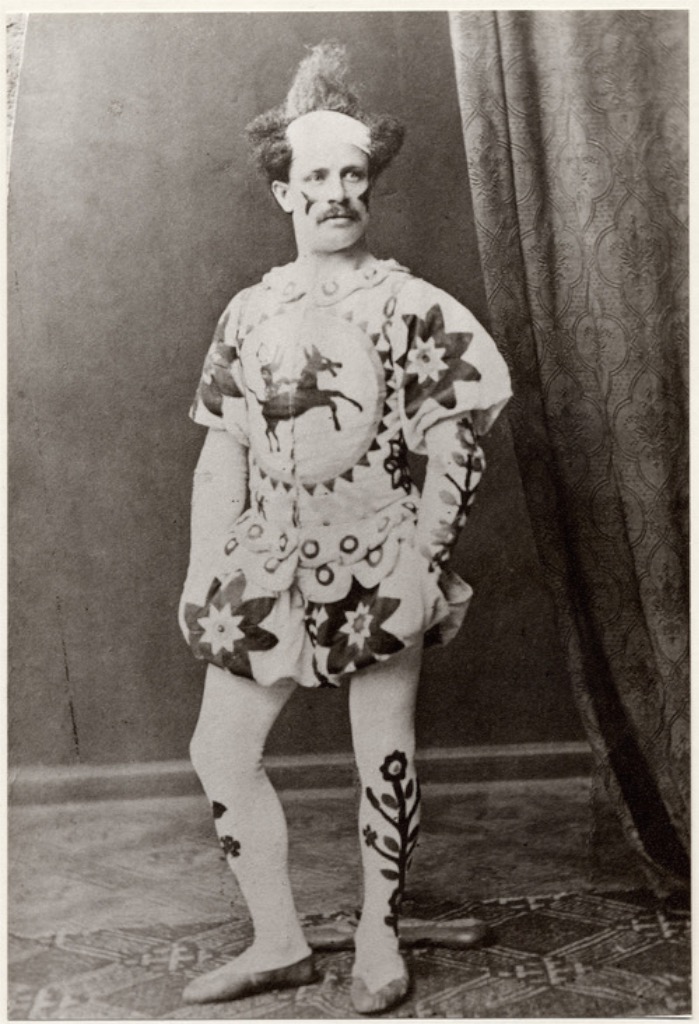
Ken Campbell
First published in The Independent, 1994
The main square in Bury St Edmund’s is packed with citizens. A military band is playing and American officers stand next to the mayor, saluting. Something to do with D-Day. Up the road people are shuffling into the nicely preserved stalls and circle of the Theatre Royal to see actor, writer and director Ken Campbell perform ‘Jamais Vu’, one of his legendary one-man shows. Ken ambles on, preceded by the hypertrophic eyebrows which, when he lowers his hairless head, appear as greying hamsters filing across his brow. The boiled egg eyes roll quickly round the auditorium before he kicks off with a convoluted anecdote about how he came to be doing the show he is now in the process of doing.
It seems, according to Ken, that Richard Eyre, Artistic Director of the National Theatre had had the idea that since they were doing all three of David Hare’s plays why didn’t Ken open his new one there and then do ‘Furtive Nudist’ and ‘Pigspurt’ and they could call it the ‘Year of the Trilogy’. So Ken goes along and Richard says ‘You know about the Hare trilogy?’ and Ken says ‘Yes. I understand you want a Bald Trilogy.’ And the discussion went so well that Richard suggested that since Ken was going to Sydney, Australia, why didn’t he pay a visit to Vanuatu in what used to be called the New Hebrides so he’d have something to talk about?
Before that bit, though, there was the business about the sink plungers. One minute the people of Bury St Edmunds are in the Royal National Theatre and the next Ken is sticking a sink plunger on his shaven head and they’re off down memory lane with the actor Eddie Davis who, Ken claims, once took a curtain call of My Fair Lady with no less than six sink plungers sucked onto his pate.
Ken loves Eddie Davis, describing him as a comedian who wanted HYSTERIA – an audience HELPLESS – BEGGING FOR LESS. When Ken says things like this you can hear the capital letters as if they were printed out on his large, discoloured teeth. Take away the shag-pile brow foliage and the thyroid gaze and you’ll still get value from the voice alone. Like Peter Sellers, Ken seems to have either half a dozen normal voices or none at all.
On stage the condition is even more advanced: he will mutter nasally, roar hoarsely, whine confidentially and generally produce a menagerie of vocal effects that, harnessed to his labyrinthine anecdotes, enforce a sense of chaos being channelled, only just, through one man’s gristled throat.
Anyway, the plunger, he informed an anxious Eyre, will constitute a central component of his next show, the one we’re watching now. Except now, of course, Ken has been to Vanuatu and has much, much more to talk about.
Ken’s devouring fascination with the unlikely, the fortuitous and the tangential helped spawn such unforgettable shows as ‘Illuminatus’ (1976), twelve hours long with intervals (“the intervals were a big hit in Liverpool”), an uproarious trawl through the worlds of conspiracy theory, numerology, mystics and pyramids which, incidentally, saw Prue Gee, mother of Ken’s daughter Daisy and “my ex-wife and friend” play Eris, the Goddess of Discord. Then, in 1980 at London’s ICA, there was ‘The Warp’, based on the life and visions of UFO-seer Neil Oram, clocking in at a compact twentytwo hours. In between alternative times, Campbell has racked up a respectable career as an actor, including stints in ‘In Sickness and in Health’ and ‘Brookside’. This has paid the rent while Ken has been concocting his own productions.
Ken had left RADA in 1960, and the tone was set early on; while sharing a flat with two dwarves, one of his first jobs was in Bournemouth directing the shallow-end acting in a swimming-pool based version of ‘Treasure Island’. After some relatively straightforward work at Stoke-on-Trent and the Royal Court in London, his subversive inclinations found their first full employment in the Ken Campbell Roadshow, which ran from 1969 to 1973 and made him famous.
The Roadshow’s currency comprised urban myths and tall stories dramatised by Ken and performed by promising young newcomers like Bob Hoskins. After a while the shows started to generate their own myths; it was under their umbrella that the first six inch nail was hammered into a man’s nose; it was here that the first ferret was lowered into the trousers of a valiant, and presumably leathery, performer. Presiding over all this was the comic genius of Ken Campbell, deftly presenting the wild tales that fascinated him with the confident touch of one who knew how to stage mayhem on a nightly basis.
The apprenticeship has borne fruit. Now, at the age of 52, Campbell is acclaimed as the master of the one-man comic show, a genius at marrying wit to the wilder shores of synchronicity. Last year, ‘Jamais Vu’ won the Evening Standard award for Best Comedy and delivered him from the admiration of cult audiences to a much broader constituency. He has just wowed them at the Almeida with ‘Mystery Bruises’ and, next Saturday the ascension will continue when Ken presents a brand new show, ‘Knocked Sideways’, at the Queen Elizabeth Hall on the South Bank.
But this particular June afternoon, Ken is at home in north London, working on a new script with two trusted henchmen, Colin Watkeys and James Nye. For some time Ken has been involved with Reality on the Rocks, a prestigious series on cosmology currently being made for Channel 4. It features Ken as a loveable but sceptical Everyman who gets to quiz quantum boffins about their inscrutable theories. The producers think it would be really marvellous if Ken were to work some of the cosmic materials into a special one-man show to be staged at Brentwood Theatre the following Saturday. They’ll have cameras there and will insert passages of the show into the documentary. Ken has risen to the occasion, as expected, but it’s Wednesday afternoon already and the producers want at least an hour’s worth off him. In the second half he has decided he’ll chat with his old visionary chum Neil Oram, now an enthusiastic participant in the search for extraterrestrial intelligence. “I am a supposer,” Ken says,”but Neil is a knower!”
Which is where Charles Fort, an American journalist, comes in. Ken loves Charles Fort. Understand Fort and you’ll understand Ken. In 1919 Fort published ‘The Book of the Damned’, a collection of weird and unexplainable phenomena culled from newspapers, magazines and scientific journals. Fort was content simply to record without theorising – he believed in the unity and connectedness of all things and felt that the apparent disconnection of events should be no barrier to supposing (he was also a major supposer) that a grand and unfathomable machinery organised them as well as disorganising us. Which is more or less how Ken sees anecdote. It’s not that his lurid stories lack narrative per se it’s just that they’re not links in a chain. They’re strands in a Gordian knot.
At the moment, Ken’s feeling uneasy about how to portray his recent meeting with Stephen Hawking. “I have this thing about cripples. And he’s the Brain of Britain. And it’s difficult to talk to him. Anyway, one thing I wanna…” He abruptly leaves the room.
“One thing you wanna…oh. He’s going to the loo, I presume,” says Colin. He turns to James. “Did you say that thing to Ken?”
“Yeah,” says James.
“Let it fester away, then. Let it fester away.”
Colin Watkeys, stocky and bearded, is Ken’s manager and outside eye. James is a red-haired youth with specs. It’s not clear yet what he does for Ken but he has sheaves of photocopies on his lap and he’s in the inner sanctum.
The sanctum is Ken’s place down by the River Lea in Stamford Hill. It’s an appropriately incongruous neck of the woods – a lost bit of London at the top end of the Seven Sisters Road between the Hasidic community and the big reservoirs. The estate is actually rather yuppyish, a private road enclosed by smart little terraced houses ranging up from the pleasant shock of the riverside.
“We’re only smoking in the kitchen today, chaps,” Ken announces. “Neil’s coming round with his daughter, raised in a violently anti-smoking manner. It’s a bit of thoughtfulness, so he’ll talk to me about aliens.”
Having smoked, the kitchen team moves to the sitting room with a view of jungle garden. A homely dog climbs onto the sofa. His tag reads ‘Fred Campbell’. Around the sitting room are a number of lewd wooden statues staggering under the weight of giant pillar-box-red penises. They must be from Vanuatu, where they worship the Duke of Edinburgh. Or were they from St John’s, Newfoundland, where, Ken announces, they didn’t know that you didn’t actually have to finish Stephen Hawking’s book with the result that everyone there had read it?
Essentially, Ken monologues at Colin and James in a style poised between anecdote and performance while Colin listens intently and James scribbles things down. Ken is musing on Stephen Hawking’s wheelchair, which carries not only the distinguished cosmologist but also his voice synthesising apparatus. “The thing about Hawking…you can’t tell if he’s too polite to press his ‘Fuck Off’ button. If he’s got one.” Ken warms to the theme, grasping the handle of his blue plastic shopping trolley, the battered and much-used carrier of Ken’s props and surprise items. “His voice is very good, in fact. It comes out of the back of his trolley.” He puts a brown hat on top of the shopping trolley. “That’s my impression of him!” Colin and James hoot with laughter, simultaneously shocked and delighted.
“He’s got three sorts of voice he can use: they’re called Perfect Paul, Uppity Ursula and Whispering Wendy. He prefers Paul. Anyway, I said to him ‘Stephen, what you want is an ironical Yes button.’ So he says ‘Yes’.” Ken imitates the flat, abrupt voice of Hawking’s voice machine. “And then he said ‘Maybe.'”
“Yes,” Ken growls. “It’s hard to know if he likes you. How would he show it? I think I wanna talk about his trolley language.” More laughter in the house. “Yeah…what would he do? Would he run it over your foot?” That goes in the notepad, definitely.
Colin, who rarely takes his eyes off Ken’s face, is getting excited.”I do think that’s a very human way into all the science, Ken.”
He is interrupted by noises at the front door. “That’ll be Neil,” Ken says and then, without a pause “Who’s that mummified figure they bring out from time to time in that college?”
I see my chance to be helpful. “Bog Man?”
Ken is suddenly immensely fierce. “NO!! Not Bog Man!” he shouts. For three seconds the loveable goblin bristles with irritation and contempt, then moves to the open window. “Don’t let that little girl fall in that pond!” he barks. In the back garden a young woman in a long dress is holding a baby. She smiles nervously. Must be one of Neil’s three wives. A stooping, grey-bearded figure looks up, blinking beatifically. Neil Oram, radiant advocate of the unfathomable invisible, is taking a turn round the jungle.
Ken nods and carries on chatting about David Deutsch, an Oxford quantum physicist with an extremely untidy house. This makes for very promising material, as does the business of James Tilley Matthews, a Victorian asylum inmate who drew up plans for a giant persecuting machine that emitted effluvial rays causing the brains of the unwary to lengthen and burst. James Nye and Ken have sensed that there are links between the parallel universes theory of Deutsch and Matthews’ hell world. All will be revealed on Saturday night
The Brentwood Theatre is packed out and the camera crews from ‘Reality on the Rocks’ are cluttering the downstage area. As soon as Ken ambles on it’s clear that something is terribly wrong. His mind has either gone blank or there’s too much in it. Ken, not to put too fine a point on it, is crap. He stumbles, hesitates, mutters unintelligibly, gesticulates vaguely, flubs all his best gags. It’s down to Neil Oram, sage watcher of the skies, to revive the evening.
Neil, whose flies are undone, is otherwise splendid in papal purple shirt and waistcoat. Patient and good-humoured with a faint West Country burr to his voice, he reveals that flying saucers are, in fact, alien thoughts. Certain types of alien, acquired by abduction, are hyper-developed twelve week old foetuses. Cattle mutilations may be the means by which they absorb protein through their skins. On Ganymede, a satellite of Jupiter, live twelve thousand Earth people, developing their minds before their apocalyptic return. Assuming that Jupiter survives the comet.
“What I want to know is, Neil, why haven’t I come across any of these aliens?” Ken enquires. The sage strokes his beard. “Ah. They’re too difficult for you to encounter because you’re so high profile, Ken.”
Ken Campbell is high profile indeed. He’s also pretty hard-headed and too much of a pro to be unduly bothered by the cock-up at Brentwood.
“It’s a bit vast and weird,” he says, “that Tilley Matthews area. I thought it would automatically collide and fit in with my native wit but it was more native than wit, I’m afraid. It’s like these things often are at the beginning – you appal yourself and then it pulls together.”
Sitting across a table in the bar of the Almeida Theatre, smoking roll-ups, Ken Campbell presents only a modestly reduced version of his eye-rolling, voice-bending stage persona. There’s a faint edge of irritability obtruding from beneath the generally affable manner and for a man who professes a wish to share his experiences of the uncanny he’s pretty canny about deflecting personal questions – his technique being to have heard another question instead. On matters more Fortean he is, naturally, forthcoming. The significance of wild theories, for example, is perfectly clear. “They’re an area of humour. Most humour is neophobic – it expresses everyone’s fear of anything new. Mine is more the humour you find among the geezers at science fiction conventions, the neophilics who embrace projection, prediction and novelty.”
What about certainty then, does he need it or is he just certain that things are uncertain? Ken grimaces – either the roll-up or the question is faintly distasteful. “Yeah, well, some things seem pretty certain. I mean, when I was with Professor Roger Penrose he told me that actually there’s no such thing as time and then he said ‘Blimey, it’s half past six – I’ve got to run!'”
This is Ken Campbell, the old-fashioned comic with a taste for particle physics, demonstrating the collision between his down to earth love of the well punched gag and his taste for the unexplainable. Of such incongruities are careers made – in Campbell’s case his in-your-face delivery, his wacky props and his lack of cynicism align him more with music-hall than alternative comedy, yet he routinely deals with vanguard ideas that threaten to dissolve the most cherished assumptions about reality. In his rather blokish world of anecdotal pint-swilling eccentrics there are few women and little politics but the thrust, nevertheless, is resolutely modern. This makes for an uncomfortable comfiness, an attractive disturbance.
Since losing the calling for the full-length play – “It wasn’t stage-fright, it was play-fright” – Ken is freer than ever to mould his professional life around his most absorbing preoccupations. “I’d much rather meet someone who saw a gnome last week than someone who’s being quite successful as Macduff, or who danced rather well yesterday!”
The Fortean comic cackles loudly. At the Queen Elizabeth Hall the audience won’t meet a gnome. What they will meet are foaming aerosols and what he calls a “real shaggy dog story” in which the life and times of the enigmatic hero Werner are extended so far that they commingle in an improbable way with a commentary on the practices of a notorious cult of self-improvement. The mixture is described as improbable because Werner, it should be noted, was Ken’s dog before Fred.
1994