Shorts in June

There are many reasons why I like the very short stories of Lydia Davis. The most workaday reason is that it is possible to completely finish to finish completely as many as, say, six eight or ten in a journey. The kind of short journey about which I am thinking. On the bus, on the tube. I had found the very short stories of Diane Williams breathtaking and was on the lookout in that neck of the woods. Lydia Davis is far from the same (the tone overlaps now and then but there’s a world of difference) but I came across her shortly after and I knew an imminent reading pleasure when I saw one. The book that I came across looked very attractive. Although it was bright pink it was also very plain. The covers were matt, a bit like those sombre French paperback series. I’m looking at it now and it’s not so much pink as salmon. There is a problem, however, this book, the one I’m coming to, ‘The Collected Stories of Lydia Davis’, that I found in a charity shop, has over 700 pages. No way am I going to carry this around. But luckily yesterday I forgot to take with me my acceptably weighted copy of ‘Gun Machine’ by Warren Ellis when I went out and started to fret. I mean that as a result of the oversight, I started to fret. As soon as the bus stopped I walked 30 meters to the nearest charity shop to find another book that I could read in my café. Damn me. There, in attractive sky blue matt card covers was ‘Can’t and Won’t’ by Lydia Davis, at a mere 280 pages.

In a Perfect Bind

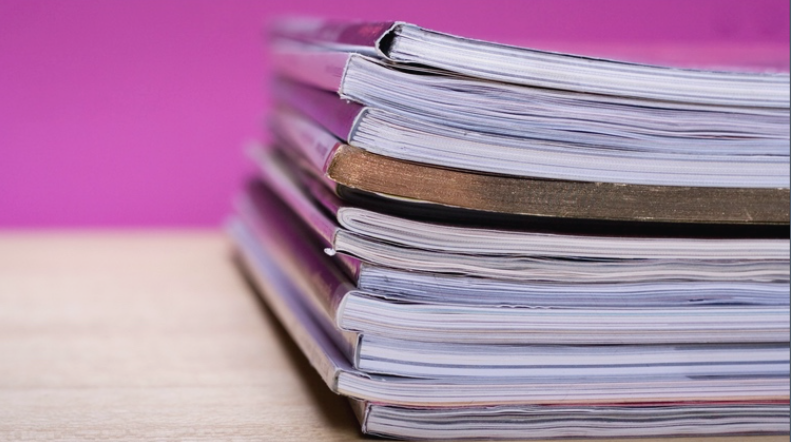
I was sitting down when I felt a curious sensation in my hands which reminded me of something I had had in my hands once but at first I wasn’t sure what it was then I realised it was a magazine. I have not held a magazine for several years if you discount the ones at the weekend in the papers.

My hands, however, remembered what magazines felt like. I wanted to hold one again. Particularly one with Perfect Binding. In the image above all the magazines have perfect binding apart from the fifth one down, which is saddle stitch.

The ones at the weekend are saddle stitch. I don’t dislike them at all. They can be good for content but the paper upon which they are printed has no sensuous appeal and there’s a dispiriting excess of articles on restaurants and holidays you can’t afford and people who have unique clothes. The magazines that my hands miss will also contain three or four long pieces of writing maybe and if there are three then you’ll buy it. They’ll still have far too much about things you can’t afford but no one is forcing you to read these dumb items. I’m not talking about perfectly bound magazines that specialise in golf or cars or male adventure or food. There’s a limit to how far binding can take you.

You may be thinking But what was in these magazines then, what were they about? Which is perfectly fair. The answer is: Oh, all manner of things.

I did have a huge collection of American underground newspapers, mind you. Village Voice, East Village Other, Avatar, Berkeley Barb, Los Angeles Free Press, Oracle, The Realist. Then I moved from one house to another. When I got to the new place, the papers had gone. I’ve never seen them since.

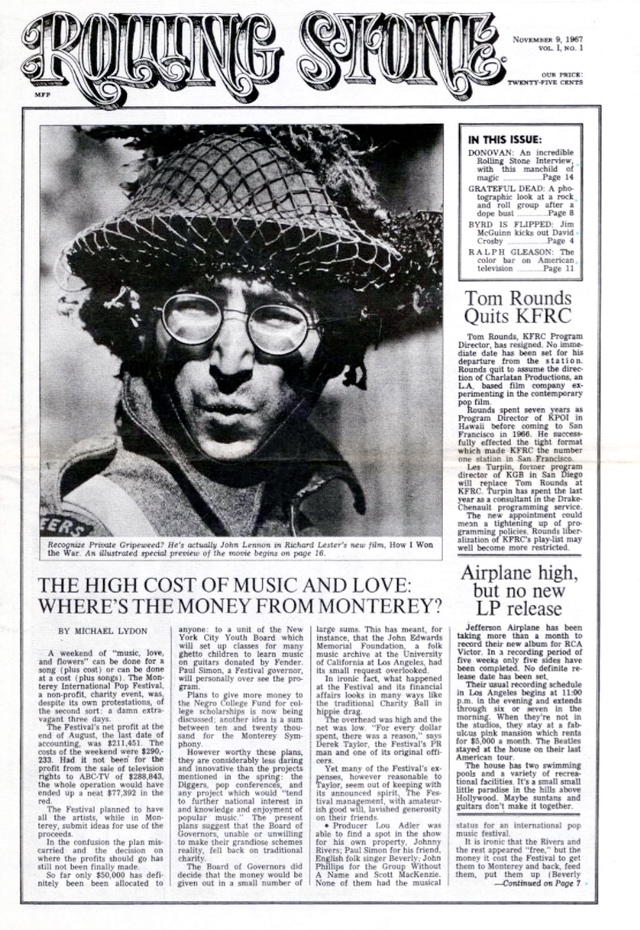
The thing about Rolling Stone (1967 and on) was they introduced longform New Journalism. Terrific, lively features on American politics, elections, riots, Hippies and Yippies and Panthers. Musicians and their appetites. Woodstock, Altamont. Hunter S Thompson, Tom Wolfe, Lester Bangs, Joe Eszterhas.

I don’t want to write about that. It was very exciting. But it’s been thoroughly well written about. I want to write about what my hands felt. Your hands can’t read, obviously, but for many years they complemented and facilitated a marvellous opening of the world.

Rolling Stone was a magazine in newspaper format but it stoked an appetite for a journalism that was closer to how you lived. It contained, of course, many slightly too fascinated articles about the lives of rich performers but it was critically acute and not really a music paper. I can’t remember if it was full-on saddle stitch i.e. with staples. Not in the early days, I think. It moved to saddle stitch at some point then, in 2008, to perfect bound.

The Face (1980-2004) had perfect binding. With layout, graphics and typography that introduced the first significant visual state change since art director Michael Rand’s groundbreaking work on the Sunday Times Magazine in 1962 – the first ‘colour supplement’. In terms of heft (perfect is usually introduced at around 90 pages) and gravitas (perfect benefits from its association with iconic mags like Vogue, Vanity Fair and National Geographic) The Face’s articulation of popular culture was subtly buttressed by its binding.

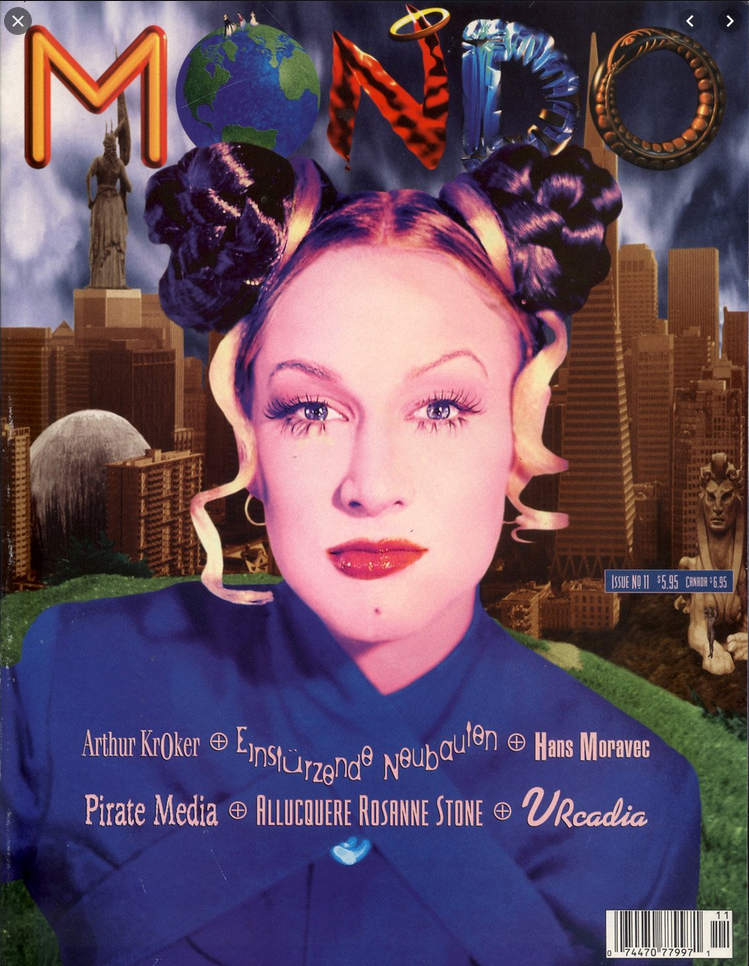
In the early 90s I was writing for GQ and had the pleasure of caressing a succession of issues in which my own longform features featured. I wrote a number of pieces about the rise of the internet and various emergent art-meets-technology developments. I went to Nevada to look into this UFO thing. When the unsoftly spoken, larger than life GQ Editor Michael VerMeulen died far too young in 1995, the glossiest perfect of them all, the cyberculture mag Mondo 2000, had been up and running for six years. Mondo, unlike GQ, had little time for food and cars and grooming. Its pages were heavy and coated and given its ardent advocacy of virtual reality, its gorgeousness could be mistaken for a key requisite of a pharaonic afterlife.

They felt nice, those Mondos. They smelt nice. Then they vanished, usurped by the new realities they had championed.

I love the internet but it plays havoc with your attentional skills, precisely at the point where you think you’ve acquired a serene 21st Century multitasking encyclopaedic fluidity.

[/et_pb_text]

I bought the first Rolling Stone in 1967, the Summer of Love, and then the rest. I kept them in bin liners in a cellar. I’d rather not say what happened to them. I did not sell them. They were not stolen. I did not lose them. I wish I still had them.

I did have a huge collection of American underground newspapers, mind you. Village Voice, East Village Other, Avatar, Berkeley Barb, Los Angeles Free Press, Oracle, The Realist. Then I moved from one house to another. When I got to the new place, the papers had gone. I’ve never seen them since.

The thing about Rolling Stone (1967 and on) was they introduced longform New Journalism. Terrific, lively features on American politics, elections, riots, Hippies and Yippies and Panthers. Musicians and their appetites. Woodstock, Altamont. Hunter S Thompson, Tom Wolfe, Lester Bangs, Joe Eszterhas.

I don’t want to write about that. It was very exciting. But it’s been thoroughly well written about. I want to write about what my hands felt. Your hands can’t read, obviously, but for many years they complemented and facilitated a marvellous opening of the world.

Rolling Stone was a magazine in newspaper format but it stoked an appetite for a journalism that was closer to how you lived. It contained, of course, many slightly too fascinated articles about the lives of rich performers but it was critically acute and not really a music paper. I can’t remember if it was full-on saddle stitch i.e. with staples. Not in the early days, I think. It moved to saddle stitch at some point then, in 2008, to perfect bound.

The Face (1980-2004) had perfect binding. With layout, graphics and typography that introduced the first significant visual state change since art director Michael Rand’s groundbreaking work on the Sunday Times Magazine in 1962 – the first ‘colour supplement’. In terms of heft (perfect is usually introduced at around 90 pages) and gravitas (perfect benefits from its association with iconic mags like Vogue, Vanity Fair and National Geographic) The Face’s articulation of popular culture was subtly buttressed by its binding.

In the early 90s I was writing for GQ and had the pleasure of caressing a succession of issues in which my own longform features featured. I wrote a number of pieces about the rise of the internet and various emergent art-meets-technology developments. I went to Nevada to look into this UFO thing. When the unsoftly spoken, larger than life GQ Editor Michael VerMeulen died far too young in 1995, the glossiest perfect of them all, the cyberculture mag Mondo 2000, had been up and running for six years. Mondo, unlike GQ, had little time for food and cars and grooming. Its pages were heavy and coated and given its ardent advocacy of virtual reality, its gorgeousness could be mistaken for a key requisite of a pharaonic afterlife.

They felt nice, those Mondos. They smelt nice. Then they vanished, usurped by the new realities they had championed.

I love the internet but it plays havoc with your attentional skills, precisely at the point where you think you’ve acquired a serene 21st Century multitasking encyclopaedic fluidity.

[/et_pb_column][/et_pb_row][/et_pb_section]

Peachy: the Backstory

I read about pecha kucha somewhere and felt that it could be fruitfully appropriated. It had been conceived in 2003 by two architects working in Tokyo, Astrid Klein and Mark Dytham, who had been trying to find ways to curtail a tendency in young architects to speak for an intolerably long time when pitching a scheme for the new library or whatever.

Klein-Dytham decided to restrict all candidates to a slide show comprising 20 slides, each of which would be projected for 20 seconds whilst being explained or described by the presenter. In the course of this 6 minutes and 40 seconds long presentation the presenter should aim for utter precision – if, for example, you consistently spoke for 19 seconds per slide then one of two things would happen. You’d stand, albeit briefly but in this context unattractively, in silence until the slide transitioned or, if you moved on to the next speech without a break, you’d start to go into overdraft i.e. the next time round you’d finish a little earlier, eventually leading, in theory, to the catastrophe that is Talking-Mostly-About-Slide 17-While-Slide 16-Still-Occupies-the-Screen. Or, of course, you could stand speechless at regular intervals. This takes nerve but in those silences resides the possibility, if you remain calm, of recovering the synchronisation.

Conversely, if you spoke too slowly or had consistently underestimated the length of a speech then you would find yourself describing the past while the present awaited your attention, its duration being steadily reduced but separated from its carefully crafted commentary. It’s only natural at this point to speed up but this inevitably involves an unseemly gabbling.

Surely, one might imagine, the slide operator could accommodate such all too human wavering with a succession of benign adjustments. But where’s the fun in that? A counter-empathetic dimension was added to the setup, ensuring that a cold, dispassionate, machinically fixed set of timings would proceed at the click of the mouse that launched the PowerPoint display. From Tokyo to London, pecha kucha presenters whose puppy had died earlier that day would not be favoured in the least. The playing field was now, like a billiard table, level. PowerPoint is not indifferent to puppies – it doesn’t know what they are.

Audiences sense these presentational challenges, especially when they are alerted to them by the compère, who happens to be me. Such disclosures endear the compère to the audience and introduce the latter to an athletic dimension not generally found in your average lecture.

I learned that ‘pecha kucha’, as used and pronounced by the Japanese, has an onomatopeic quality that resembles ‘the sound of chatter’. I also learned, having determined to use the format as the basis for a series of live public shows, that if I called these occasions ‘Pecha Kucha Nights’ I might be sued for breach of copyright. Thus it was, on January 31st 2008, that ‘David Gale’s Peachy Coochy Nites’ opened in the bar at ArtsAdmin in London. Months later, when the Nites were well under way, a lawyer told me that the copyright threat was nonsense – it had no legal basis at all. Anyway ‘Peachy Coochy’ was much better.

Thanks to the welcoming enthusiasm of Judy Knight and Gill Lloyd, the directors of ArtsAdmin; Chief Dawethi, the head technician and Toby Saunders, the free-lance projection tech, the bar, set with tables and chairs, proved to be an ideal location for the show. It was one of those venues that look gratifyingly full when they are not at capacity and pleasingly packed when rammed.

Each Nite comprised six presentations – three either side of an interval. I aspired to bring together on each monthly occasion as diverse a selection of presenters as possible. It would, I felt, be tremendous if, on a typical bill, we could offer a policeman, a surgeon, a criminal, a taxidermist and a quantum physicist. My own background was arty – I knew lots of performers, playwrights, directors, film-makers, writers, journalists, designers, dancers etc. It came to pass that these dominated the line ups because they were rather easier to recruit than, say, members of the police force.

We did, however, succeed in presenting a quantum physicist and our arty colleagues proved, more often than not, to be daring in their bending of the stern Peachy Coochy rules and thoroughly unpredictable in terms of topics and styles.

My perk as curator of the cultish events was to install myself as master of ceremonies and to compose my own presentations, which I inserted in the first slot after the interval. Whereas the five guests were, with some exceptions (Wendy Houstoun and Ursula Martinez, for example, were audience favourites) presenting for the first and last time, I decided to link my own presentations so that they had a degree of thematic and narrative continuity. They are assembled here, in the order in which they were presented.

I should point out that I was hardly the first person to notice the potential of the Klein-Dytham pecha kucha format – it is regularly presented in over 1000 cities around the world and, I imagine, tweaked and stretched on every occasion.

Our press information pack, assembled with producer Amber Massie-Blomfield sometime in 2010 (slightly updated 2019), dramatised us as follows:

David Gale’s Peachy Coochy Nites is the perfectly shaped art form for the new decade: a celebration of artistic expression that is concise, precise and fleet of foot. In its brevity artists feel liberated to explore challenging subject matters and take risks with new material, whilst audiences thrill in the creative tension between the improvised compèring and the highly formalised, almost athletic presentations. The show prompts reflection in audience and artists alike on the way in which we consume media; specifically, images and words.

Past Coocheurs have included: Oreet Ashery, Mark Borkowski, Duncan Campbell, Marisa Carnesky, Robin Deacon, Richard DeDomenici, Tania El Khoury, Tim Etchells, Marcia Farquhar, Gareth Brierley, Ant Hampton, John Hegley, Wendy Houstoun, Alex Kelly, Lois Keidan, Keith Khan, Richard Layzell, Brian Lobel, Jeff McMillan, Ursula Martinez, Nic Rawling, John Smith, Julian Maynard Smith, Trevor Stewart, Gary Stevens and Hilary Westlake.

Past topics have included: My 20 Favourite Fonts; The Dangers of Health & Safety; Lustful Emails Sent Subsequent to my Nude Cabaret Act being Illegally Released on YouTube; Criminal Gangs of 50s London; My Family Photo Album used as Evidence of my Precocity as a Live Artist; An Introduction to Quantum Physics; Public Art in Poundbury, Dorset; An Enquiry into the Origins of Compressed Chewing Gum Found on Pavements; Art on Roundabouts; My Life and Art in Bombed Beirut.

David Gale’s Peachy Coochy Nites has run monthly at the Toynbee Studios since 2008; it has also played at the National Review of Live Art, the Riverside Studios, The Victoria & Albert Museum, Battersea Arts Centre, Cambridge The City Wakes, Poole Lighthouse, The Maritime Museum, Greenwich. The show works particularly well in a festival context, as an alternative, arty end-of-evening entertainment. It prompts dialogue between artists and audiences around their work, offers a platform for fledgling ideas and encourages audiences to experience the work of artists they may not typically take a risk on. It also goes down very well with a drink.


David Gale’s Peachy Coochy Nites #21

20 slides are each projected for 20 seconds and spoken to for the same period, no more, no less. The script for one of these precision-based presentations is found below.

Season 4: PC#21

Previously on Peachy Coochy I had gone to Tibet and learned the art of concretised visualisation in which a mental image is gradually made into a real object by intense and protracted concentration. On my return I lived with a beautiful pale woman but she faded away to the point where she was no more than an idea.


I realised I had made a fundamental error and determined to concentrate instead upon the human body as a means of pulling myself together. I’d had enough of abstraction and concepts, I decided to wholeheartedly throw myself into things. First I needed to stand out more. I needed an outfit.


I looked good and I felt good. I could really get involved now. The world was just a place and I was a person. I laughed at the idea that there were things that you couldn’t do. What could go wrong? If your body was hard there would be no harm. I decided to assess my body in terms of its suitability for my intentions.


I was disappointed to see that the inside of the body could be detected from the outside. I felt alright about the mouth and eyes being, respectively, a hole and an organ that was half in and half out but there were far too many signs of the way the body worked that you could see quite clearly and that did not need to be so obvious.


If I was to throw myself thoughtlessly into things it was possible that some of these things could pierce me. What particularly unsettled me was the prospect of a situation in which purely personal matters might be revealed to those with whom I was not on intimate terms. Imagine lying on the ground while people stared into your open body!


I decided to ignore my misgivings and get stuck in. The tube carriage was extremely crowded and I realised that I actually had no idea of what all the people touching me were like. Right in front of me was a woman wearing a rucksack that jutted straight into my chest, making me lean backwards.


As I fell I grabbed randomly at a suitcase held by another traveller. I found myself tumbling to the floor, effectively using someone else’s luggage as a battering ram. There was a number of bags piled by the carriage door and I brought them all down around me. The noise was considerable.


It was good to be back in Hampshire. Nothing much had changed. There were odd pieces of clothing strewn along the side of the road and some of the bushes had male and female toiletries jumbled up in them. I found some Jo Malone fragrance – suitable for both men and women.


When I looked up I thought at first that she was looking down on me. Certainly her movements were very deft and skilful. It became apparent that she was, in fact, staring at the ground beyond me. I could not tell whether she was emptying me out or filling me up. I hoped that my fragrance would make her wish to fill me.


If I found that she was emptying me I could run away and find my own straw. I would carry my bale with me and whenever I faltered I would stuff myself. In that way I could cross and recross the border between life and death. Such a journey would not only strengthen me but invigorate the community.


It was difficult to discern whether my visits to the shadowlands were states of mind or experiences. Sometimes I went down and down and other times up and up. Wherever I ended up, I was always aware of objects. Most of these tended to float but some were tethered. I even came across books but it was usually too dark to read.


With a great effort of concentration I was able to remember  that despite my disorientation I was still in Hampshire. I was shocked to realise that I had, once again , confused an everyday activity, such as the stuffing of a child’s toy, with an invitation to the transcendent. I shook my head briskly and was in Petersfield.


The town was clean but almost entirely depressing. There was, however, little that threatened to be confusing. The few citizens that I saw seemed purposeful. The streets were largely empty but the shops had assistants in them and my search for a café and restaurant was fruitful. I ordered a flat white.


To my great surprise I found myself sitting opposite the actor Christian Bale. He told me that he had a small flat in the town. I said to him “But Christian, this place is amazingly fucking boring!”  He explained that as much of his professional life was spent playing deranged  individuals, small town life was the perfect antidote.


“With respect, Christian,” I said, “Is it not the case that in the protracted absence of meaning sociopathic tendencies will incubate, giving rise to random and explosive acts of destruction much like popcorn in an uncovered pan?” He did not answer me directly but seemed instead to be studying the package I was carrying.


“What do you call that?” he asked. “It’s my straw,” I said, “It’s in a bundle.” His face darkened. “Do you believe in the Christ, David?” “I have no faith, Christian,” I replied. “Did you see my movie ‘American Psycho’, David?” “I loved it,” I said. “There are things in that movie you don’t want in your mind,” he said.


In the dark there were the usual children but Christian was keen to keep moving. “There’s someone who can help us,” he kept saying. The girl said “Take me with you, Mister Christian.” Christian said “Nothing must leave this place.” The girl said “I’m somebody’s daughter.” But he was resolute. He would not deviate.


Then I realised who it was. Christian hugged Heath and started crying. “I love you, man,” he sobbed. Heath seemed very pure. “Heath, why are you so pure?” I asked. “Whatever you were when you took off, that’s what you take with you,” he explained. “You had nothing, you had no skin,” I stuttered.


“I went through my skin. I stepped outside. Thousands supported me. Thousands stood aside as I swept past,” Heath said. “I was one of them, man,” Christian sobbed. “But I couldn’t make the final journey.” Heath gripped Christian by the shoulders. “It’s not a journey. You don’t start. You finish.”


The two film stars turned to me. “There’s more to life than Hampshire, David,” they said. “And there’s more to life than life. Be like a dog now. What can you smell?” I lifted my head. I started to run. I got to the edge. It was no longer dark. It was pure. I could see a boat.

~~~~~~~~~~~~~~~~~~~~~~~~~~~~~~~~~~~~~~~~~~~~~~

56 Strips


originally published weekly in Facebook 24.03.17 > 27.04.18